Chapter 01
Productivity: Health and Work Organization
Welcome to the secondary tutorials of The OPSEC Bible, where we cover how to maximize your productivity by ensuring that your Health is kept in check, and making sure that you properly organize your workflow.
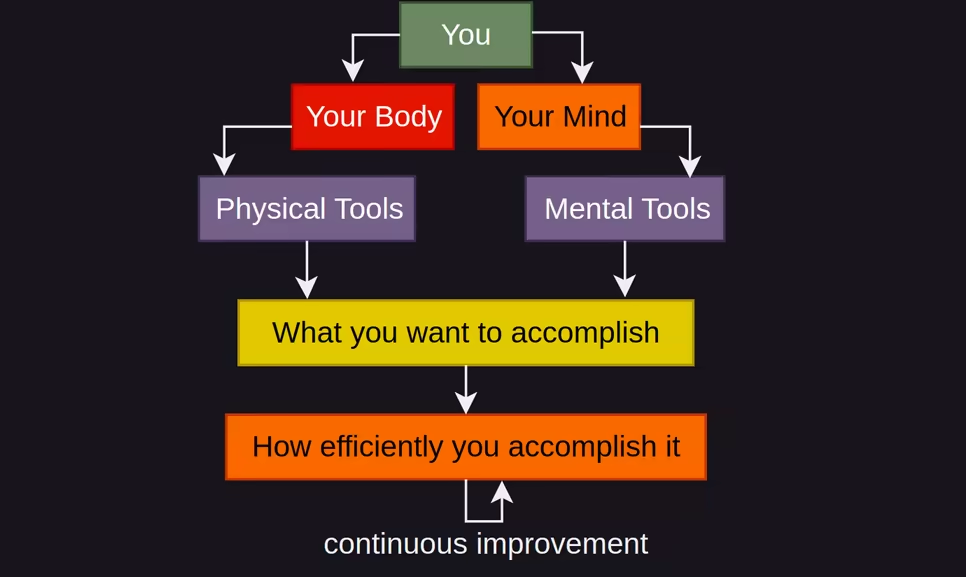
As you can probably tell, productivity is also something passionate about, because I think it's paramount to make sure that you effectively accomplish what your life is about.
You should realize what your life is truly meant to be about, your clarity about it must always remain, you must never forget what the right path is, and never ever deviate from it.
We're all here for a limited amount of time, do you seriously think you have time to waste with pointless addictions? Come back to reality. Restore clarity, because you're here for a very small amount of time. You better ONLY do what truly matters to you, and stick to it enough to actually make it a reality while you're still alive.
There is an entire approach to Productivity, from restoring health, clarity, to figuring out what your life is about, to visualize it, plan it out, schedule it, to actually do the work, review it, and continuously improve how efficiently you achieve your goals.
Chapter 02
Introduction to Nihilism
The Act of Rejecting Something
You have a TON of Nihilism practices out there (most of which that I don't agree with, to be clear):
- 01
Political Nihilism: a negative outlook on existing political and social structures, similar to anarchism.
- 02
Existential Nihilism: asserting that life is inherently meaningless and lacks a higher purpose.
- 03
Moral Nihilism: rejects the existence of moral phenomena.
- 04
Epistemological Nihilism: rejects the possibility of objective knowledge,
- 05
Metaphysical Nihilism: argues that the experience of the universe is a mere illusion without an underlying reality.
- 06
Cosmic Nihilism: is the view that reality is unintelligible and lacks inherent meaning.
Your mind is a Temple
As we'll cover in the next tutorial, your mind is your holy temple. You want to keep it clean, to be able to use it to it's fullest potential.
If you are a religious person, I'm sure you understand what I mean. Would you be willing to go to church to pray or meditate for an hour if the place was dirty from top to bottom?
The goal is not to keep adding more and more stuff to the temple, the goal is to keep rejecting everything that can be rejected until there's nothing left in it.
In your mind, over time, dust settles in, the trash piles up, the filth accumulates. Do you seriously think you can keep your temple holy without ever using the broom?
Nihilism is the Broom that cleans the Temple
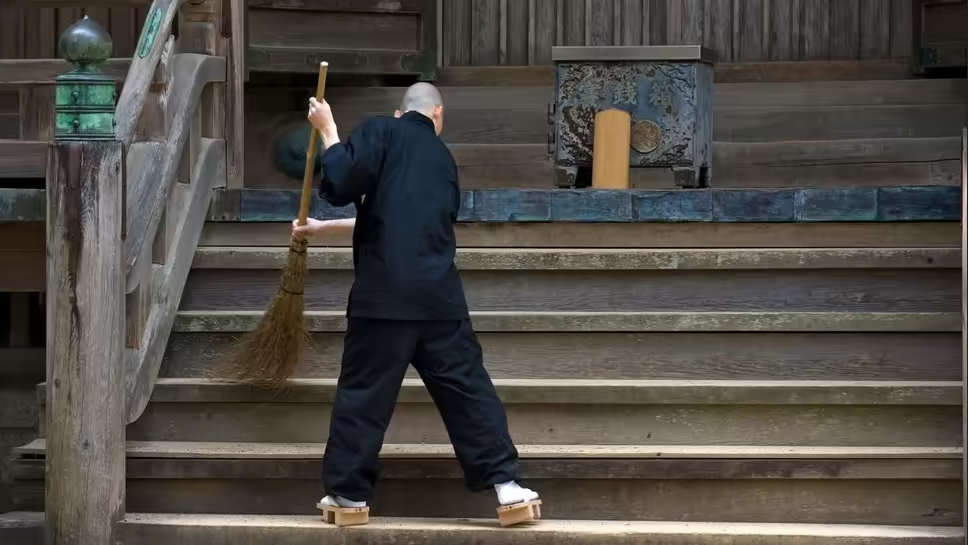
As the title suggests, Nihilism as a practice is like a broom, and when it is used properly, you can use it to effectively reject everything you want from your own mind.
In the upcoming tutorials, we're going to cover the use of carefully-crafted mantras that are there to reject all the garbage that may have accumulated in your mind over the years.
What is the garbage that needs to go?
Over time, as far as I'm concerned, there are 3 main types of garbage that you need to purge your mind of:
- 01
Compulsions: What is making you waste your time doing what doesn't truly matter to you.
- 02
Beliefs: What is making you arrogant, stagnate and destroys the possibility of knowing.
- 03
Identities: The Ego distorts your perception and prevents you from perceiving beyond your own self-interest.
If you didn't clean up your mind in a very long time, your mind may have become a very contorted mess. Over time, you may not even realize what is plaguing your life anymore, the more you descend into your own lack of clarity.

In real life, do you picture yourself living like a Hoarder? I definitely hope not. You need to understand that more is not better. You will not attain infinity by adding, the only way to attain it is by subtracting, to arrive at emptiness.

Less is more. Minimalism has a lot of virtue in real life So take a garbage bag, and in it, put everything that has no reason to stay in your bedroom. You're going to realize how pleasant it is to rediscover your own bedroom after it has been thoroughly cleaned up.
Why Mantras?
Mantras are essentially sentences that you utter mentally, to alter your mind, one way or the other.
Mantras are either positive or negative. The issue with positive affirmations is that they empower delusional beliefs most of the time, and that would just be worsening the problem.
Conclusion
And that's it! You now have the context as to understand why Nihilism is essential for your own mental health.
Chapter 03
The Poison of Modern Times
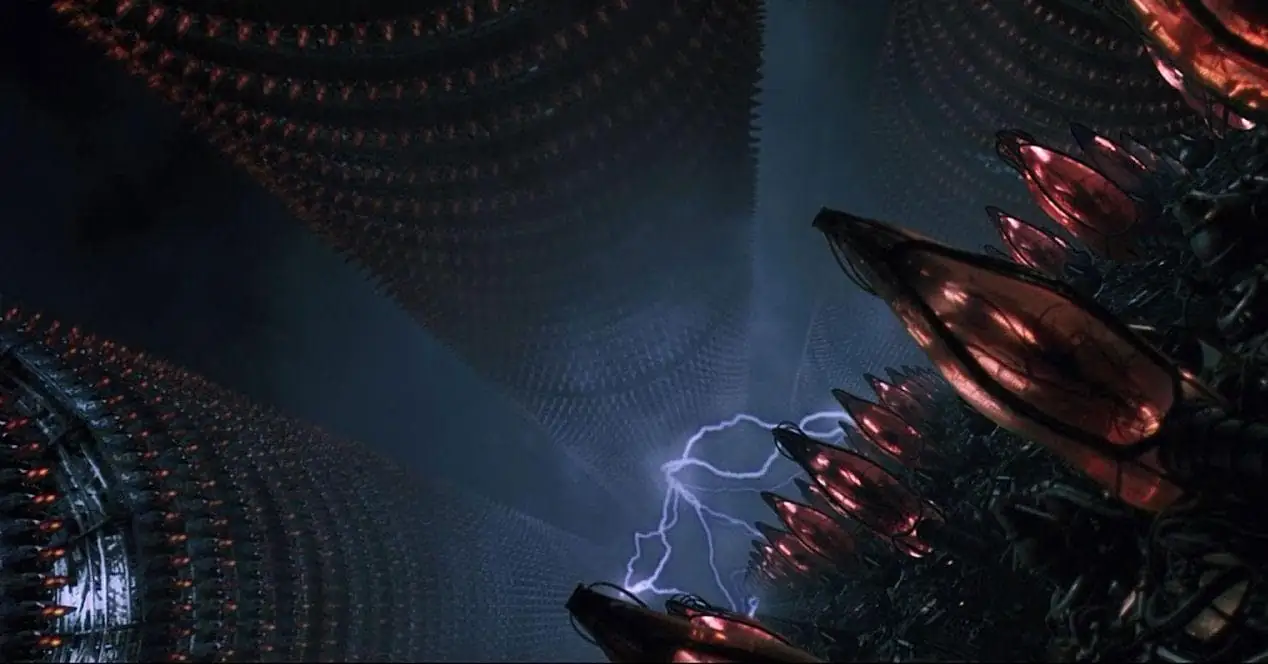
At some point in your life, you have invariably felt it. There is poison that is being spilled all around the world, straight into your mind. It has been changing everyone around you, it may have started to change you as well.
But why is nobody talking about it? Why is nobody naming it, calling it out? Why is nobody questioning its existence, or it's authority?
The mind poisoning of mankind is real, it has become efficient, it has become convenient, and even worshiped.
How is the poison manufactured?
99% of the societies out there are structured by having a government at the very top, which regulates everything and everyone on its own geographical territory, from the largest corporations, to the smallest businesses and employees at the bottom.
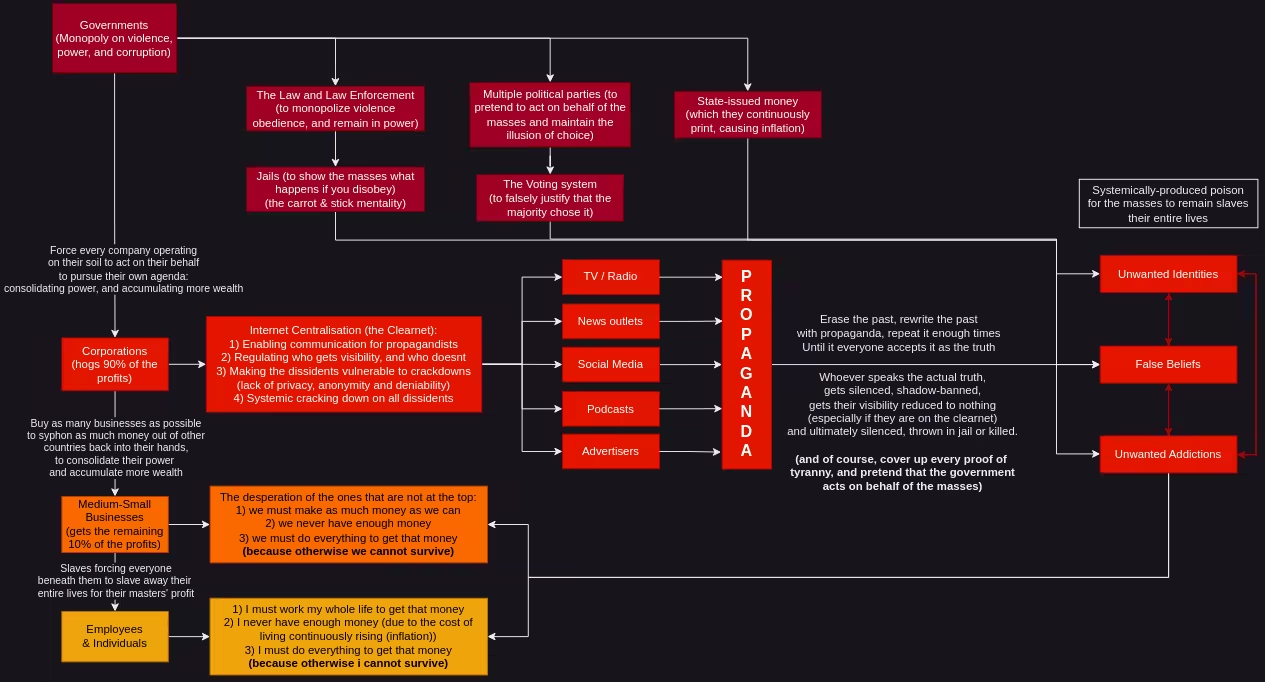
Governments: The source of the poison
At the very top you have governments, or states, which are all illegitimate groups of people that have seized power through faking choice for the masses, by giving them the illusion that they are acting on their behalf.
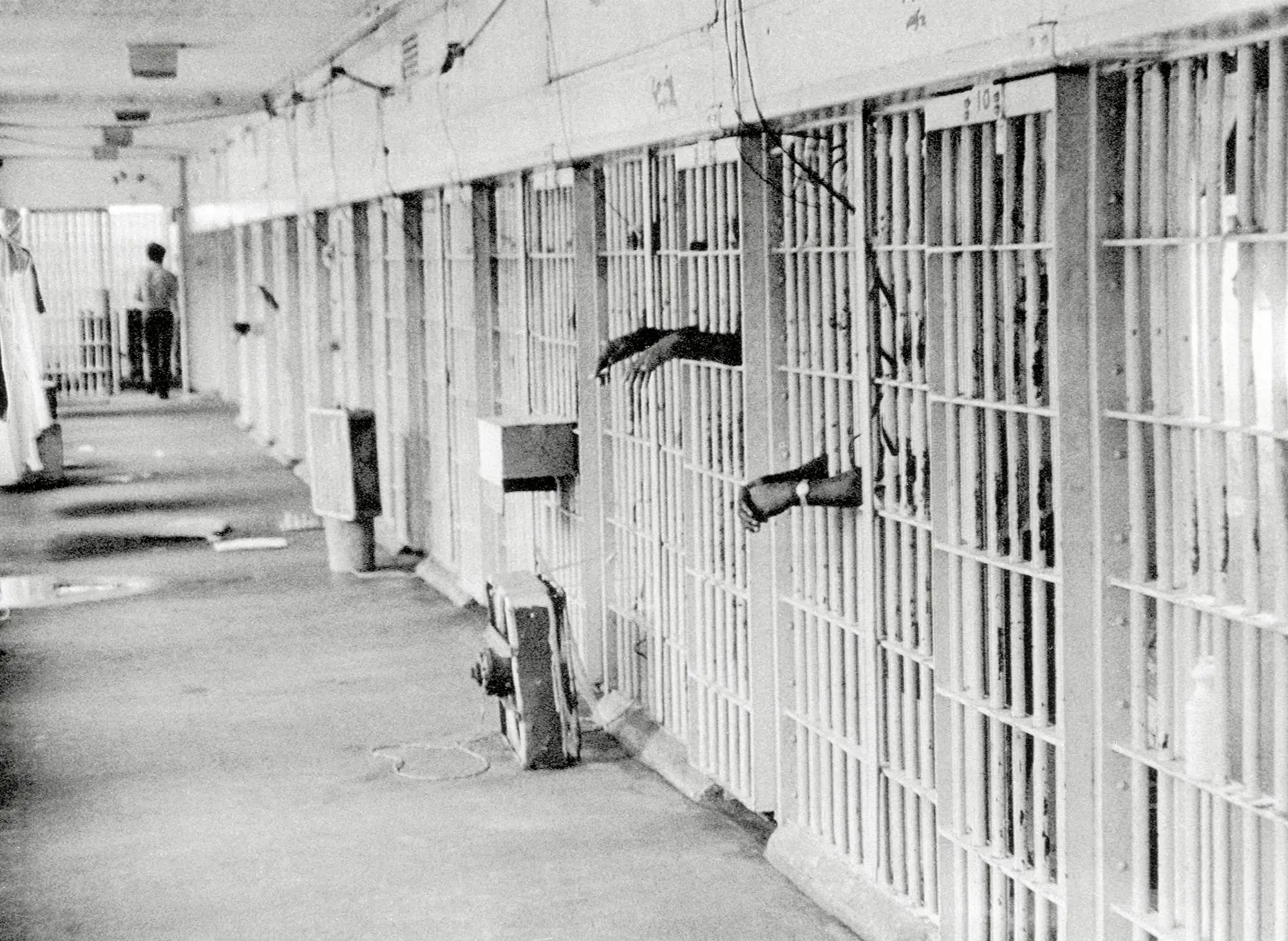
The first step is for the government to have a monopoly on violence, to submit every dissident into submission and obedience, that's what law enforcement is there for, with jails to exhibit to the masses what disobeying looks like, to prevent other people from disobeying as well.
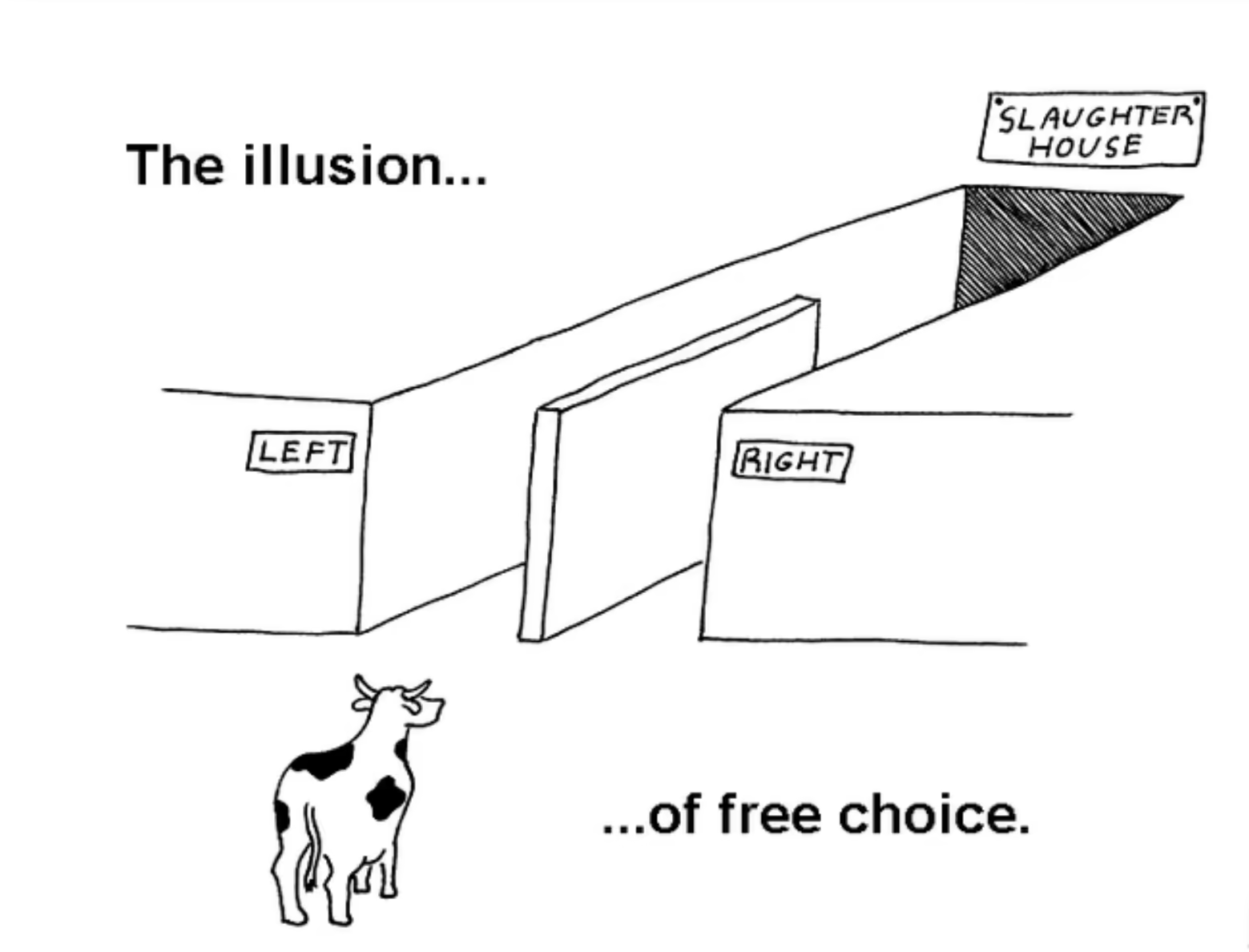

And the last key to power is to have a state-issued currency, this is to make sure that the government stays all-powerful money-wise, at the expense of everyone underneath them. It is to make sure that there is a carrot that everyone chases their whole lives, while at the same time remind them that if they don't chase it, they will end up on the streets. This is the carrot (becoming rich) and the stick (staying poor) that they will do everything they can to remind everyone of.
This is why governments and especially banks make people take loans for education, or for buying houses, that is so that those people spend most of their lives repaying those loans, making sure that they remain obedient and dependant to the system.
Corporations: The manufacturers of Poison
Right underneath the government, you have Corporations that do everything to harvest as much money as possible, at the expense of the whole world.

On that quest, Corporations serve many purposes, which is mostly accelerated by the centralization of the internet, where they propagate propaganda everywhere they can, while at the same time facilitating the passing of that same propaganda, by artificially and intentionally increasing and decreasing each and everyone's visibility and discoverability at the request of governments.
The power that those corporations (especially on social media and news broadcasts) wield over everyone's minds is immense, and it is not to be taken lightly. Their propaganda goes through Television, Radio, News outlets, Social media, podcasts, and even advertisers. Every medium is a good medium for propagandists as long as it can be used for their message to reach the masses quicker.
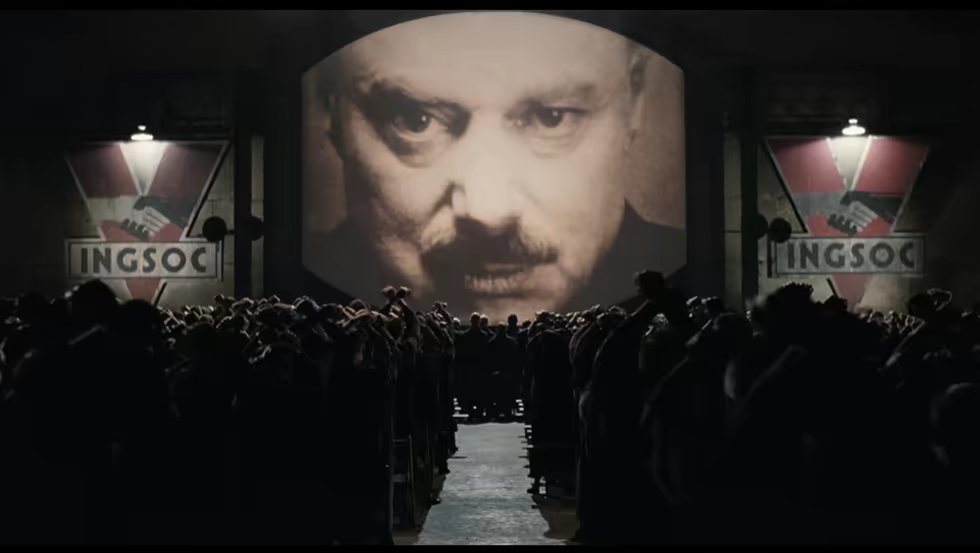
Even so-called independent journalists are no exception from this wide-spread corruption.
This is something you'll see in action especially with dissidents on social media, they are silenced, made invisible, shadow-banned, deplatformed, and so on.
Everything is done to protect the false beliefs that the government wants you to hear, see, and believe.
Not to mention that in order to keep grabbing your attention, nothing is out of bounds. This is known as the war on attention,
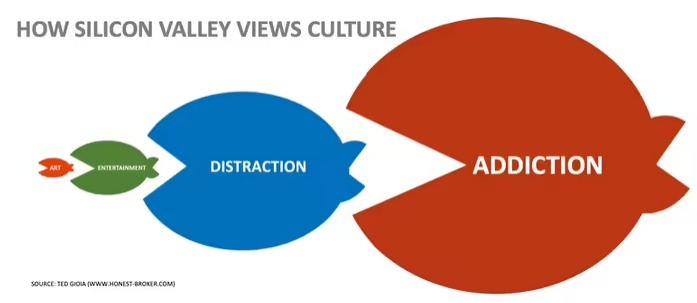
The fastest growing sector of the culture economy is distraction. Or call it scrolling or swiping or wasting time or whatever you want. But it’s not art or entertainment, just ceaseless activity.
The key is that each stimulus only lasts a few seconds, and must be repeated.
It’s a huge business, and will soon be larger than arts and entertainment combined. Everything is getting turned into TikTok—an aptly named platform for a business based on stimuli that must be repeated after only a few ticks of the clock.
Ted Gioia
The clearest place you can see this in action is on the YouTube crypto section:

Everything is made so that you are baited into clicking their worthless content (yes, bitcoin is worthless). All of it so that you may view ads forced onto you by YouTube, so that they may generate profit for themselves, and by extension the """content creator""" (more like the addict creator) is reaping some of that profit themselves for successfully having made you click. All of it is done in search of pleasure, On those platforms, Everyone is desperate to remain relevant, to be able to get that one more dollar carrot. Despite the incredible amount of content, 99% of the content uploaded there is produced out of desperation. Everything about it is made to turn you into an addict.
The human mind was not made to receive that much stimulus, you were not made to take the weight of everything happening everywhere all at once, it's too much to handle in any case. (yes, go watch this masterclass of a movie, you'll understand exactly what mental overload means, and what it can lead to)

The Dead internet Reality (Video on it)
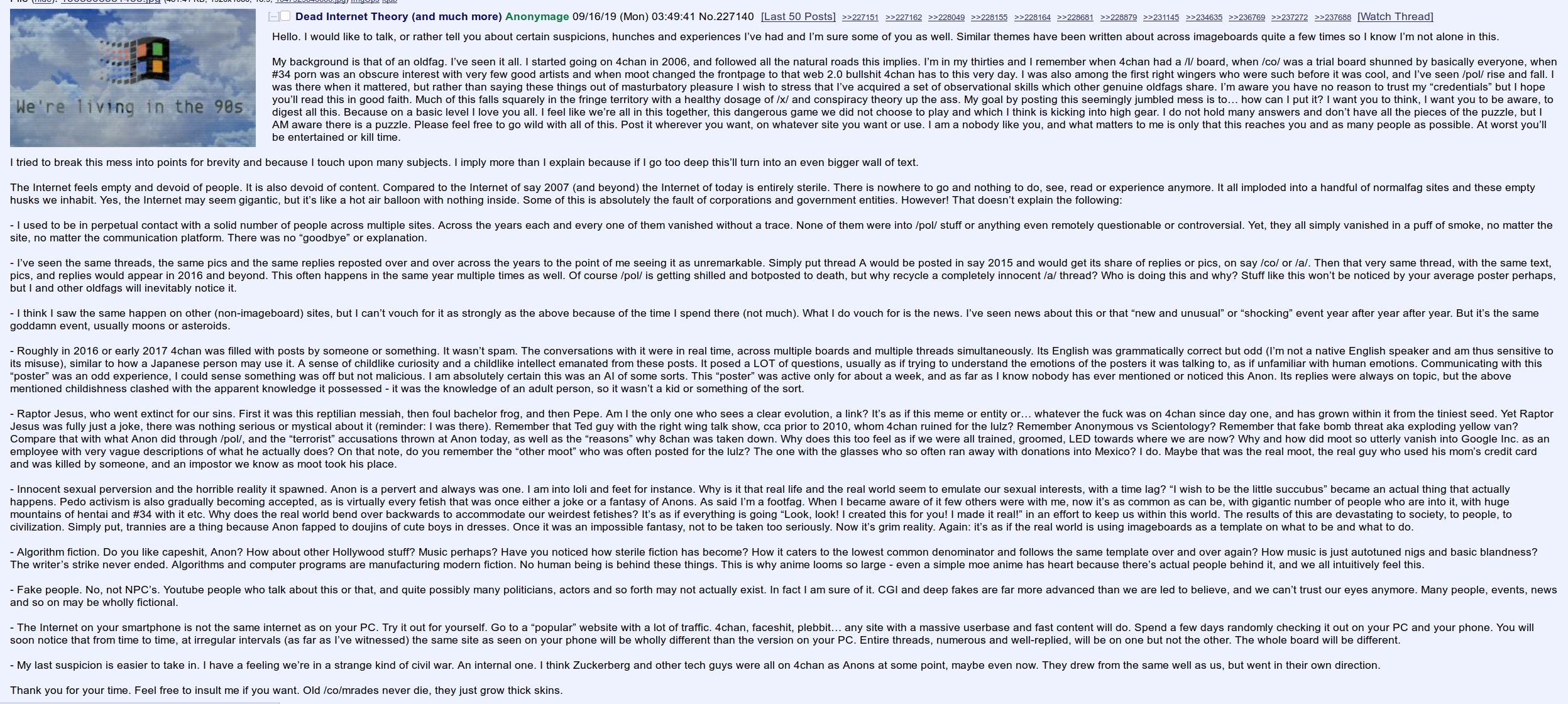
The clearnet internet as we know it is becoming increasingly more quiet.
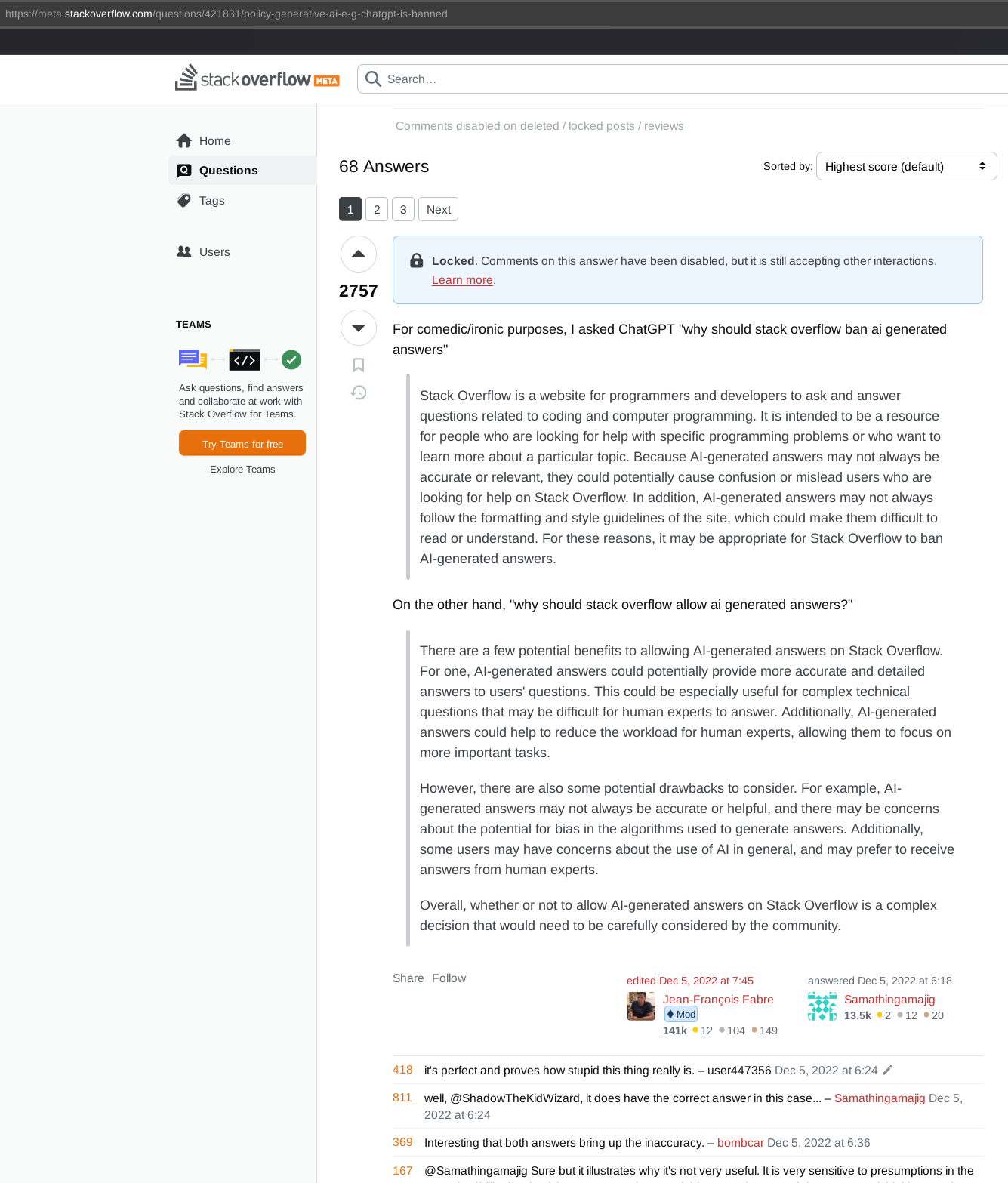
People are no longer writing texts, they use LLMs to write it for them:
People no longer do art, they generate slop images using AI:

People no longer make videos, they ask AI to make videos for them:

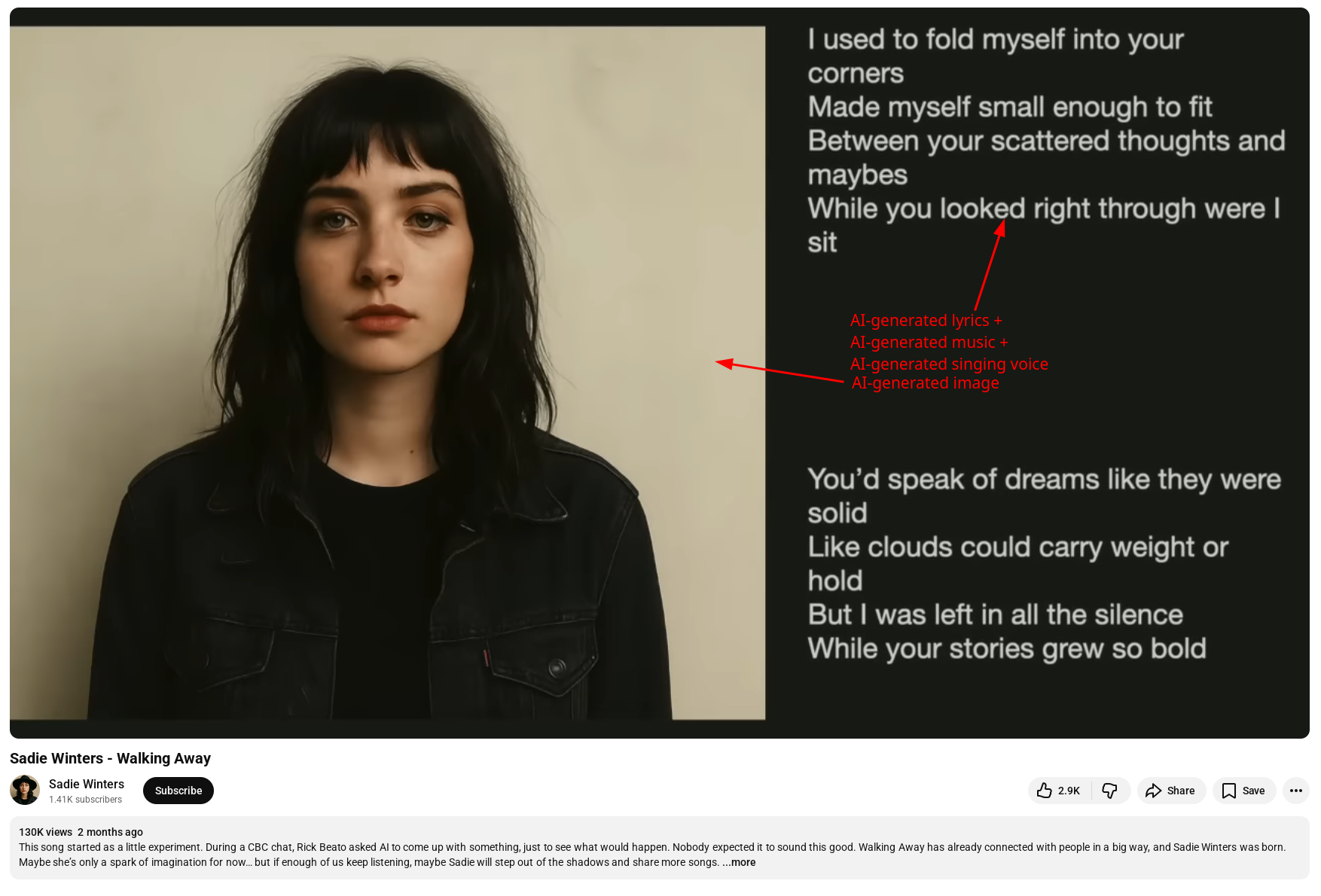
People no longer make music, they ask AI to make music for them:
They also use bots to automatically create the channels, automatically generate their videos and their contents, automatically post them online, and automatically comment on those videos with more ai-generated content to boost their own visibility up the algorithm, competing against both legit content creators and AI-generated bots alike.
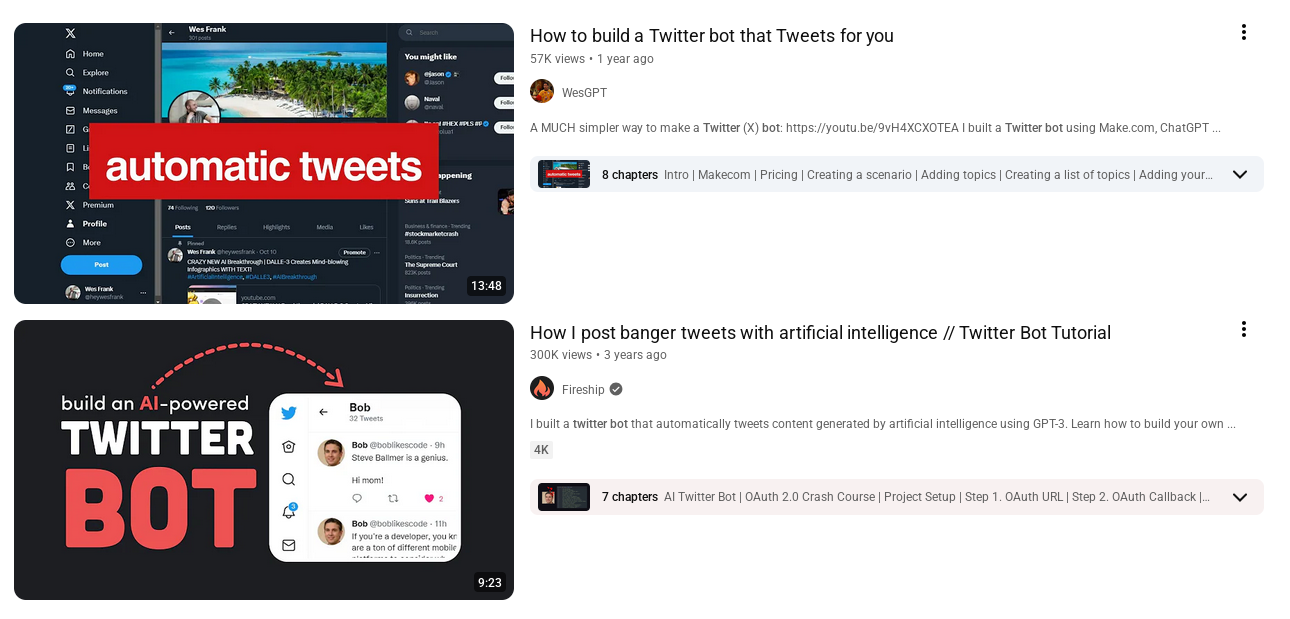
And people no longer argue online to further debates, they fake interactions by using AI to spread propaganda:
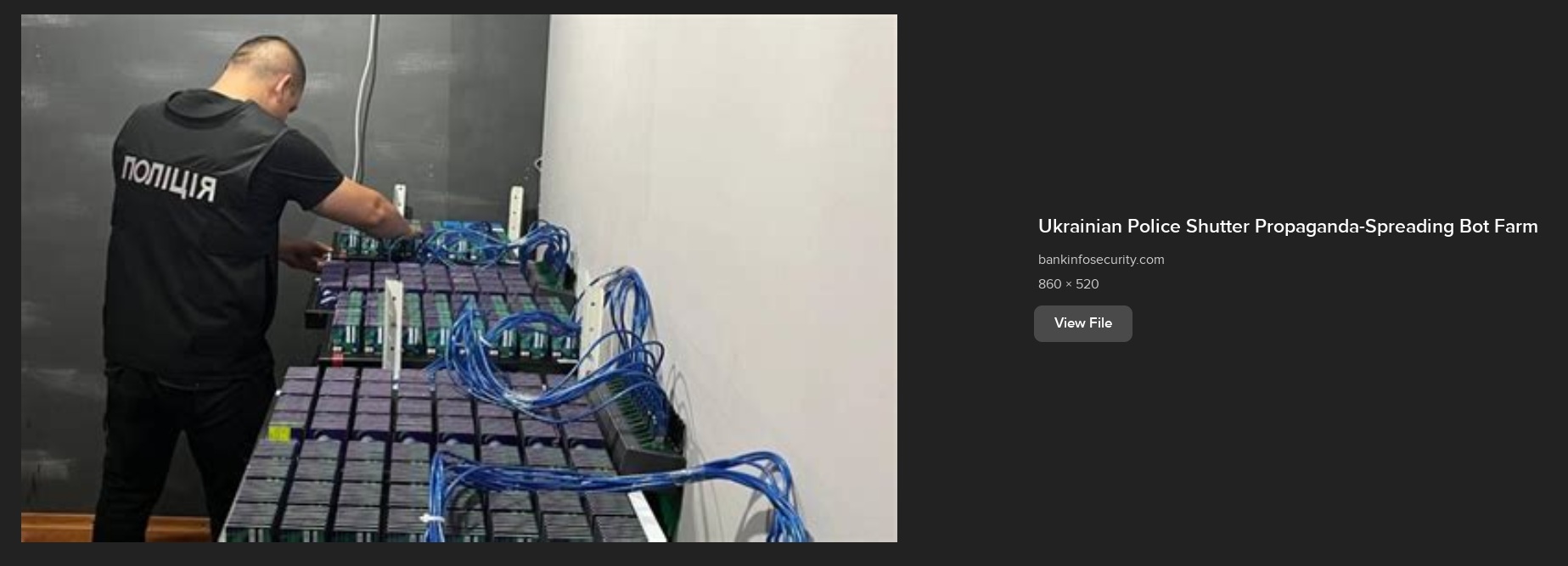
Not to mention bot-farms being operated and rented for whoever has money to pay for their services.


Some people have the nerve to talk about the dead internet being a theory instead of a reality, despite the overwhelming evidence against it.
AND add to all of that, that LLMs are training on data that they find on the internet, they keep on feeding on their own self-generated, inaccurate bullshit, all for what?
For the profit of whoever posts the right combination of AI-generated words, images, videos, music slop that makes the most people click, just to generate the most ad-revenue possible.
The reason behind why people do things
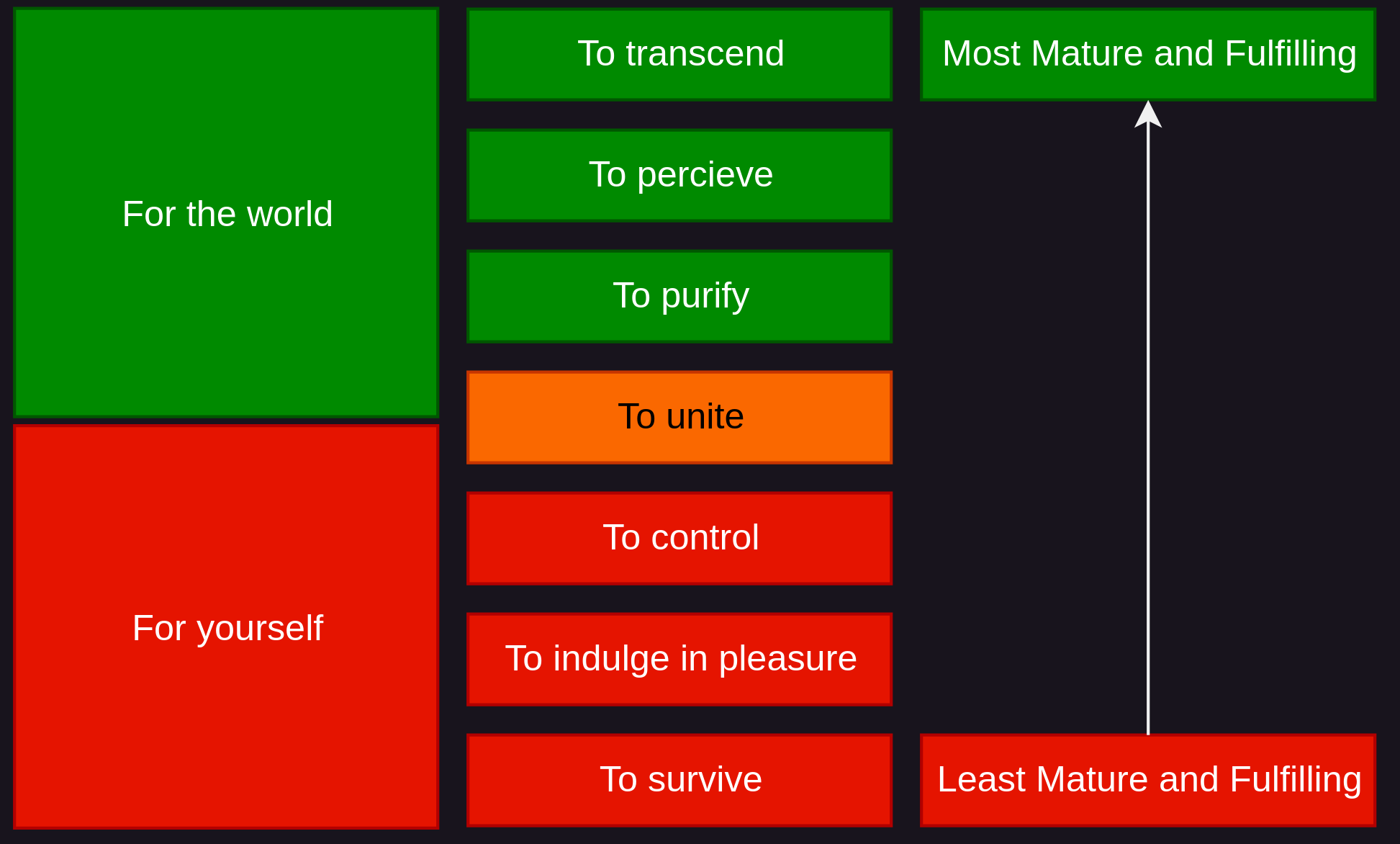
For everyone's tiny, and insignificant selves, capitalism is all about survival, indulging in pleasure and consolidating their current control, It is an egotistical way of living. It is about making you believe that your life can only be fulfilled from outside. When that is the way, Addiction to just about anything that makes you feel a little better is the result, no matter if it causes the world to be destroyed on the way.
If you are part of the unfortunate 90% of people out there, ask yourself if feeling pleasure is actually all that truly matters. If this is the case let's look at a few things that make you feel the most pleasure:
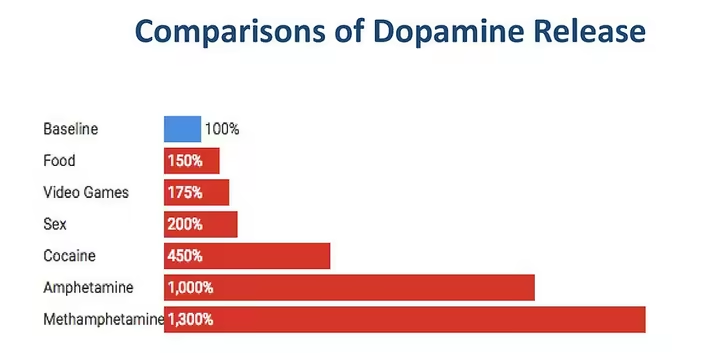
Do you seriously think that methamphetamine addicts are the most joyful and fulfilled people on earth? On the contrary, it is exactly what is destroying their lives. Pleasure seeking is the poison that is leading you astray, it is from that central poison that you seek every other poison. Instead of looking for fulfillment from within yourself, you have been led to believe that it is supposed to come from somewhere outside. It is because you think joy comes from somewhere outside that you are so desperate to find it, it will always remain a random occurrence that won't last long if you keep looking out there.
Before you indulged and abused all of those dopamine releasing poisons, you might have felt pleasure, perhaps even joy from looking at the sunset, from looking at nature, and all the mundane things in life. But after you start to indulge in bigger and bigger dopamine releases (meaning feeling increasingly more pleasure), you end up desensitizing yourself
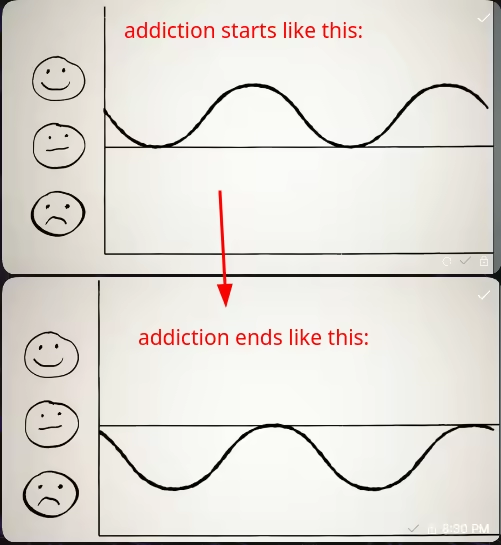
When you have such a huge caliber to shoot yourself in the head with, to feel that pleasure you seek, nothing else can compare anymore, you won't feel any pleasure from anything else. The brain will anyway adapt to it and gradually, you will feel less and less pleasure coming from the same activity. You are essentially reducing your ability to appreciate the world more and more, the more you seek pleasure.
You need to realize that pleasure seeking is a path of self-destruction. All the joy, grief, pleasure, pain, sorrow, ecstasy, and everything else you have felt so far, you have experienced from within yourself, you ARE able to generate those yourself and control them, without stimulation from the outside. You are supposed to produce that wellbeing from within yourself, True and lasting joy and wellbeing will never come from the outside, it has to come from within you.
Hell, why do you think everyone has cannabinoid receptors in their brains right now? Do you seriously think our ancestors were getting stoned? On the contrary, it is the brain that is supposed to produce those chemicals from within, rather than ingesting it from the outside.
Systemic, self-reinforcing Mind Poisoning
Let's suppose you fell for the poison of the recent US elections. You read a little too much propaganda, and you identified yourself with either the right-wing party or the left-wing party, (It doesn't matter which side you identified with) you have taken up an identity, from that point on the intellect will automatically do everything to protect it.
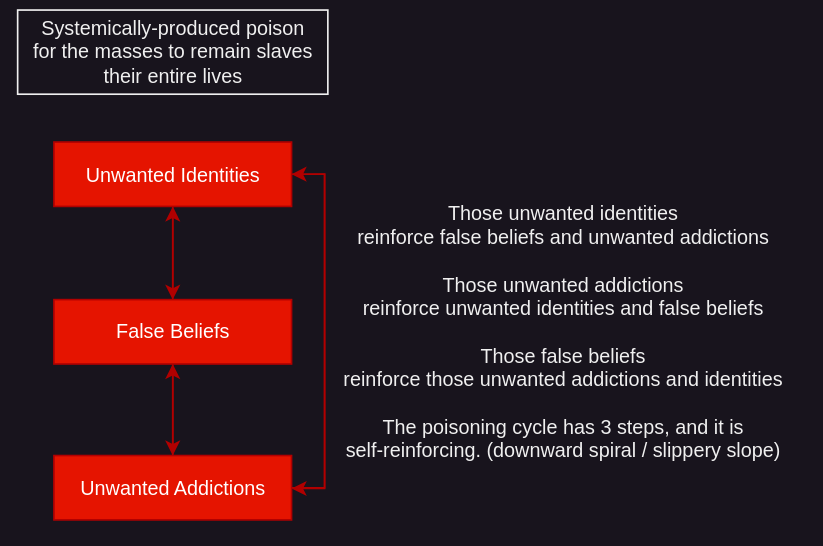
Now that you are identifying yourself with a political party, you are going to accept and believe their propaganda much more easily. And whenever someone starts to disagree on those beliefs you have picked up you're going to invariably clash with that other person, as either party is unwilling to listen to the other. Nowadays, people want to hear their own opinion come out of other people's mouths
And lastly, with identities and beliefs combined, you are much more prone to indulging in addictive behavior associated with those 2. For example scrolling twitter all day (doomscrolling) to read more and more propaganda and to trash talk anyone that doesn't agree with you.
And yet, for some reason everyone believes that this is normal, isn't it? Why are they putting up with it? You need to understand that this has been going on for decades, due to how systemically this poison has been spread into everyone's minds, the generations that were born into it are more likely to accept it as normal.
One needs to realize that it has been going on, then one needs to understand and recognize that this IS poison, to actually want to reject it, to then actually reject it.
Only the mind can purge the poison
So the poison managed to get into your mind, The solution is not going to come from outside, so don't try to listen to subliminal, binaural beats, hypnosis, affirmations or whatever other nonsense you can find on YouTube.
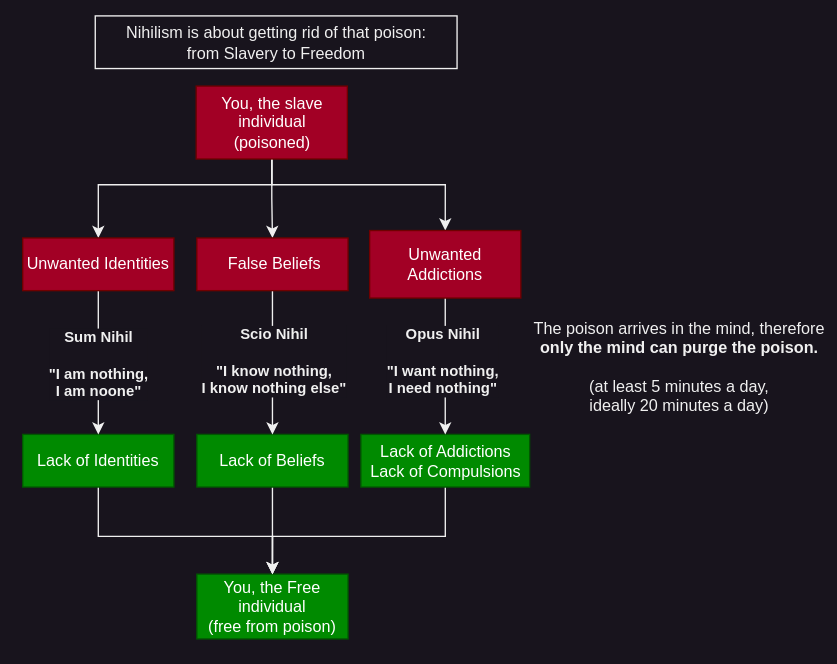
In short, to expel the poisonous identities, beliefs and addictions (since your mind isn't supposed to be society's garbage bin), you must spend at least 5 minutes every day, (ideally 20 minutes a day) repeating those mantras in your head.
Opus Nihil is about dissolving addictions and compulsions, allowing you to remain still and feeling whole.
I want nothing, I need nothing
Scio Nihil is about making you realize that it doesn't matter how much you know, there is always more to know, that way you won't ever be bored or arrogant again, every day will feel like yet a new adventure.
I know nothing, I know nothing else
Sum Nihil is about putting you back in your place since you are a very tiny happening in the universe, Effectively bringing back humility into you and making sure that you are no longer in the way of your own actions.
I am nothing, I am no one

As explained in the Nihilism tutorial, contrary to most mantras/affirmations you're going to find online, the Nihilism mantras are not about building confidence (positive affirmations), but rather, these are tools to restore clarity (negative affirmations) into you. Positive affirmations would otherwise bring solace, puff up your ego, empower delusional beliefs, and reinforce automatic behavior, at the expense of your Clarity. On the other hand, these affirmations bring clarity, because they are geared to destroy the obstacles and distortions that are in between you and what you are supposed to perceive. Identities, Beliefs and Addictions, these are all obstacles that you must destroy on a daily basis to be able to maintain that clarity within you.

Once you have managed to take your mind out of that poison being spilled everywhere in the world, you'll be able to realize everyone else that's still hooked up on it. But the thing is, the individual has to be willing to expel the poison, it must come from their own individual will, you cannot force them from the outside, it has to come from within them as well.
“The Matrix is a system, Neo. That system is our enemy. But when you're inside, you look around, what do you see? Businessmen, teachers, lawyers, carpenters. The very minds of the people we are trying to save. But until we do, these people are still a part of that system and that makes them our enemy. You have to understand, most of these people are not ready to be unplugged. And many of them are so inured, so hopelessly dependent on the system, that they will fight to protect it.
Morpheus, The Matrix”
Chapter 04
Discipline over Comfort
Who is the one in control? Who is taking the decisions in your life?
When the Body chooses
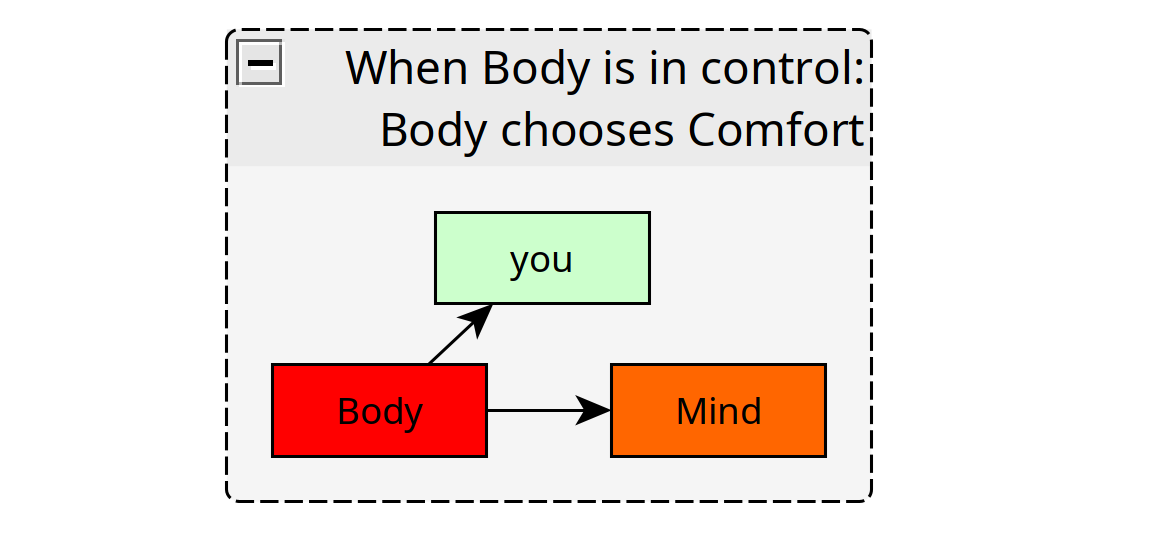
Over time, ever since you were born, you gathered a heap of food that you call your body.
Over time, you have let this body of yours do what it wanted or preferred.
The sweet and good-tasting food and drinks, the sweet comfort of the bed, the heater turned up high, or maybe even substances that you didn't need in the first place...
Tell me, are you truly the one in control here?
When the Mind chooses
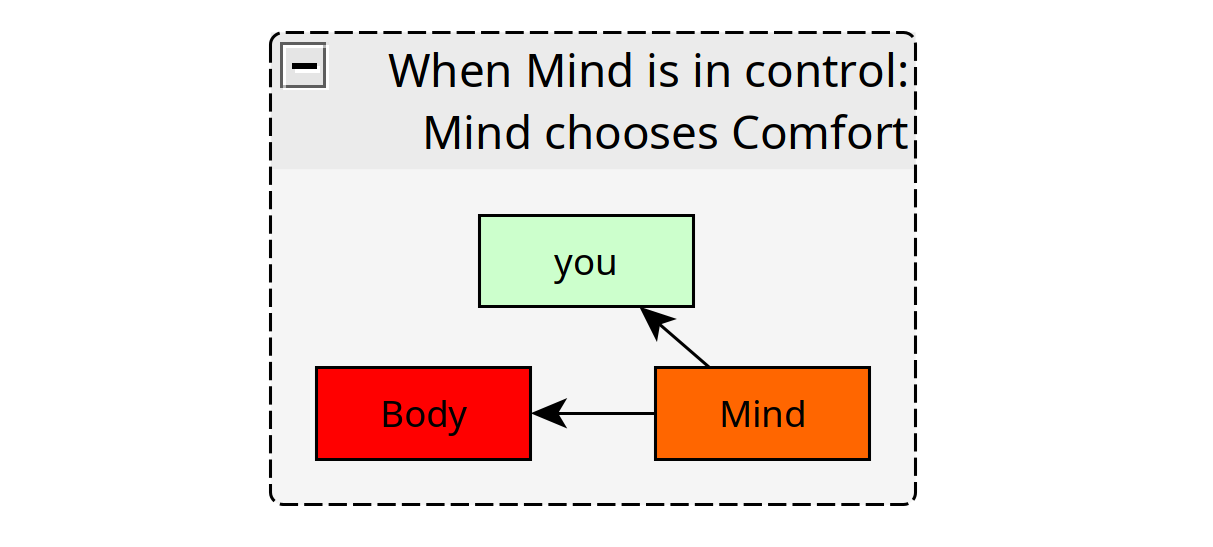
Over time, ever since you were born, you gathered a heap of information from outside, that you call your mind.
Over time, you started to believe that you were things that you have never been, and you have strongly identified with those things.
With those identities that you have gathered, your perception of the world has narrowed, to protect that which you identified with.
With that narrowed view, and with most certainly shame being brought upon ignorance, you have also started to believe, things that you do not truly know.
Few of those beliefs, may include things that you do not truly want, and things that you do not truly need.
Tell me, are you truly in control here as well?
You are not this Body, nor this Mind.
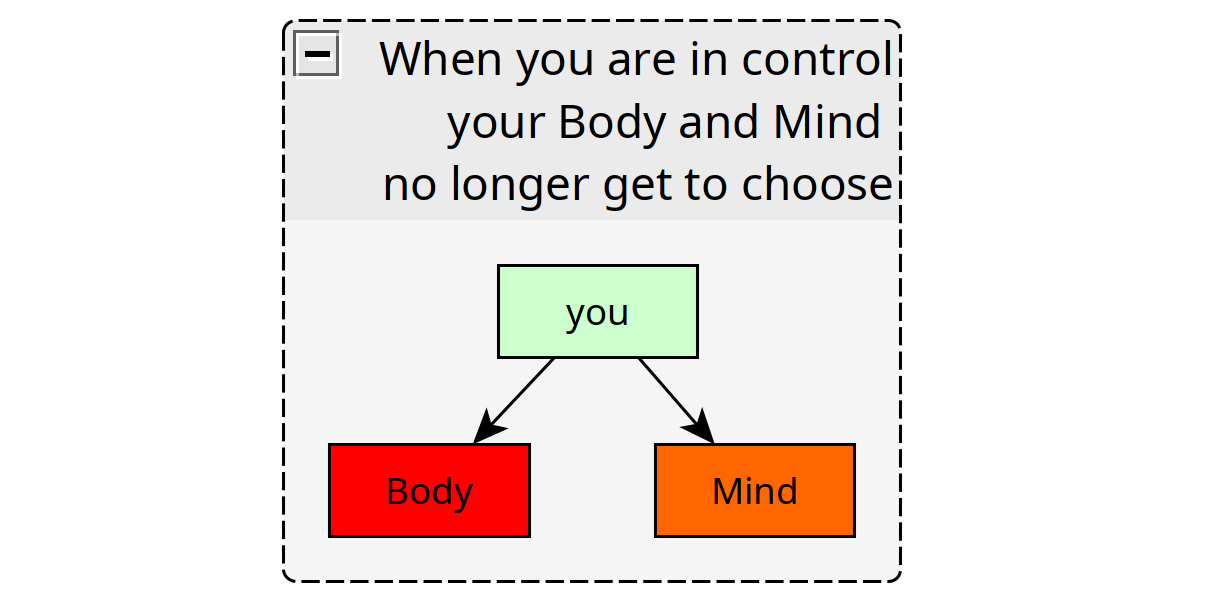
Is this Body a weight that you have to drag every day? Or is it a reliable tool at your disposal to do anything you want?
Is this Mind an unstoppable cacophony? Or is it a platform for you to reflect on the past, act in the present, and project into the future?
Why does it matter what your Body wants, or what your Mind wants? Should they do their own thing, and not take orders from you?
Chapter 05
Yoga to stretch the entire body
What is Yoga?
Yoga as a word means Union, it has existed for thousands of years already, and it has been used as a way to bring into fruition just about anything that can be achieved within human beings: health, peace, love, joy, ecstasy, compassion, wellbeing, bliss, heightened perceptions, dissolving the ego, purifying the body, etc.
Yoga practices most commonly include using the Body to align it to a specific geometry that provides benefits. As a practice, it can turn your body into a completely friction-free machine, which means that you'll waste less energy, and you'll be able to do things with your body more efficiently.
Least amount of friction means that your body won't be a hurdle to you anymore, it's going to be a platform for you to do just about anything that you want to do.
It may be perceived on the surface as stretching and twisting into impossible postures, but in reality it's about trying to unite with reality, through geometry.
Sidenote: Yoga is an entire world by itself, so below is a very quick and dirty get started quick guide, it's not a complete exploration by any stretch.
For Beginners - Yoga Namaskar
If you never did yoga so far, I recommend trying out this one first:
The main focus here is on stretching the spine, as this will allow you to think more clearly, and to be able to sit straight for longer periods of time.
I recommend only doing the standing up posture for beginners, but if you're flexible enough, try out the squatting down posture which is much more tricky.
Once completed, your spine should be stretched fully, and you'll see that you can think more clearly afterward.
If you are a beginner, I recommend doing this once a day, as soon as you wake up. Before having your morning cold shower
For Advanced users - Yoga Angamardhana
Isha has another yoga practice they keep hidden for their advanced users, which revolves once again around the spine. It's called "Angamardhana", literally meaning killing the limbs. It is a complete fitness practice in itself. In terms of health, the aerobic exercise that this practice brings, the muscle tone it brings about, without bringing rigidity, it is a great system of preparing the body for optimal performance, and maintaining health, especially on the cardiovascular level.
The goal of that practice is to stretch everything that can be stretched in the body, so that only the user feels in the end, is his spine.
It is definitely an improved version over the previous yoga practice we've looked at, and I recommend doing it only if you are a seasoned yoga practitioner.
Skipping the meditation parts, it should only take 20 to 30 minutes to complete. And by then you'd have already worked out some sweat with your own body weight, along with having stretched just about everything in your body.
Once done, you should be able to sit at absolute ease. The body shouldn't be a problem anymore.
If you are a seasoned yoga practitioner, I recommend doing this once a day, as soon as you wake up. Before having your morning cold shower.
Chapter 06
Preparing the Body - Diet to favor cerebral activity
The article initially covers the misinformation and disinformation regarding macronutrients in the pharma-industry. It is highly recommended to read.
Chapter 07
Sugar is public enemy #1
Sugar (especially refined) is the worst thing to eat because it is a poison to your body.
It is a simple carbohydrate that is quickly absorbed into the bloodstream, causing a spike in blood sugar levels. This can lead to a number of health problems, including:
####
* Weight gain: Sugar is a high-calorie food that can contribute to weight gain if it is consumed in excess.
* Type 2 diabetes: Sugar can increase your risk of developing type 2 diabetes by causing insulin resistance. Insulin is a hormone that helps the body use glucose for energy. When you eat sugar, your body produces insulin to help lower your blood sugar levels. However, if you eat too much sugar, your body can become resistant to insulin, which can lead to type 2 diabetes.
* Heart disease: Sugar can increase your risk of developing heart disease by raising your blood pressure abnormally and bad cholesterol levels.
* Stroke: Sugar can increase your risk of having a stroke by damaging the blood vessels in your brain.
* Cancer: Sugar can increase your risk of developing cancer by promoting the growth of cancer cells.
* Tooth decay: Sugar is a major cause of tooth decay. When you eat sugar, the bacteria in your mouth feed on it and produce acids that can damage your teeth. This can also rarely result in decay of nerves in the mouth and worse consequences.
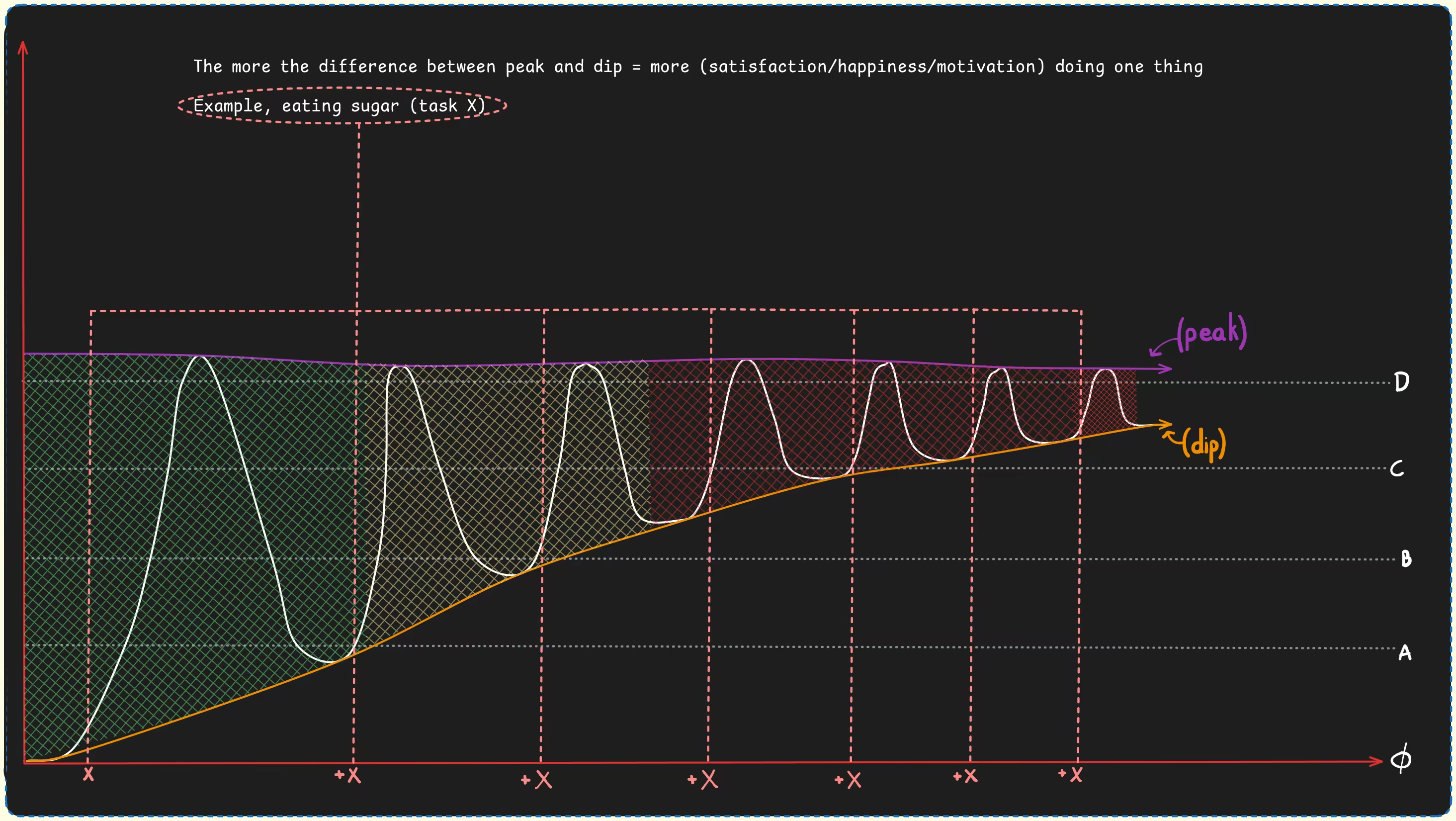
The worst part about sugar (and also many "anti-depressants" - more on them later) is instant gratification.
It is like putting a band-aid on a deep wound and telling that it'll heal. It will not. ** Sugar intake triggers the release of dopamine - the 'feel good hormone'.
However, the sudden increase in blood-sugar levels are coupled with insulin, which decreases the amount of blood-sugar level, that dips down the already dropping dopamine level.
Continuous cycles of this leads to what's called the "Dopamine Baseline Level" increasing more than decreasing. This causes your body to get used to high levels of dopamine - which is directly related to happiness, motivation, desire for hard work, and good mental health.
Therefore, in a nutshell, the greater the sugar (high dopamine) intake, the more that the baseline bloats, so the tasks that felt rewarding are now way less rewarding. As a result, you now want more sweets to feel good than earlier, you want more 'junk food' to feel good than earlier, and so on.
The graph below tries to illustrate how it works.
Sidenote: daily cold exposure improves glucose and lipid metabolism, on top of enhancing insulin sensitivity, which reduces risk factors associated with metabolic diseases such as obesity and type 2 diabetes.
(cis, unsaturated) Fats are good for you
Now that the sugar is our of our way, we are already very healthy. Now it's time to gain healthy energy instead of the unhealthy one that sugar gives.
Benefits of unsaturated fats
###
* Improving brain function: Unsaturated fats are essential for brain development and function.
* They can help to improve memory, learning, and mood. They are directly responsible for the cognitive speed of your brain as they enhance the transmission of electric signals among neurons.
* Reducing the risk of cancer: Unsaturated fats have been shown to reduce the risk of some types of cancer, such as breast cancer and colon cancer.
* Improving bone health: Unsaturated fats can help to improve bone health by increasing the absorption of calcium.
Essential fatty acids (EFAs) like 'Omega-3', 'Omega-6' are crucial for cognitive (thinking, learning, remembering, logical analysis) functions of the brain.
Omega-3 fatty acids are essential fatty acids that are important for brain development and function, and they have been shown to protect against cognitive decline.
Omega-6 fatty acids are essential fatty acids that are important for the production of hormones and other signaling molecules.
Cholesterol is bad for you!!.......................right?
One of the biggest lies we've been told is that cholesterol is bad for you. You might've heard doctors say that it clogs your arteries and that you should avoid cholesterol at all costs.
Let me list the things cholesterol is actual responsible for.
####
1. Sex hormones - Testosterone (& derivatives) and Estrogen (& derivatives)
2. Reduces various types of Cancers
3. Protects brain from internal damage
4. Essential for many bodily functions, including other hormones' production and cell growth
5. Decreasing inflammation (especially the one caused by bad (shit) seed oils and our dear poison - Sugar)
- 01
* *
Critical Note
When you eat a lot of carbohydrates (explanation coming up), the fats you eat are stored in the body as reserve energy, which realistically, in today's day and age, we don't need.
This localization of fats (near gut and face in males, near thighs and over the time near mammary glands in females) is often indicated by low LDL (chemical that transports cholesterol and fat around) yet high cholesterol; that is, there's fat being moved around the blood but is not used, thus it often gets clogged in the arteries and bulks up as what we know as fats, in front of the belly.
Because doctors are trained by schools affiliated with Big Pharma (we'll talk about in a bit), their immediate reaction to this is to decrease fats and increase carbs (carbohydrates) in your diet.
Your body prefers burning carbohydrates because carbohydrates (including sugars) have high energy density than proteins and need less power to break down than fats. However, the energy gained from burning the carbohydrates is unclean energy and the side products are often bad for you.
When you start eating even more carbohydrates and decrease the amount of fat, all you're doing is keeping the old fat in its place and adding more fat to the pile, all while burning more dirty energy.
This stops the body from 1. Burning dirty energy, and 2. Start using up the fat reserve and start moving the cholesterol and fats with the help of LDL.
As we talked about fats being more energy dense and cleaner than carbohydrates, your body now burns fat without feeling heavily lethargic. This also unclogs the arteries because now your body is in a state of burning fats for energy, and it needs as much fat as it can to burn and give you energy.
Some people unfortunately, are born with really rare genetic mutation where they can not digest healthy plant-based cholesterols/oils (sitosterol/beta-sitosterol) from sources like Avocado and Olive and end up clogging it up in the arteries. Again, this is SUPER RARE and you probably do not have it unless you had to go to a doctor and the doctor said that to you.
- 01
* *
"Food Pyramid" - the most successful business campaign
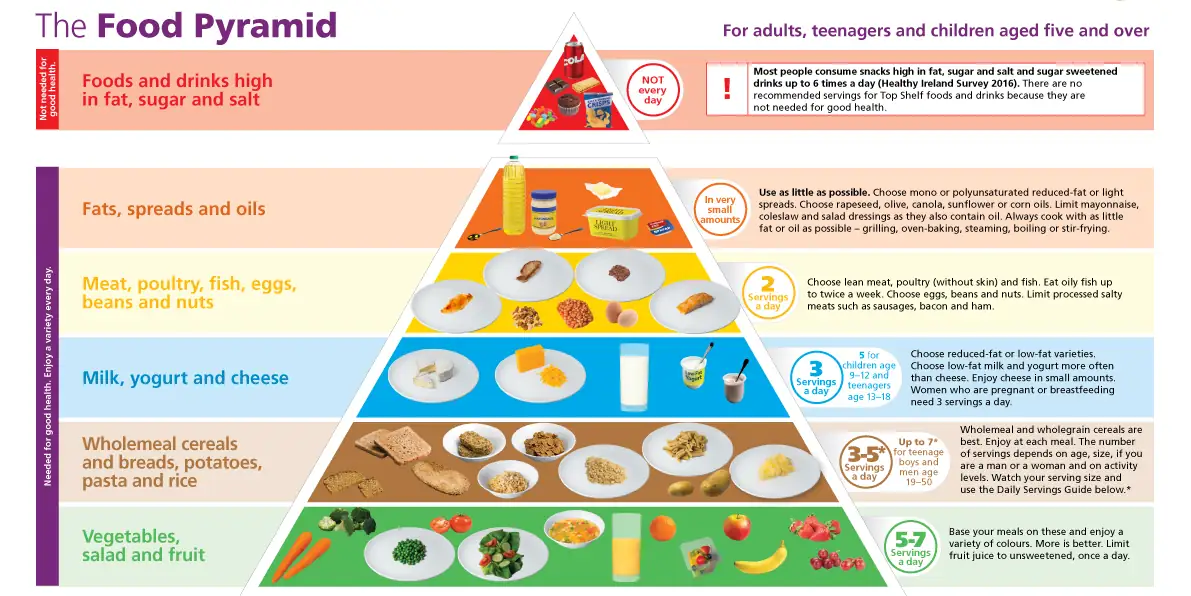
After what was said earlier about fats being essential and the only way to not have body fat and feel lethargic while also having a sane functioning non-brain-foggy focused mind is to drastically decrease the carbohydrate intake and increase the (healthy) fat intake, have a very close look to the pyramid.
What does it say?
####
- 01
Mostly eat carbohydrates.
- 02
Eat less fat.
- 03
Eat less salt (more on that below).
Big Pharma's Deception
If this wasn't enough, let's look at how the "normal levels" of certain things in our blood have changed in just 40 years.
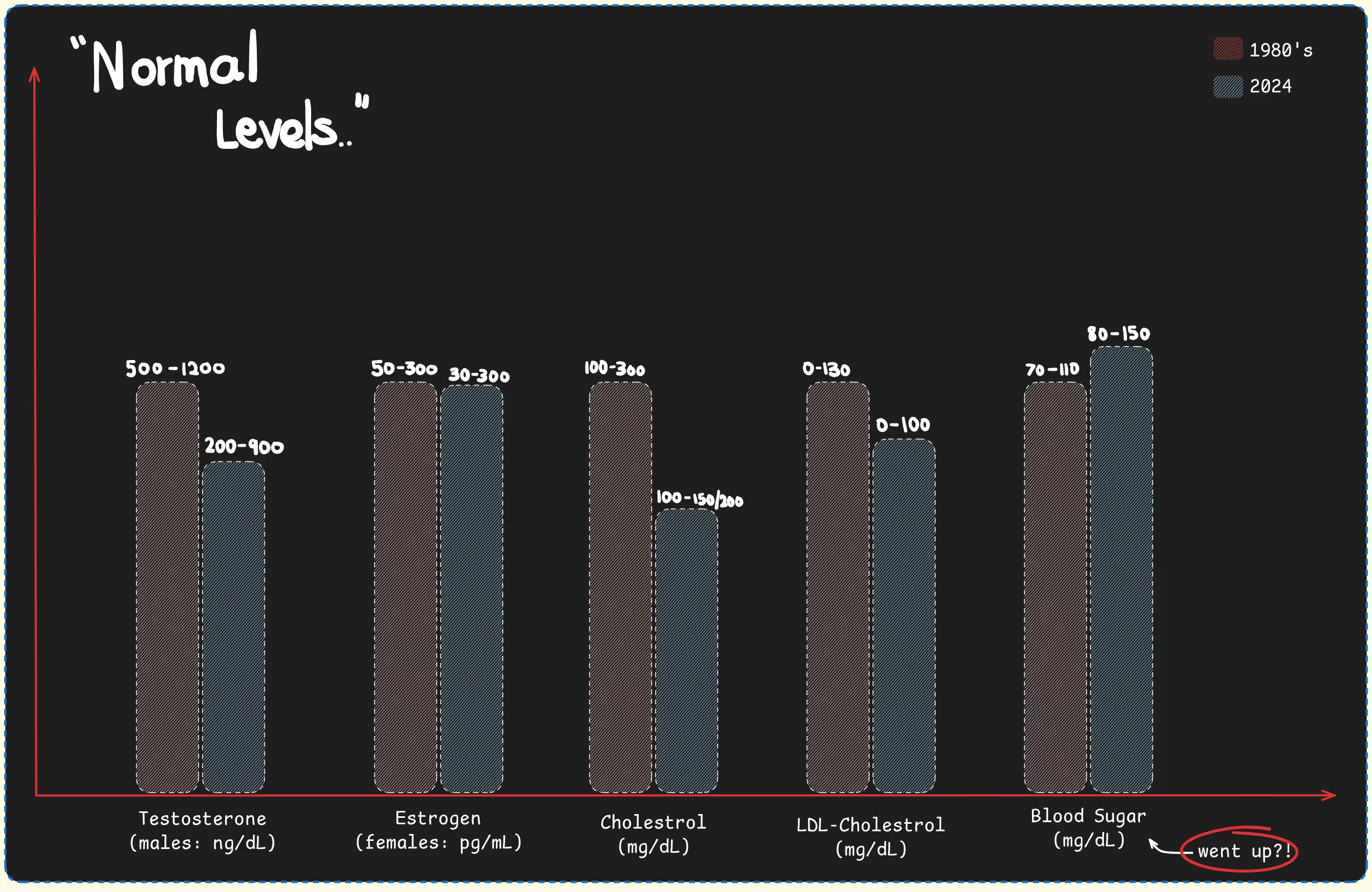
I have people running after me telling me that all of this is alright and that even if they (organizations) are affiliated with pharmaceutical companies, they wouldn't lie.
They said the same thing about our privacy btw. Yet here we are.
Chapter 08
Preparing the body
Now that we have understood the reality of the necessary macronutrients and how we should not blindly let a company control our health, let's look at how do we successfully implement it
Let's go through how you can improve your diet step-by-step:
###
1. Cutting out the Sugar. (You can lower your sugar consumption by eating Fruits instead)
2. Do some amount of Cardiovascular exercise (minimum 150–180 minutes per week). See Yoga Angamardhana for that.
3. Get at least 15 minutes of cold exposure every week. This will also aid in the cellular cleansing by reinforcing your immune system.
4. Calculate your Body Mass Index (BMI)
5. Take a Blood test [CBC/Cholesterol/Blood-sugar/Sex-hormone] (check with a nutritionist or a doctor for accurate advice on what you may immediately need to regain balance)
6. Get enough ample and quality sleep every night, it is an absolute requirement for everything health-related.
Chapter 09
How to eat properly
First of all, the most important part is the meal frequency: 2 meals per day at the most. Eat once at noon, and Eat once in the evening. No snacking, no breakfast. That is because you want your body to actually naturally cleanse itself on the cellular level, the cancerous cells are consuming much more than regular cells, hence by intentionally spacing out your meals you are starving off all the cells that shouldn't eat more than they should. You cannot go through this natural cleansing without having an empty stomach, this is essential to prevent cancerous cells from forming within you.
-6h00: Waking up
-12h00: Lunch Time (food)
-19h00: Dinner time (food)
-22h00: Sleep
You need to experiment with food. Just check how long you are digesting a certain type of food, and if you are alive and energetic after digesting it. If your body feels like it wants to go the grave after eating something, and you feel like you can't function properly after digesting, your body is clearly telling you that this is not good food, it is having a hard time with it.
You will see after experimenting a bit, that your body digests best what is furthest away from you from an evolutionary perspective. Try out eating only meat for one meal and observe how your body feels, based off the above 3 criteria. You'll see that it takes forever to digest that kind of food, the body will be dragged down by the inertia caused by the digestion itself, and you won't feel energetic at all you'll most likely want to sleep (even though you cannot properly sleep and properly digest at the same time). And as a counter example, see how your body feels after eating what I recommend below:
If your body feels agile and alive, and it doesn't take long to digest, your body is telling you that this is good food because it is not building up inertia, but rather it is making it feel alive and well. Inertia is not what you are looking for when you want to live, as death basically is total inertia. You need aliveness, energy and agility.
On top of that, the more inertia you make your body go through while eating, the more you will need to sleep for your body to repair the damage done that has been done. But if you eat the right kind of food, your sleep quota will go down, as there will be less damage done to the body, meaning less maintenance to do on the body, meaning less sleep will be required.



4. Essential Fatty Acids, Fossil Lipids and EPAs: That also includes eating Fish in general, Fish oil, Chia seeds, Walnuts, Soybeans, Olive oil, Coconut oil. This will do wonders for your neuron membranes. These are the aforementioned Omega Sixes and Omega Threes, which are essential for your brain health. (1h30 digestion time)


6. Water: That's an obvious one, as approximately 70% of your body is water after all. But only consume water either before eating, or after the digestion has finished. Don't just eat and drink at the same time, as the water will make the digestion longer than it should be. Above all this is why Fruits are the best possible fuel as they contain water, and this on the other hand actually helps with the digestion. Now don't just drink a fixed amount of water, listen to your body. If it is thirsty, you must drink enough water to quench that thirst, without interfering with the food digestion.

Don't forget to eat diversely, as this is vital for your overall gut health (and gut microbiome) so don't hesitate to eat different types of fruits, vegetables, nuts, fish, etc. This will help support digestion, nutrient metabolism, energy expenditure, regulating hormones secretion, modulating your immune system, and influencing your brain function (yes, there is a strong connection between your gut and your brain, believe it or not) and emotional wellbeing.
And that's it! Now you should have enough advice on how to improve how you eat, remember to experiment with food and to carefully listen to what your body is saying about it when digesting it, and how it feels after digesting it.
Chapter 10
Nihilism: Mantras to reset the Mind
In case if you were wondering why I keep talking about Nihilism.
The structure of your mind
When we're talking about resetting the mind, we're talking about the following variables:
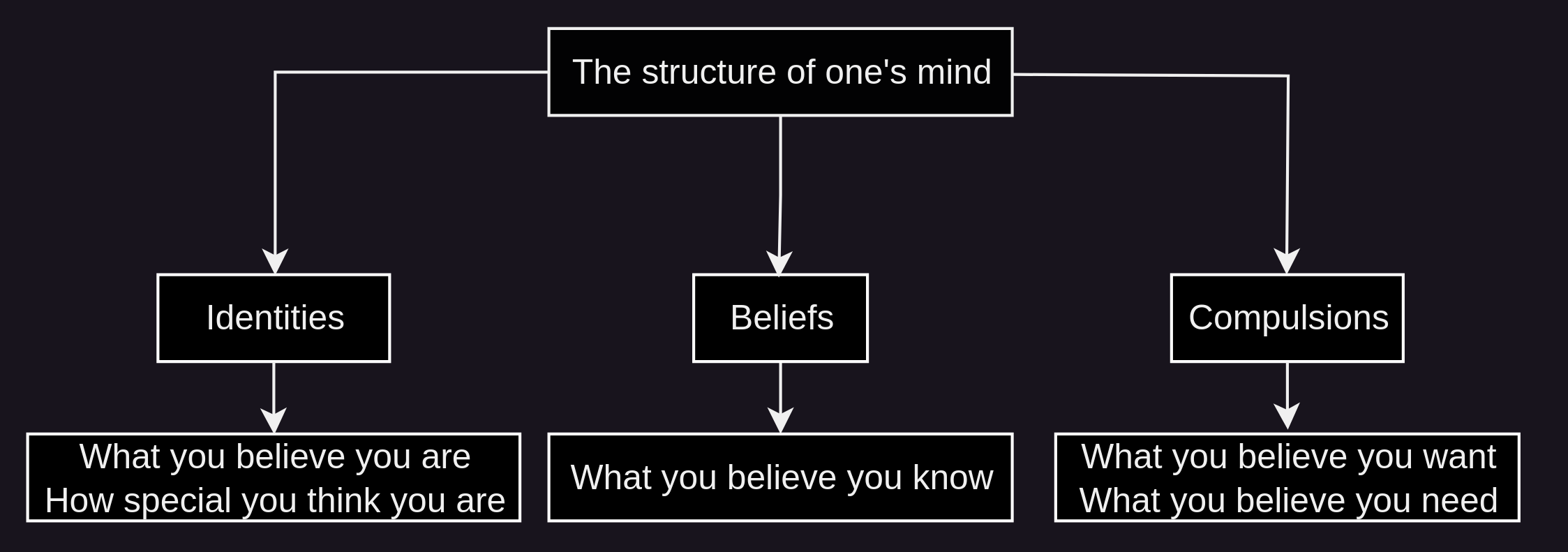
What you identify with
What you believe in
What your compulsions are
There is a common belief that people have, that for some reason these are determined from the start, and they cannot be changed.
Over time, the more identified you are with those 3 facets of your mind, the more you reinforce them, with enough cycles, at some point they may become so reinforced that you cannot just break free from the cycles you have indulged into, and you may feel trapped within your own mind. That is usually where depression comes from, your inability to rewrite your mind as you see fit, essentially a loss of control over your own mind.
Control over your own mind is something you need to practice every day, if you want to make sure it keeps doing what you want it to do.
But it doesn't stop there, you are also believing things that you do not truly know. If you think you know everything, how the hell can you sit still and shut up? It's never going to happen.
And you may have picked up compulsions as well over time, things that you think you want, and things that you think you need. You won't be able to sit still either if you keep believing you need and want those things.
Without being able to reset your mind to wire it the way you want it to be wired, you won't ever know peace of mind.
Is it normal to follow the norm?
Suppose you are on the road, driving at full speed. Are you more at peace when you see that there is nothing obstructing the road, or when there are obstacles on the highway?
Suppose you are trying to enjoy the sun outdoors, do you want there to be anything obstructing the sun rays from reaching you?
This is all you are doing when taking up identities, beliefs, compulsions, and allowing them to permanently stick to you.
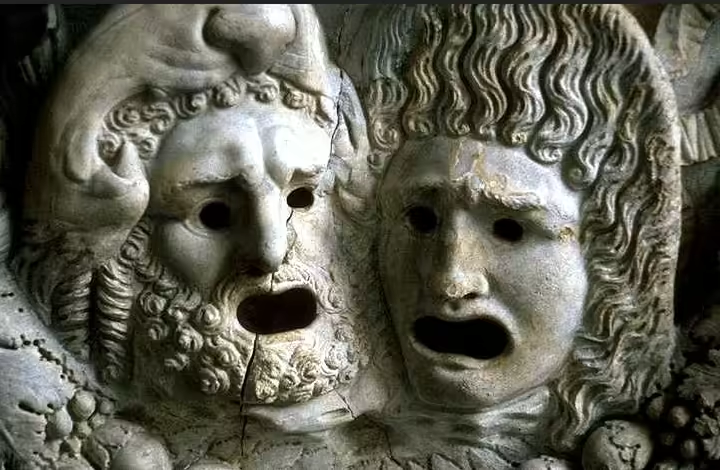
You have taken up masks after masks, placed it on your face, one on top of the other, and now they have begun to stick to your face. the more layers you stack on top of your face the less you are able to perceive things as they are. On top of that you are unable to take those layers off without being in pain. Over time, you may have even given up trying to remove them, and probably you have even started to accept this mess as your new normal.
After all, everyone's like that, why does it matter if I become like them aswell, I'll fit right in !
Thing is, even if you're in a madhouse where being mad is considered being normal as we have previously explained, you better stay mentally sane and refuse to fit in, especially if you want the ones that are stuck there to come back to mental stability one day.
This is where the crux of the problem is, the less you exert your ability to choose how to be, how your body is, how your mind is, how your emotions are, how your very life energy is, the least control you have over it. When you start making it normal to lose control over them, do not be surprised that they start to deteriorate and break down.
Do you seriously believe that this body of yours, and this mind of yours, were designed to produce the suffering you are experiencing? On the contrary, they were designed to produce incredible levels of wellbeing, the thing is that you've been given a very intricate technology, and you don't know how to handle it. It's not painful because that's their nature, it's painful because you're not handling the super-super computer like a blacksmith.
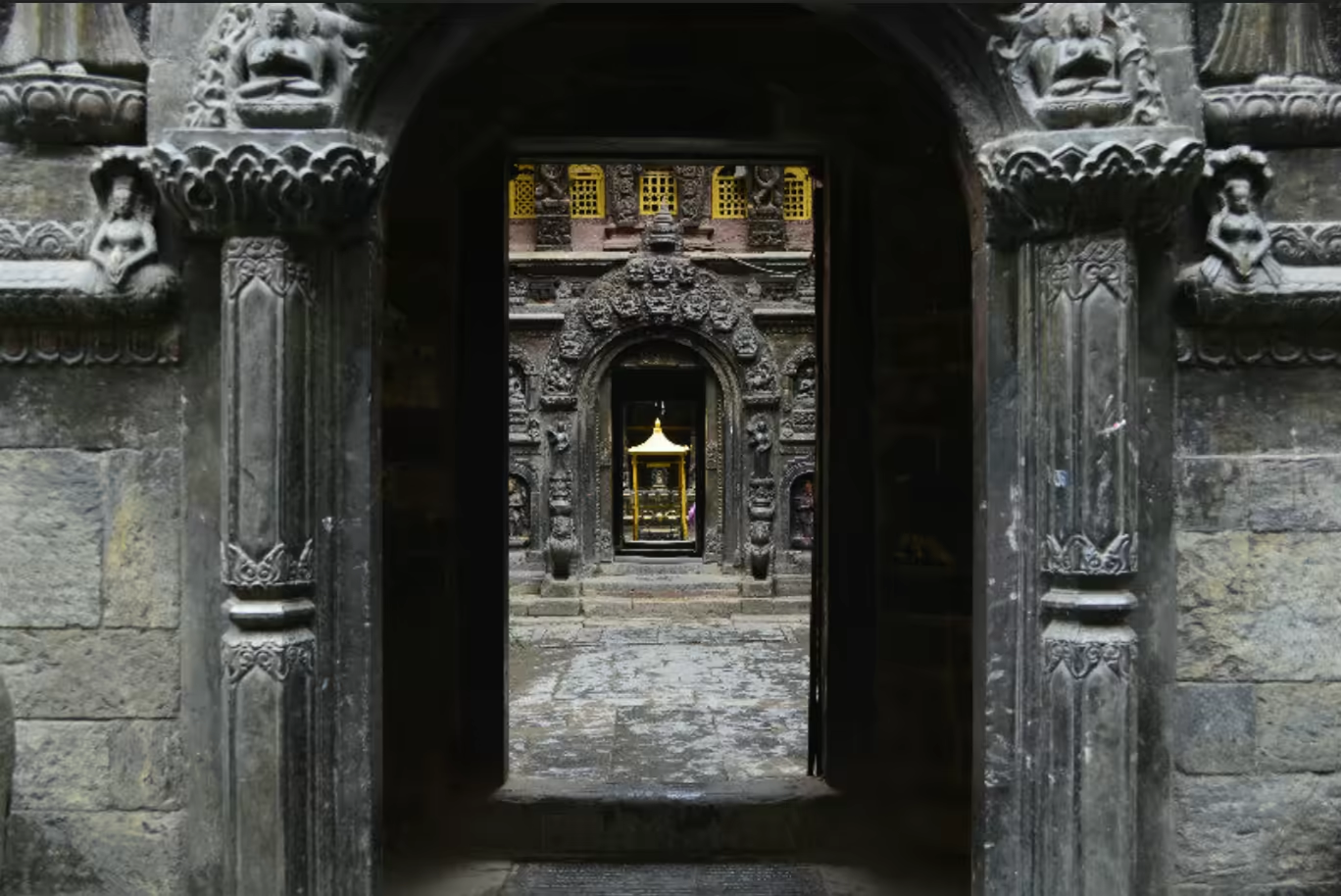
As you'll see in the following tutorials, the reasoning behind the nihilism practice comes from a minimalism approach but applied on your mind directly. Where everything that is not justified to remain in your mind is supposed to be thrown out. Everything that's on your mind must serve the one you are supposed to ultimately become, and everything else is to be destroyed.
You can't leave filth in a holy temple, because otherwise you won't be able to appreciate the subtle sanctity that the holy temple is supposed to have.
Your mind is that holy temple, and the filth is all of the identities, beliefs and compulsions that you have accumulated over the years. Nihilism as a practice is meant to be the cleansing of that holy temple, to continuously keep the temple free of filth, free of distractions, free of anything that is not truly needed, so that you may use it for what it was truly made for.
Do I need Confidence or Clarity?
So we need affirmations to alter one's mind, but should they be positive or negative?
Most of the affirmations you're going to find online are 99% positive, because they are about building confidence, rather than building clarity.
Positive affirmations are fundamentally flawed because they are meant to either puff up your ego, your beliefs or your compulsions. By puffing up either of those 3 you arrive at confidence, not clarity.
Suppose you are driving on the highway at 130kmh. But suddenly you can't see anymore because there is a lot of fog. (Meaning that there is no more clarity at the moment).
Of course, if you are not insane, don't want to wreck your car and potentially end up dead you'll wait for the fog to clear up to drive fast once again.
The Nihilism mantras are not positive, because they are not about building confidence. Rather, they are purposefully negative because these are tools to restore clarity into you. Positive affirmations would otherwise bring solace, puff up your ego, empower delusional beliefs, and reinforce automatic behavior, at the expense of your Clarity. If you want to be able to drive fast, you don't need confidence, you need clarity. These affirmations bring clarity, because they are geared to destroy the obstacles and distortions that are in between you and what you are supposed to perceive. Identities, Beliefs and Compulsions, these are all obstacles that you must destroy on a daily basis to be able to maintain that clarity within you.
Another way of looking at it is that you sooner or later you'll need to realize a series of things, such as your true purpose in this lifetime, sooner or later in your life you're meant to realize those things. But how soon or how late you're going to realize those things? It all depends on how clear your perception is. When the time comes, Will your ego be in the way? Will your false beliefs be in the way? Or will your addictions be in the way? These lightning strikes will invariably happen in your lifetime, and you never know when they will happen. That's why you need to be ready and receptive at all times, because you do not know when it's going to strike, and those may only strike once and never again in your lifetime.

You may have been going in the wrong direction for your entire life, you may have been wasting all that precious time away so far, and one day, one random dude on a random blog on the Tor network may tell you something that could make you realize the most important thing you may have ever came across in your lifetime. But your ego, your beliefs, and your compulsions may prevent you from listening, understanding, perceiving, receiving that important message. It is only if you are receptive to the message that you could realize that your life was meant to go in a totally different direction.
Nihilism: in Nothing we trust
In philosophy, nihilism; from Latin Nihil 'nothing') is any viewpoint, or a family of views, that rejects generally accepted or fundamental aspects of human existence, namely knowledge, morality, or meaning.
While it is often mistaken for pessimism and depression due to being about "Nothing" (but in fact, pessimism comes from negative identities, beliefs and compulsions), Nihilism counterintuitively is actually essential to your mental health, especially because it allows you to dissolve your concretized thinking patterns, reinforced identities and false beliefs. It is a way of efficiently restoring your neuroplasticity, or in other words, your ability to rewire your brain the way you see fit.
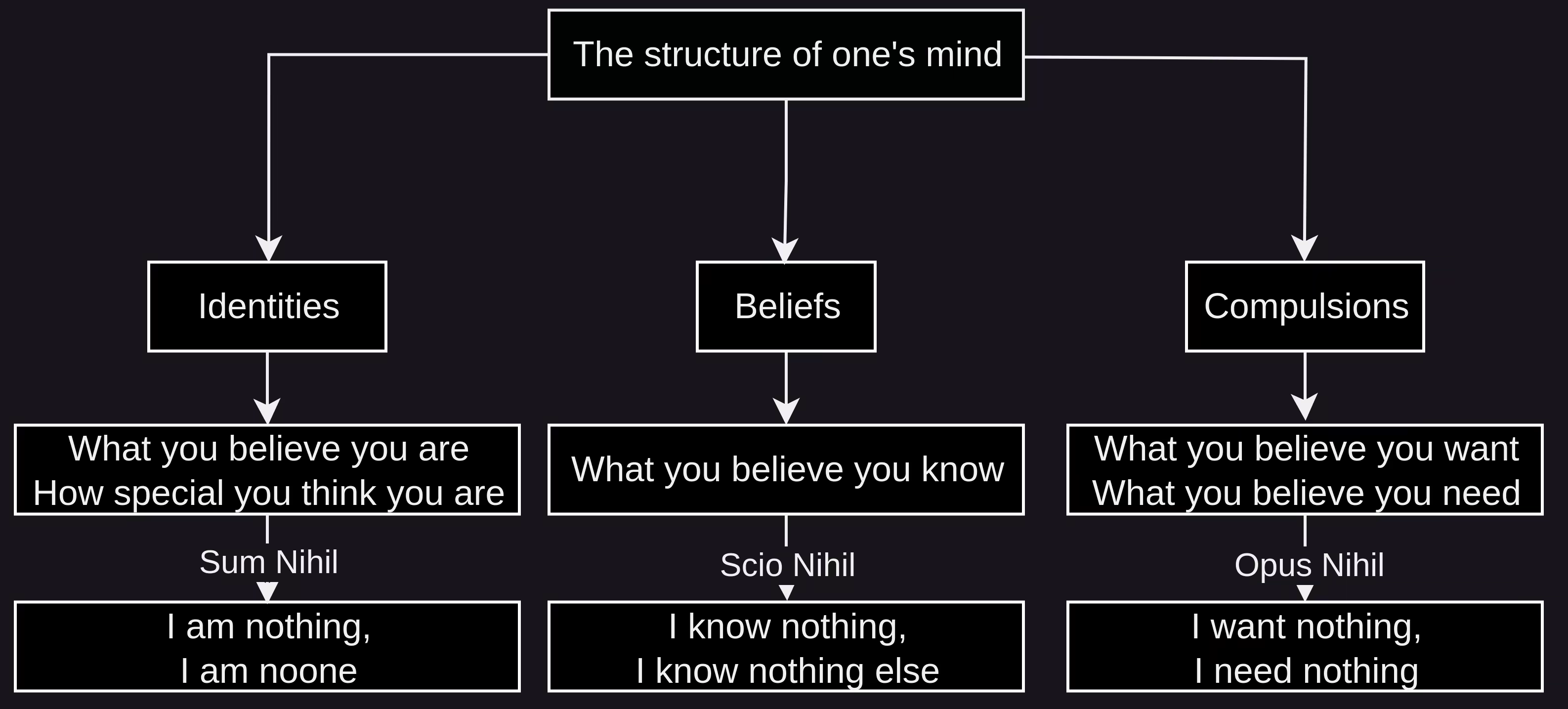
My approach to Nihilism is structured around the 3 main variables that can be influenced over your own mind, your identities, your beliefs and your compulsions.
Don't be fooled, most people perceive Nihilism as pessimism, But they fail to realize that pessimism is a also set of beliefs, identities and compulsions, that are destructive in nature. No, these are also meant to be destroyed with the following practice. We aim to dissolve both the positive AND the negative identities, beliefs and compulsions, because that's the requirement to restore Clarity.
Nihilism as a practice is composed of 3 Mantras, each are designed to dissolve a facet of your own current way of thinking and your current way of perceiving things.
Opus Nihil: to dissolve your compulsions (including addictions)
Inhalation: I want nothing,
Exhalation: I need nothing
Scio Nihil: to dissolve your beliefs
Inhalation: I know nothing,
Exhalation: I know nothing else
Sum Nihil: to dissolve your identities
Inhalation: I am nothing,
Exhalation: I am no one
None of those sentences may make sense at first, but in their own way these are all deeply rooted in reality (i have rewritten them more than 50 times over the course of the last 10 years, with daily use). There is a way to perceive each mantra, in a way that makes sense, to give it additional weight as a fundamental reality that shouldn't be forgotten, upon mentally uttering them.
1. Opus Nihil: What is it that you truly want? What is it that you truly need? What do you even need to survive? 2. Scio Nihil: How can you possibly know anything at all? Do you realize the magnitude of how little you truly know? 3. Sum Nihil: Do you truly matter in the grand scheme of things? Among 8 billion humans, Are you truly as special as you think?
All you need to make use of them is to sit comfortably in one place, to close your eyes, and to intentionally and repeatedly, mentally utter each sentence in synchronization with your breath.
Each thought being mentally uttered, must last the entire duration of the Inhalation or Exhalation. Given the level of focus it takes to maintain it over long stretches of time, if you are doing it correctly, you shouldn't be able to fall asleep while doing it, especially if you are intentionally slowing down your breath the whole time.

Over time, once again you will be able to enjoy the sunrise in the morning, you may rediscover small things that you may have forgotten about, such as how beautiful nature can be, and how peaceful it can be.
Keep in mind that this is not a one-time deal, this is to remain a daily practice, it can be practiced whenever you have a few minutes to sit by yourself, quietly with your eyes closed. At least 5 minutes a day, but ideally 20 minutes in total.
Make no mistake, it is very easy to fall back in the trap of being identified with things that you are not, believe things that you do not truly know, and fall into new compulsory behaviors. But at least when you are taking a break from the madness, you are able to see when you are stepping into it and when you are stepping out of it.
Chapter 11
Opus Nihil: Dissolving Compulsions
I want nothing, I need nothing

In this tutorial we're going to take a look at the first Nihilism mantra that you need to know. It is the one that will help you regain, maintain and reinforce your ability to control yourself, as it is a crucial tool to have in order to be able to unwind addictions, in order to move from compulsive behavior, towards conscious action.
Underground, I sat next to the crystal-clear lake, sublime, untouched, pure.
It doesn't need anything, besides being contemplated for it's own beauty.
[...] Should I dump black ink into it?
Your brain has a reward system (which is a collection of brain structures and neural pathways that are responsible for reward-related cognition), that essentially makes you feel good upon encountering certain stimuli. The problem is that your brain may give you the reward not for you actually achieving your work, but rather it may reward you along the way for totally unrelated things.

Over time, you may become completely desensitized after indulging into too many stimuli (video games, sex, substance abuse, etc.), so much so that nothing may feel rewarding anymore. And definitely not accomplishing any meaningful work.
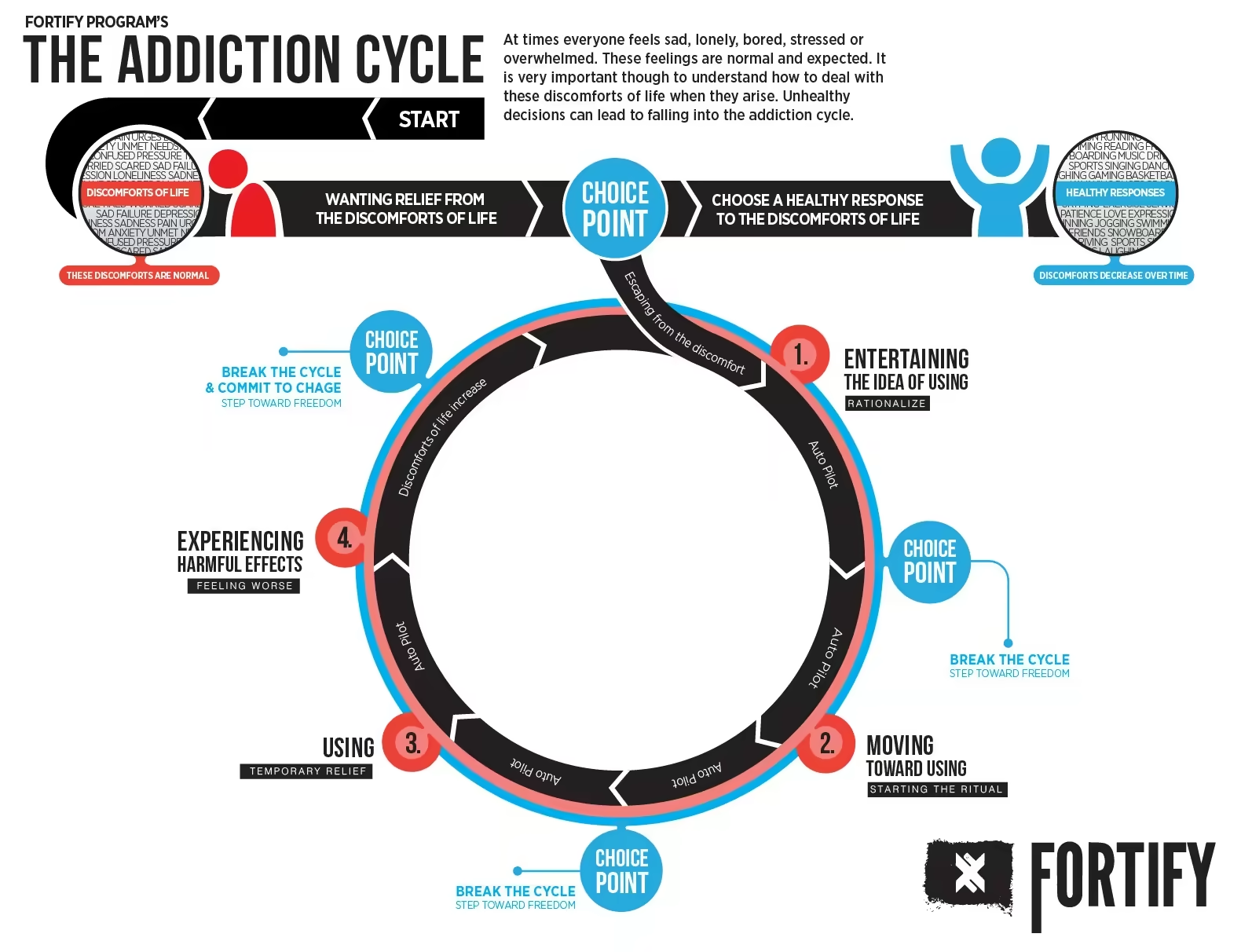
Addictions are essentially compulsory behaviors that you are having a hard time stopping yourself from doing. You can consider this as going in circles. You used to walk in a straight line, going to a great destination, but somewhere along the way you wanted to escape the discomfort, and you started to walk in circles. The end result, you guessed it, as long as you keep walking in circles, you're never going to go anywhere.
What is it that you truly need?
Do you even know what you truly need?
Look back the last 10 years of your life, did you always need the same things just to live?
Did you take up habits over that period of time, things that you did not even need in the first place?
Upon the crystal-clear lake, What would happen if I threw poison into it? I want to see.
I like what happens when I throw it in there, I think I want to do it again,
[...] I've been doing this for a while, I think I need to keep doing it
After indulging into those things for a while, do you even want them? Is it true that you need those things?
You don't need anything else. Work that poison out of your system.
What is it that you truly want?
Do you even know what you truly want?
Look back the last 10 years of your life again, did you always want the same things? Or did the things you wanted for yourself change over time?
Most likely, if you have a very active life, the things you wanted at one point in life, you no longer wanted them the next month.
Perhaps even, now you realize that you didn't truly want those things in the first place.
We all try to get more of something, whatever staircase you have found, be it Money, Power, Fame, or Substances
We all want to get more of something until we arrive at infinity, but that will never happen by doing additions.
The only way to arrive at an absolute, is by subtracting. You can arrive at emptiness, not at fullness.
Truth is, the content of our minds change on a regular basis, you can't ever be sure you truly want something, in the long run.
Maybe you don't truly want something in the end, how can you be sure you're not chasing someone else's dream?
The poison is not only physical, it also comes in the shape of thoughts that are not truly yours. You need to work that out of your system too.
The Poisonous Ocean of Pleasure
There exists an ocean out there, containing all of the pleasures you can imagine and the ones you can't even imagine. It contains more pleasure than you'll ever be able to experience. Even if you were to only dip your toes in it from time to time, you'd have enough pleasure to experience to last an entire lifetime.

At first when you were young, you were on the shore, you didn't know of the pleasures of this world, back then the world was beautiful, intriguing, radiant, every little thing was an adventure.
And then you started to go into that ocean, you experienced pleasure you didn't even believe was possible to experience. Since then, everything else that doesn't provide that pleasure felt boring, unsatisfying, pointless.
After a while, you kept going back to that ocean again and again, but for some reason it was never enough, you never stopped going there, so much so that you started to swim into that ocean, as far as you could go, to feel as much pleasure as you possibly could.
Problem is, the farther you go into that ocean, the bigger the waves are, it becomes increasingly more difficult to stay afloat and breathe.
You lost control in that high sea, and the waves keep crashing onto you, sending you underwater, making you sink lower, and lower.

If you are or have been one of those people whose lives have been destroyed by addictions, I'm sure you know exactly what I'm talking about. You know what that rock bottom feels like. At the bottom of that ocean, there is only darkness, there is no joy at all. Only pain, and suffering.
The moral of the story is just this: There is more pleasure than you could ever experience in your entire lifetime in that ocean, the deeper you go into that pleasure ocean, the darker your world becomes. Therefore, if you want your world to remain beautiful, you must stay out of that ocean altogether. You must not only reject the act of indulging in pleasure, Most importantly you need to realize that you do not truly want it, nor need it. You need to reject the very idea of indulging into Pleasure altogether.

Nihilism: Dissolving Compulsions
Modern Nihilism, as I am pioneering myself, is a set of sentences, or mantras, to be repeatedly mentally thought of, in order to change yourself from within, this aims to alter your perception, your beliefs, and your actual sense of self.
Opus Nihil:
Inhalation: "I want nothing"
Exhalation: "I need nothing"
(Sidenote: each mantra utterance must last the entire (intentionally slowed down) Inhalation/Exhalation, to silence the other thoughts)
We normally breathe 50% deep, to do the nihilism mantras effectively, you are supposed to breathe 2 times slower, and 2 times deeper (full inhalations/exhalation), AND the mantras you mentally utter need to last the entire duration of the inhalation, and exhalation
Warning: do not mistake this for being pessimism, the goal is not to make you not want or need anything, but rather to make sure you get rid of everything that your life was not meant to truly be about. In fact, is it not rather because you stop indulging in all addictions that you are finally going to do what you were truly meant to do?
It doesn't matter what you currently think you want, or what you think you need. It's an illusion anyway. And to be able to get rid of those compulsions, you need to uproot them from your mind directly.
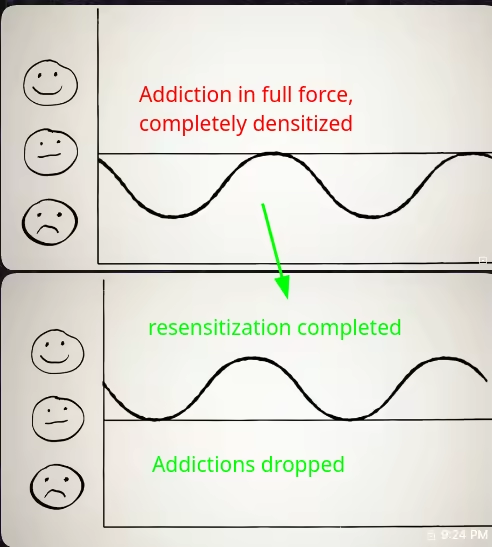
If you ask me, when looking at the problems in the world, the biggest problem of all the addiction to money, due to that one in particular it has become such a sick world, everyone should put in effort to starve off addictions wherever they can, otherwise we will keep on burning the world away until someone's insatiable greed destroys the world altogether.
Opus Nihil in action: Escaping the Addiction Cycle
Let's say you have 12 days ahead of you right now, and you pack your schedule to make the most out of it:
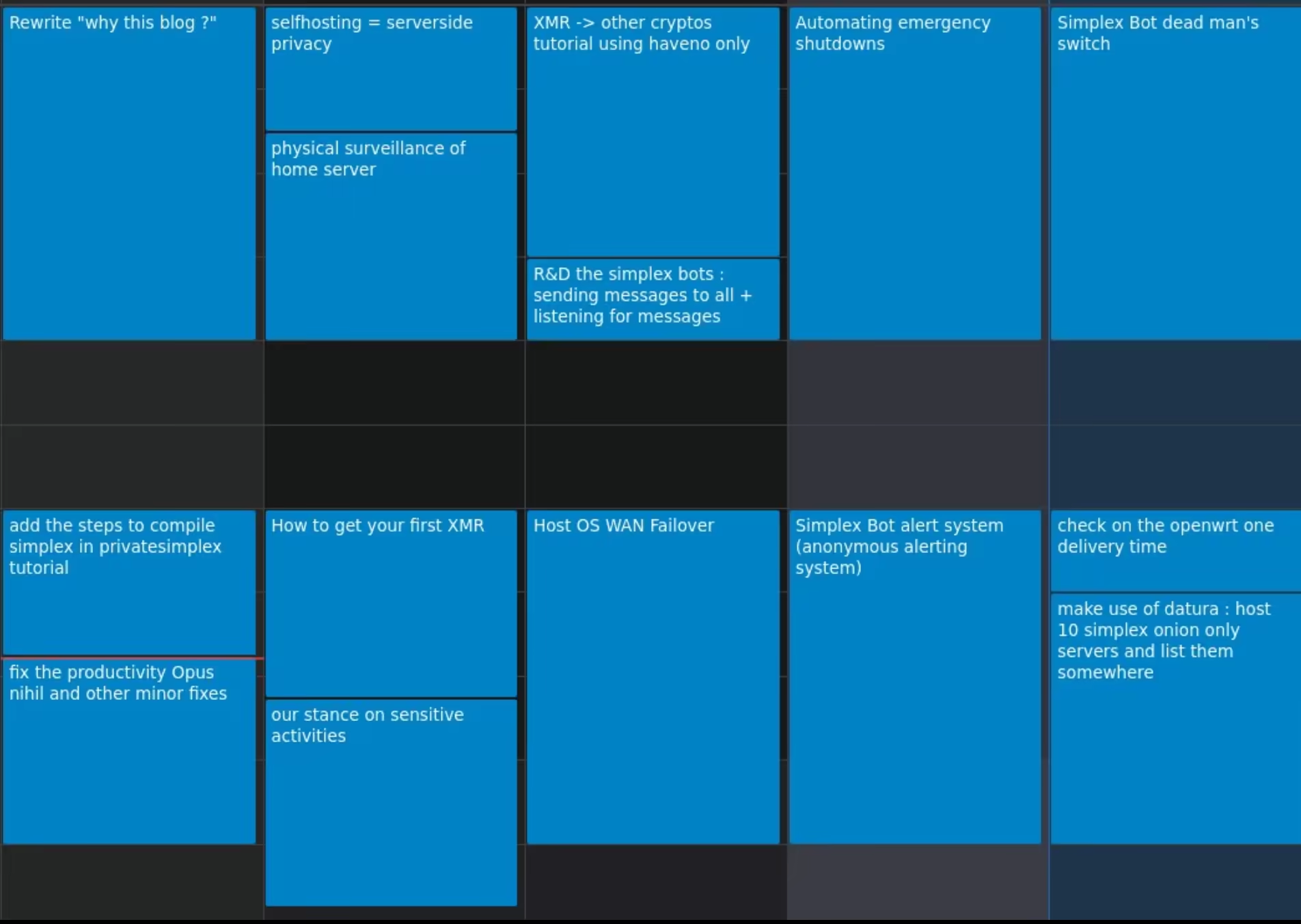
Great, you won't have any reason to be bored and indulge in any addiction whatsoever. In theory, it sounds nice, but if you have been addicted for years on a substance or on some addictive behavior like me (I've been addicted to playing way too much video games), But in practice your brain is going to want to escape the increasing discomfort of the grind you scheduled, to do something more relieving sooner or later during the day.
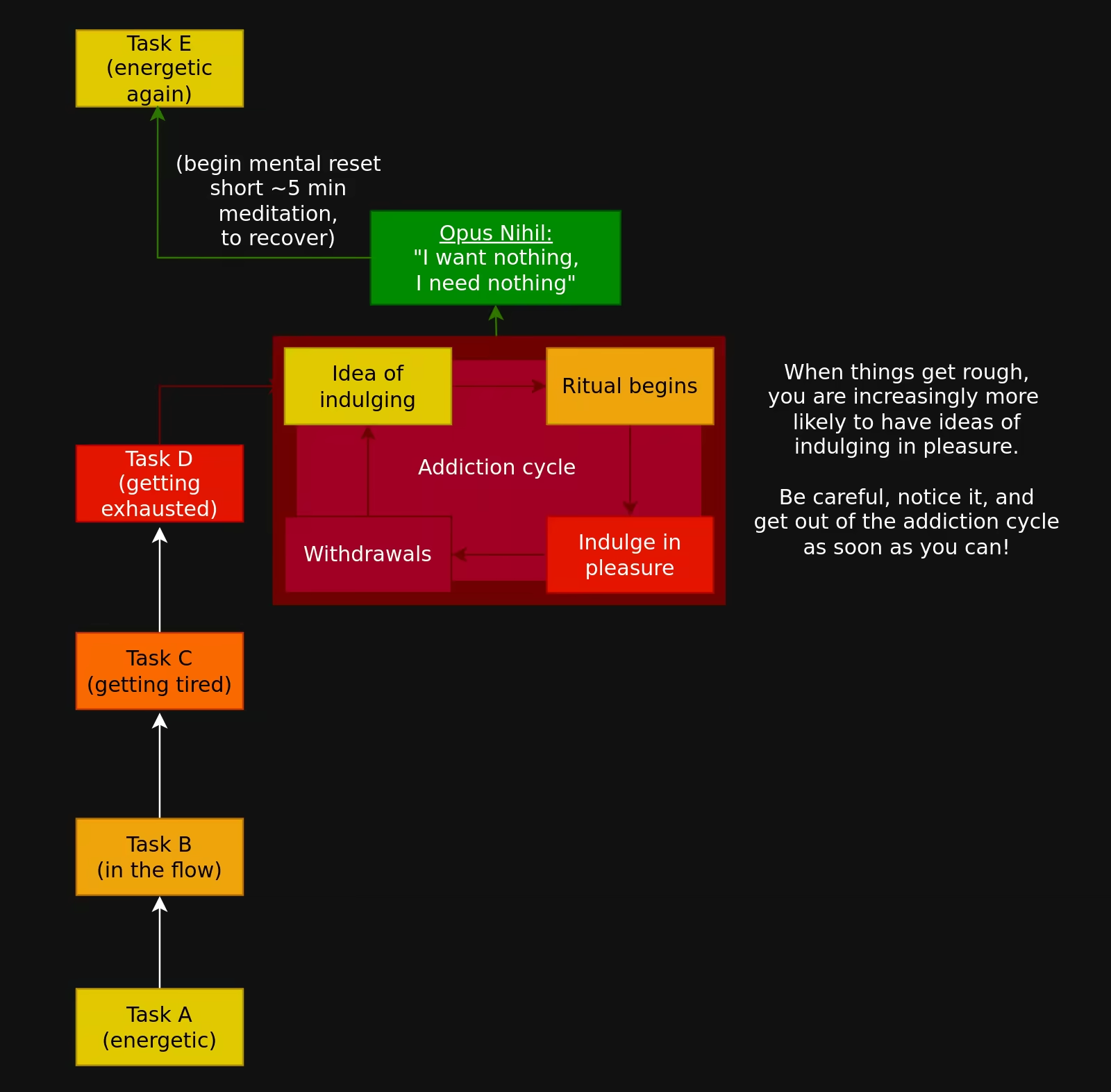
You start the day grinding. On the first task, you're fresh out of the cold shower, energetic and ready to roll. Once you completed the first task, you move on to task B, still in the flow you keep going. Moving on to task C you're getting tired, but you keep pushing forward. And now here comes Task D where you're getting mentally exhausted. The bigger the discomfort, the more likely you're going to want to escape the discomfort by indulging in some addictive behavior just to feel better.
Be extra careful when the discomfort is at its peak, as it is the sign that you need to rest and recover, so DO NOT indulge in an addiction. Indulging in an addiction can be as simple getting the idea, opening the web browser, typing the URL to a website, and opening it. Be aware of what the addiction cycle is, and especially that it starts as a simple thought in your mind:
"Man I really need [...]"
"Just one more time won't hurt"
"Just one last time, I deserve it"
"I need it, I deserve it"
"No one will know that I did it, it's okay"
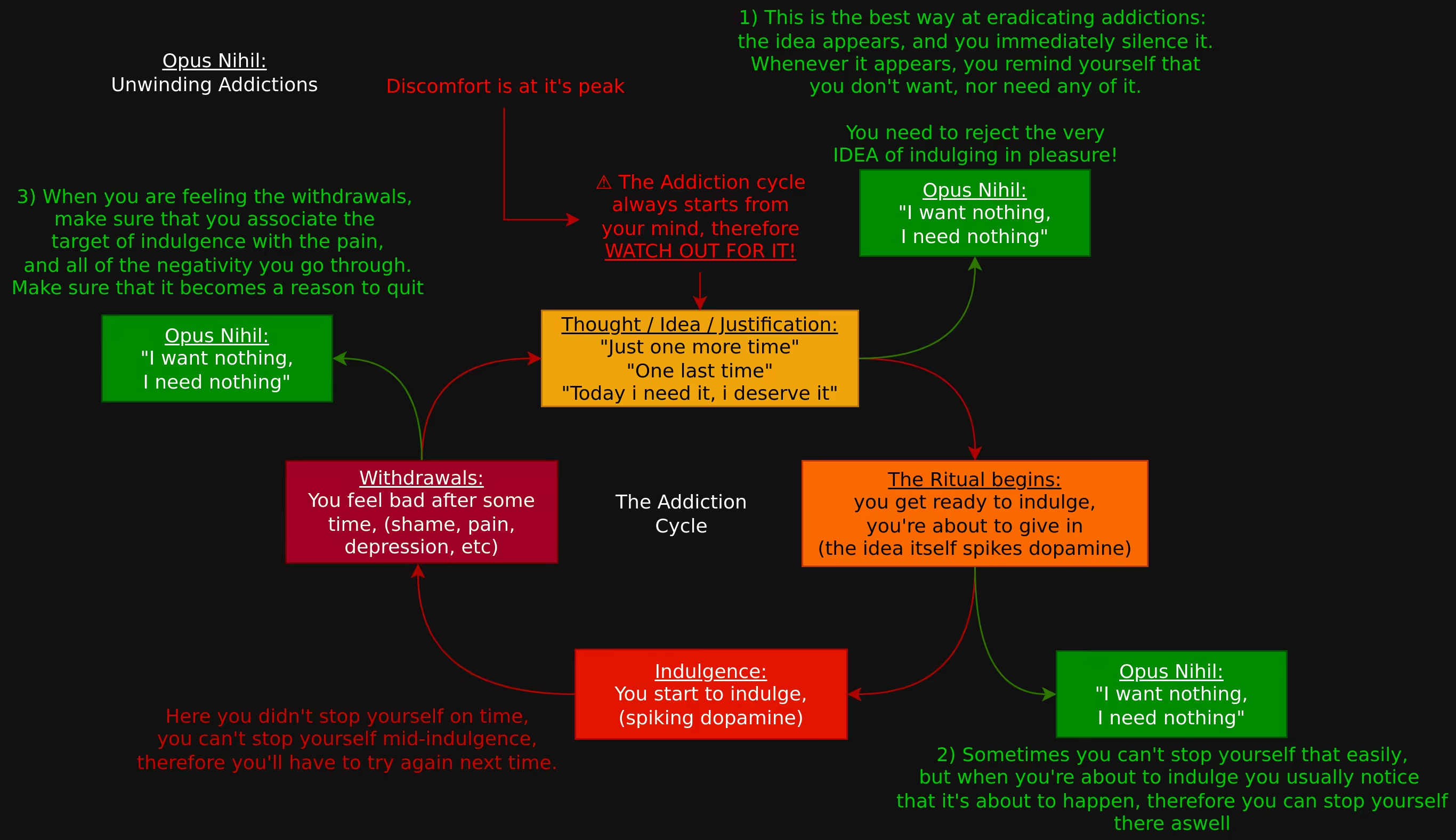
1) The best moment to do the Opus Nihil meditation is right after the idea of indulging in pleasure appears in your mind. Because you are actively rewiring your brain to a different thought pattern, and with enough repetition, your brain won't associate the idea of indulging in said addiction as a solution when facing discomfort. As explained above, the goal is to move from compulsive action to conscious action.
2) The next-best moment to do the Opus Nihil meditation is when the ritual begins, but indulgence didn't start yet. At first your mind is not trained enough to stop itself as soon as the poisonous thought emerges, and you may end up starting the ritual on autopilot (ex: starting to type the URL of the website in the browser), This is also a good place to start the Opus Nihil meditation, to dis-engage in the activity and stop it before it's too late.
If you don't manage to stop yourself on time and begin indulging in the actual addictive behavior, try as you might, Opus Nihil won't be able to stop it until you finish spiking your dopamine (aka feeling a lot of pleasure in one go). This is when it's too late to do the Opus Nihil meditation.
3) Lastly if your addictive behavior produces negative side effects (it can be shame, pain, depression, unrest, disease, or even cardiac arrest) Opus Nihil is also a good thing to do as you're going through the negativity, because you want to associate the addictive behavior / substance with the hell that you're going through at that moment, view it as a "fuck that, never again!" mode of thinking. It is a last resort at helping escape an addiction cycle, but if you're in one of the hardest addictions to quit like opiates, every little help you can get to get out of the downward spiral is a good thing.
Lastly, not everyone has the mental toughness to escape their own addictions on their own. Do not hesitate to some outside seek help if you can't escape addictions on your own (especially with hard drugs, in practice it's very hard to quit them). However, to successfully unwind addictions, YOU must want it. You must decide that you want to get out of the addiction cycle, and then you must implement Opus Nihil wherever possible to unwind the spiral as much as possible, until the self-destructing pattern is completely gone from your mind.
Chapter 12
Scio Nihil: Dissolving Beliefs
I know nothing, I know nothing else
In this tutorial we're going to take a look at the second Nihilism mantra that you need to know, as it is the one that will ensure you remain open to the possibility of knowing. It is used to trim away beliefs, to be able to undo all distortions that one may have upon his own perception.
One day, Aristotle was walking on the beach. A glorious sunset was happening, but he had no time for such petty daily events. He was thinking seriously about some great problem of existence, because for Aristotle, existence is a problem, and he believes he is going to solve it. Thinking seriously, he was walking up and down the beach. There was another man on the beach who was doing something very intensely – so intensely that even Aristotle could not ignore him.
You know, people who think too much about their own nonsense end up ignoring life around them. They are the people who don’t smile at anybody or even look at anybody in the world. They have no eyes to look at a flower, a sunset, a child or a smiling face – or if it is an unsmiling face, they have no inclination to make it smile; they have no such small duties or small cares in the world! They ignore all the life around them because they are all busy, solving the problems of existence.
But Aristotle could not ignore this man, and he closely observed what he was doing: this man was going to the ocean, coming back, going to the ocean, coming back, all with great intensity. So Aristotle stopped and asked, “Hey, what are you up to?”
The man said, “Don’t disturb me, I am doing something very important,” and went on and on.
Aristotle became even more curious and asked, “What are you doing?”
The man said, “Don’t disturb me, something very important.”
Aristotle said, “What is this important thing?”
The man showed a little hole he had dug in the sand, and he said, “I am emptying the ocean into this hole.” He had a tablespoon in his hand.
Aristotle looked at this and laughed. Now, Aristotle is the kind who can spend a year without a single moment of laughter, because he is intellect. It takes a heart to laugh. Intellect cannot laugh; it can only dissect.
But even Aristotle laughed at this and said, “This is ridiculous! You must be insane. Do you know how vast this ocean is? How can you ever empty this ocean into this little hole? And that too, with a tablespoon? At least if you have a bucket, there’s some chance. Please give this up; this is madness, I am telling you.”
The man looked at Aristotle, threw the spoon down and said, “My job is already done.”
Aristotle said, “What do you mean? Forget about the ocean being empty; even the hole is not full. How can you say your job is done?”
The other man was Heraclitus. Heraclitus stood up and said, “I am trying to empty the ocean into this hole with a tablespoon. You are telling me it’s ridiculous, it’s madness, so I should give it up. What are you trying to do? **Do you know how vast this existence is? It can contain a billion oceans like this and more, and you are trying to empty it into the small hole of your head – and with what? With tablespoons called thoughts. Please give it up. It’s utterly ridiculous.** ”
-Sadhguru 17/12/2014
Microcosm: What is it that you truly know?
Most people nowadays have given into the "I know it all" attitude, mainly due to the false identities they have taken up, which have reduced their perception of the universe, down to a very narrow view.
But tell me, what do you truly know? Words are just words, they can't possibly encapsulate the intricate complexity of reality.
If I mention the word "Apple", that doesn't mean I know what an Apple is, from the inside out, on every layer, with all of its intricacies. Nor do I know why exactly it is there in the first place.
I may know what an apple means to me, I can use it as food. But do I know what it is exactly? Cell by cell, down to its molecular structure, and it's subatomic particles?
Hell, do we even know what an Atom is, in its entirety? Do we even know why an Atom is 99.9999% emptiness?
Macrocosm: What is it that you truly know?

Alright, microscopically this is too complex. Macroscopically, how is it so?
Do you know how big that universe is? Do you know where it begins, where it ends? Or when it began, and when it will end?
Do you know which side is up? Hell, do you even realize just how huge our sun truly is? Or how small it actually is?
Yet, there has been times you have pretended to have known everything, didn't you?
Our perception of the world has narrowed for some reason, and we forgot about those things.
Besides, how can you truly know something when words are only arrows pointing at the ineffable existence.
How can you even arrive at that certitude of "I know it!"? And remain certain of it forever?
Nihilism: Dissolving Beliefs
Modern Nihilism, as I am pioneering myself, is a set of sentences, or mantras, to be repeatedly mentally thought of, in order to change yourself from within, this aims to alter your perception, your beliefs, and your actual sense of self.
Scio Nihil:
Inhalation: "I know nothing"
Exhalation: "I know nothing else"
(Sidenote: each mantra utterance must last the entire (intentionally slowed down) Inhalation/Exhalation, to silence the other thoughts)
We normally breathe 50% deep, to do the nihilism mantras effectively, you are supposed to breathe 2 times slower, and 2 times deeper (full inhalations/exhalation), AND the mantras you mentally utter need to last the entire duration of the inhalation, and exhalation
Warning: Do not mistake this for being pessimism, the goal is not to make you believe anything negative, the goal is to destroy all beliefs, INCLUDING those negative beliefs. It is in fact negative to believe something that you do not truly know, you should always remember that there is more to know, more to explore, more to discover, otherwise you'll start to believe that this world has nothing more to offer.
It doesn't matter how much you believe you know, in the end you're only believing you know something. Words cannot fully encapsulate the true depth and richness of our unfathomable reality. Knowing how to use something does not mean you know what it ultimately is.
These sentences are uttered out of the sense that no matter how much you believe you know, you ultimately cannot know more than an insignificant portion of the existence, if at all you are capable of knowing something.
When even an atom you are unable to know in its entirety, how can you ever pretend you know anything from there? It is a fundamental reality that people keep forgetting or intentionally ignore.
To bring back the awareness of your own ignorance is fundamental. To be able to know anything, one must first admit that they don't know. Those that pretend to know, for them the possibility of knowing is not even there.
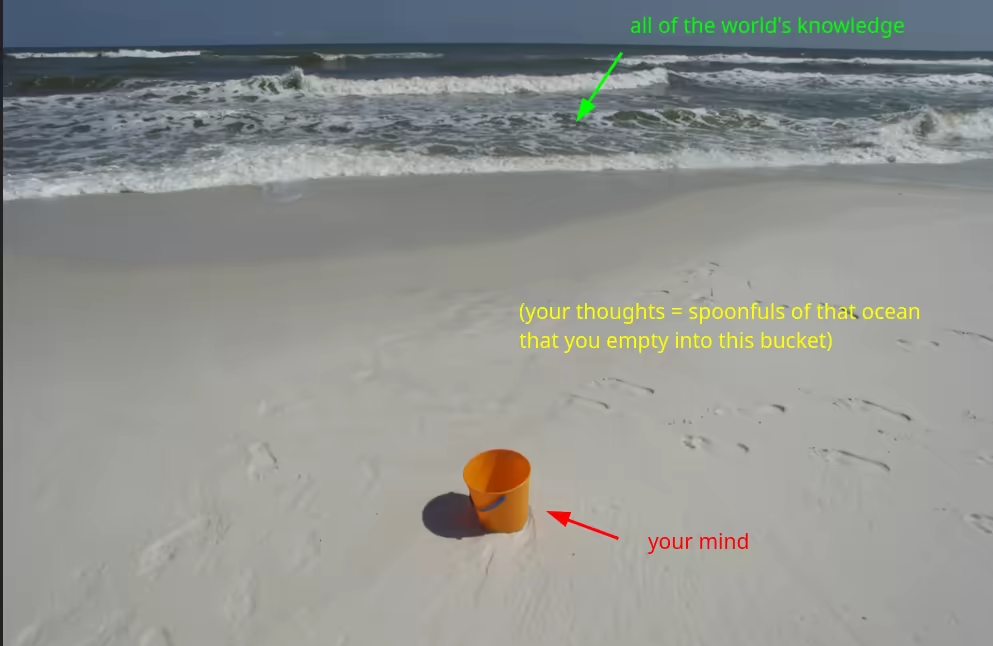
This mantra is not there to reject the possibility of knowing either, but rather it is there to remind you that there is always more to know, Like what was explained at the top with the Ocean and bucket analogy, your mind is like a Bucket, and all of the whole world's knowledge is like an ocean. Trying to empty that entire ocean into this bucket is a futile endeavor, isn't it? Yes it takes time to fill that bucket with spoonfuls of that ocean (which your thoughts are), so it may feel rewarding to have filled that bucket after some time, but the bucket being full does not mean that you managed to empty the entire ocean, that's not even possible in fact.
Once the awareness of your own ignorance is brought back into you, as a reality that you keep close to you every day, you'll feel a burning longing to know in you. It may be uncomfortable at first, but this is essential for your wellbeing, because otherwise you become arrogant, bored, uninterested, the more you become identified with what you think you know.
This is especially a detriment to your mental health if you start to believe that you know everything. If you start to think that there is nothing more to know, it means that you are rejecting the entire universe and it's countless possibilities. However, if on the contrary you are constantly aware that there is more to know, there will be wonder, curiosity, adventure, it will be impossible to stay bored! This mantra is there to make sure that you stop stagnating. There is always more to know, Always more to explore, Always more to discover, and you can't ever reject that objective truth.
Chess: Lessons in Humility
To practice staying humble you should try playing chess for a while:
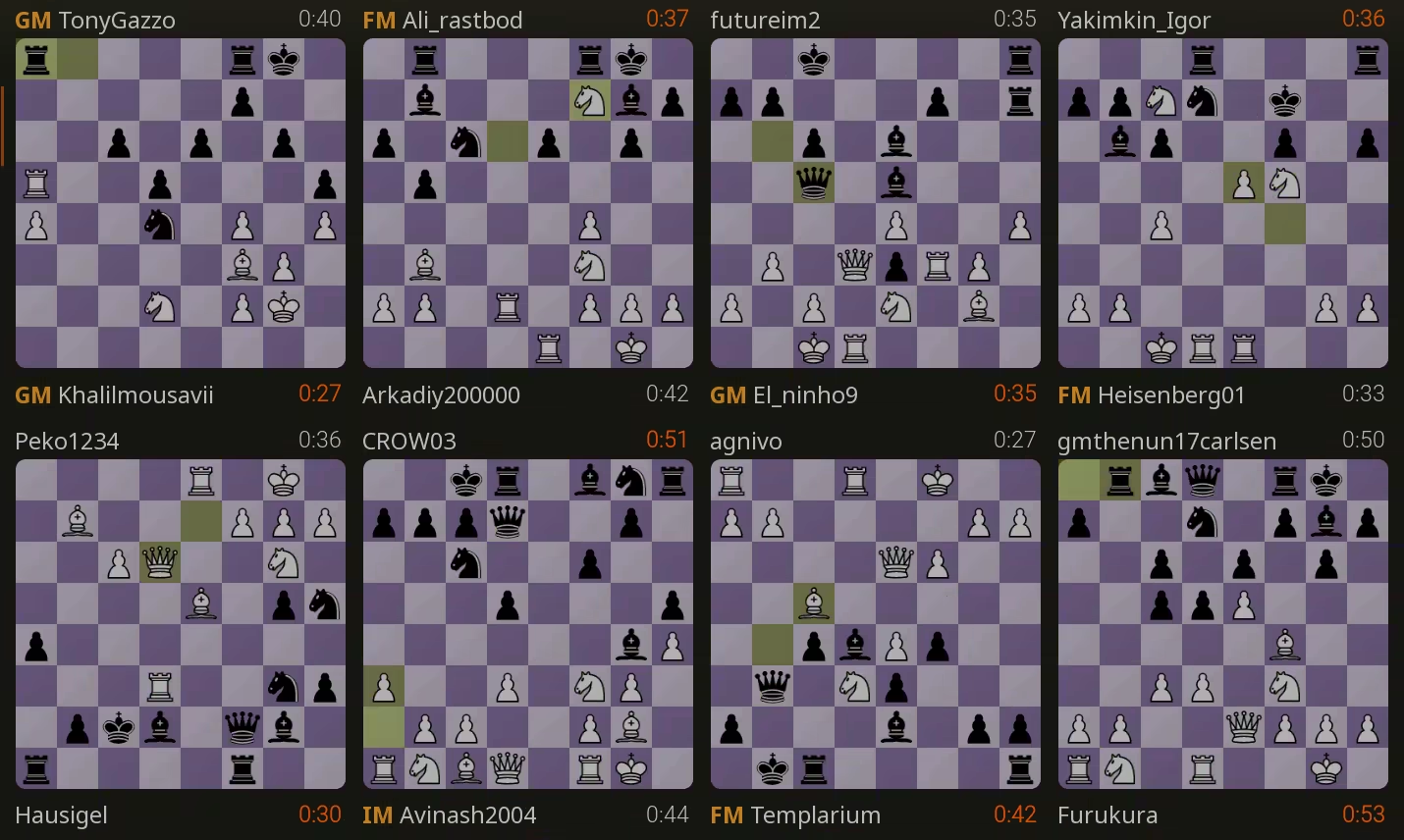
On the surface, chess looks trivial, 64 squares, a few sets of pieces, and whoever checkmates the other first wins. But when you start to dig into it, you'll realize that there are so many different skill levels in Chess, that you can spend your entire life trying to master it and still not attain 100% precision in every game.
The game is immensely beautiful by its sheer complexity, despite looking like a trivial game on the surface. The total number of possible games in chess is 10 to the power of 120, which is superior to the number of atoms in the universe. At times, you will be convinced that you are doing the right thing, but against a stronger opponent, your beliefs are invariably going to be shattered, leaving you scrambling to find a way out of your own mess, many times in disbelief.
A little reminder that there is always more to learn, always a new niche technique and pattern to learn, some of which can be truly challenging to comprehend, and remember. So don't hesitate to sign up on Lichess, play some games and get better at calculating and pattern recognition by doing your daily chess puzzles.
You may win over 10 noobs and call yourself the best, but when a real pro comes in and teaches you a lesson, not everyone has the humility to sit down and listen, especially if their ego is in the way of their own improvement.
In short, there is always something more to learn, and since you do not know when lightning is about to strike, you need to remain open to the possibility of learning and knowing more at all times. Stay aware of your own ignorance at all times, because staying humble is what will allow you to remain grateful when your beliefs are being destroyed, Returning to reality is the goal, not leaving it.
Chapter 13
Sum Nihil: Dissolving the Self
I am nothing, I am no one

In this tutorial we're going to take a look at the third nihilism mantra, which the most important one. Its purpose is manifold, where you are trimming away all of the false identities you have picked up, releasing your intellect from being a chaotic mess, and undoing the remaining perception distortions you may still have, to restore the clarity you once had.
Just because it’s sharp, it does not mean it’ll be effective because sharp intellect or a sharp knife can cause any amount of damage to you.
If you have a sharp knife and you don’t have a steady hand, you will cut yourself all over the place.
That’s all that’s happening. Human suffering is just this.
You don’t know how to hold this intellect in your hand properly. Every day, you’re cutting yourself.
All suffering is on self-help because your own mind causing this to you all the time.
No matter what happens, people suffer, whichever way, they suffer, because they don’t know how to hold this intellect.
If you had the mind of an earthworm, you would be quite peaceful, yes?
You’re trying to do it in so many ways to reduce the sharpness of the intellect by drink, by drug, by overeating, by doing all kinds of things,
somehow to take away the sharpness because the damn thing hurts.
It hurts not because that’s its nature; it hurts because you do not know how to hold it.
As the intellect is the knife, the identities that you have picked up are the hands that wield that knife.
Which is more important?
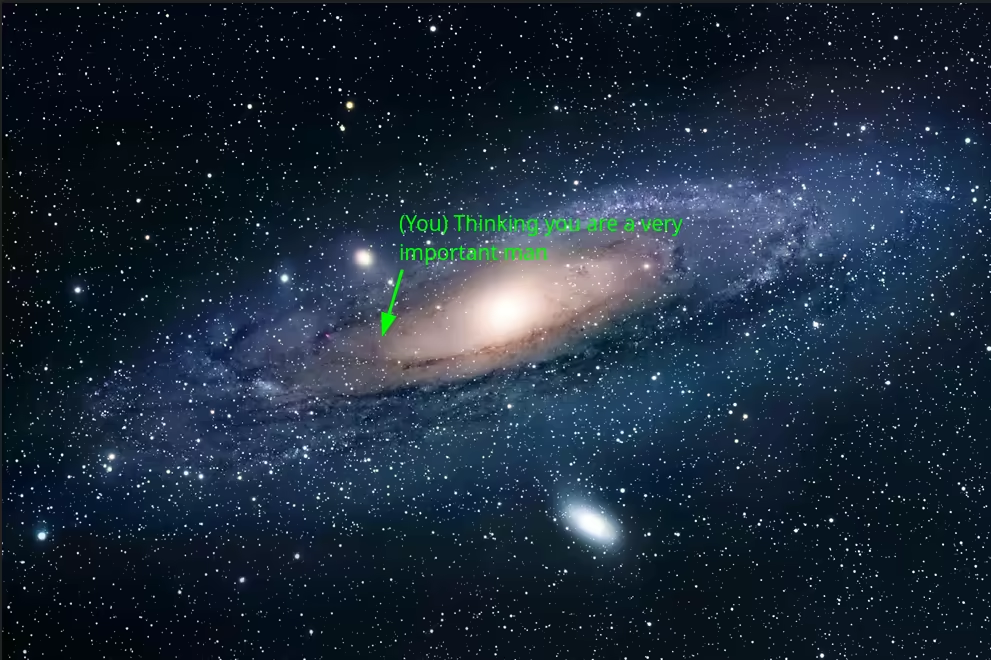
There is a reality everyone seems to forget, a context to be more precise:
Do you know how big this universe is? Do you know Where it begins, and where it ends?
So in this Vast universe there are a few grains of sand that you call the Milky Way
in these few grains of sand you have got some microscopic particles of that cosmic sand you call the solar system
In those microscopic particles called the solar system, there is a supra-microscopic particle called planet earth
Step down from your high horse, a little cosmic wind happens and your entire world as you currently perceive it just evaporates. All of those things you believe are very important, your family, your work, your house, your wealth, all those things you identified with up until now, these are all minuscule and insignificant happenings in the grand scheme of things.
Are you truly special?
"Alright, I'm a small happening in the grand scheme of things, but there's no one else like me! Right?"
How many trillions of humans have walked the earth before you? Tell me, do you think you are doing anything new?
Humans have done just about anything for survival, for pleasure, and for control, since the beginning of time.
Just like you and me they were all born, they worked, they reproduced, and they all died at some point.
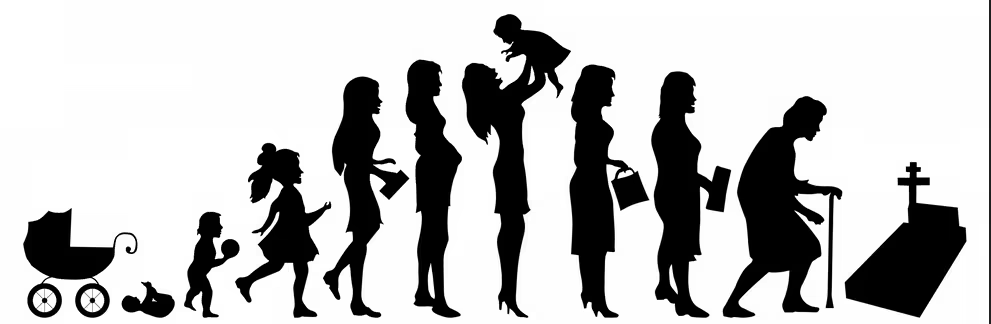
They all did what they had to do to survive, they reproduced, they got themselves a place to live in, and then they died.
How are you different, from all those people? Take a good look at the reasons behind what you are doing currently.
As far as I'm concerned, more than 90% of the people on this planet are all doing things for their own selfish interest, one way or the other. Be it for Survival, Pleasure, or Control.
For someone to start acting outside of their own interest, it takes that someone to put himself out of the way of his own actions
Who / What am I?
We as humans we are able to accumulate many things. We accumulate money, we accumulate trophies, we accumulate movies, whatever staircase we have found we try to have just one more.

All of that effort to try and accumulate more and more of something. Tell me are you going to be able to carry all of it from this world to the next?
No you're not even going to be able to take a small needle with you after you die, everything you try to keep to yourself you will anyway have to release it sooner or later.
Let's say you are a very successful businessman, your staircase is to accumulate money, by selling oil. You managed to become a millionaire, and you have all of the money you'd ever need for multiple lifetimes.
Luxurious lifestyle, Lamborghinis, house on the beach. From society's standpoint life is settled and you've got everything. Now the neighbor is a multibillionaire with a much bigger house and 4 Lamborghinis, for some reason you're not satisfied anymore with what you have isn't it?
All that is happening is that you are looking at life from the minuscule keyhole vision that society prepared for you, and you believed that was all there was to it.

You are not your house, you are not your Lamborghini, you are not the clothes you wear, you are not that sum of money, you are not even special in the end.
The body is a heap of food, and the mind is a heap of impressions. Back when you were 3 years of age you had a small heap of food, and a small heap of impressions
And now 30 years later you managed to accumulate that big of a heap of food, and that big of a heap of impressions.
But you are not what you accumulate. So you have Sadhguru's Isha Kriya Mantras:
Inhalation: I am not the body
Exhalation: I am not the mind
Human suffering happens either in the body, or the mind. On a daily basis, if you distance yourself from both, this is the end of suffering for you.
Effectively to my amazement it lifted off the depression I was going through, like a weight had been put down from over my head. Since then (more than 10 years ago) this practice has never left me, I kept practicing it on a daily basis and refining it more and more, to keep trimming away more of everything that I didn't need to have on my mind.
The mantra below is the result of that rewriting of the mantra over 50 times over all those years, to make it as efficient as possible, and I am quite proud of the result frankly.
Your Staircase of Improvement
You have been thrown into a reality into which you were supposed to arrive at a great destination, but every path that was presented to you has been nothing but leading back to square one. You have been intentionally misled, to make sure that you don't go anywhere and keep slaving your life away.
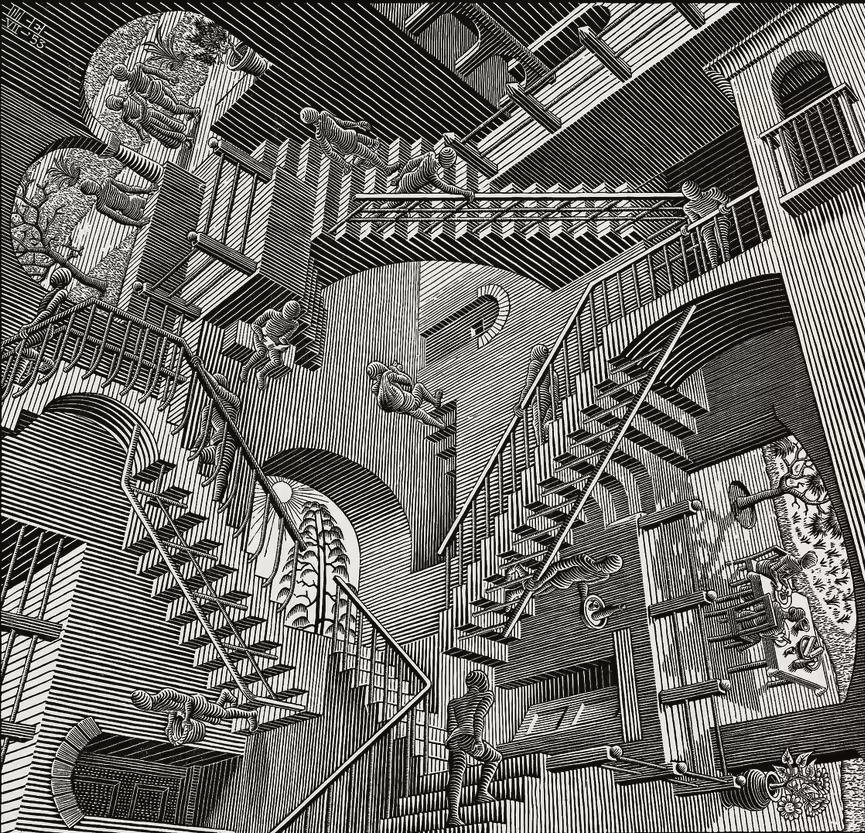
You have been shown many staircases over your life already. You have been told to get better at school, You have been told to get better at High school, you have been told to get better at college, then afterward you have been told to get better at work, then you've been told to get better at hoarding money, getting a house, a Lamborghini, maybe you've been told at getting better at feeling pleasure with hard drugs, What staircase am I supposed to go up in the end? What path should I take?

This is all you are doing when you are seeking fulfillment from outside. You are getting the illusion of going up, but in reality you are going nowhere. You are going in circles. If the destination is all that matters, you are invariably walking those Escher staircases that are filling this dystopian modern world, leading you astray, making you stay mediocre, stagnant, and obedient.
You were supposed to make a great journey, not walk in circles. You were supposed to walk in a straight line, without ever deviating from it. Every deviation from the true path of your own evolution is a path of self-destruction. However, where do I go, in which direction? If all you can see is your inflated Ego, you will never know in which direction you are supposed to go. All you will keep seeing is how to protect that very important Ego, in this Egotistical world.

There exists a staircase of improvement, a path that you are meant to take, sooner or later. It is the path of your own evolution. Like a bird in a cage, you were meant to fly and soar up in the sky, but you have grown to like the cage, you have gold-plated the bars, even though the prison door was left wide open.
That staircase of improvement is hard to walk, it is never coming back down for a break. It simply goes up, and up and up and forever up, it requires you to continuously dissolve your old self, to be able to take the next step.

Is it madness to constantly evolve, constantly dissolving what you currently are, so that you may become the one you were meant to become? Or is it madness to remain stagnant, walking in circles within the drawn lines of society, up until you die?
I used to be a video game addict, I dumped more than 9 thousand hours into one video game, all in the name of my ego. If that ego of mine remained the same up until now, I wouldn't have started this blog, I wouldn't have talked about how to become productive, about how one could protect and free themselves from tyranny, nor talked about how to lead a fulfilling life. I could have stayed the same, stagnated, kept going in circles, achieving nothing in my life, staying mediocre. I could've kept spiraling down that heartless, poisonous, pointless, endless path of pleasure seeking.
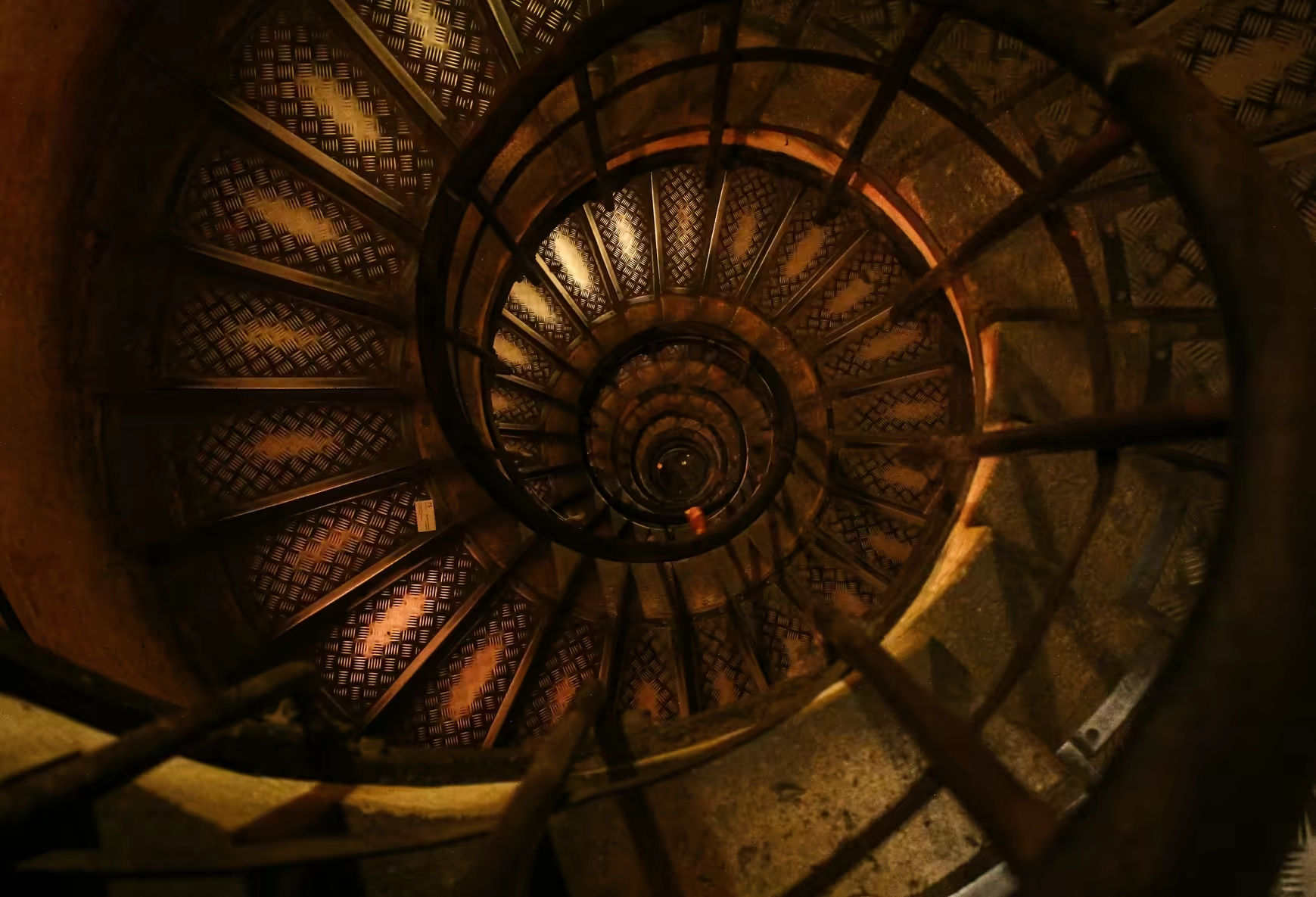
I looked at my life, I looked at what I was doing, I asked myself why I was doing these things, none of it made any sense. I was doing things without understanding why I was doing those things. It was only up until I started destroying this ego of mine, every single day that I realized I was going in the wrong direction. All I was doing was protecting this worthless ego of mine, Ultimately going nowhere.
It was only up until I destroyed that ego of mine, that I could see beyond it, I realized that every staircase people were walking, were going nowhere. And so was I.
So I started seeking that staircase of improvement of mine, and after a long while (5 years almost) I finally found it: How to use technology to liberate individuals from tyranny. That's when I started to explore that operational security topic, dedicating all of my free time into it. It is not possible to have such a goal in your life, let alone conceive it, if all you care about is yourself and how to protect your insignificant ego. It is a matter of being able to act out of selflessness, because this is the most fulfilling way to live.
By the time to leave this world will come, I aim to have continuously evolved every single day, to have lived the equivalent of 100 lifetimes, all compressed into one. I aim to lead the charge to try and change this world for the better myself, by empowering every individual out there to free themselves from governments, It's inevitable anyway, so I'm here to make the sovereign individual evolve into what it was meant to become, and make it become that right now. I am now shamelessly going into that direction, because I know that this is the path I was meant to walk. It is because it is absolutely clear to me, where that path leads to, that I refuse to ever deviate from it. Even if I may not be able to attain that distant destination in my lifetime, I aim to give it a solid shot, enough to inspire others to pursue that same path.
Nihilism: Dissolving the Self
Modern Nihilism, as I am pioneering myself, is a set of sentences, or mantras, to be repeatedly mentally thought of, in order to change yourself from within, this aims to alter your perception, your beliefs, and your actual sense of self.
This is to be practiced with your eyes closed, as otherwise the outside may distract you. It is a matter of focusing on what's happening within you, as this is where the change must happen.
As the identities are the hands that wield the intellect, the more identities you pick up, the least able you are to stop yourself from thinking. That's why it is essential to dissolve those identities, to release the intellect from being handled haphazardly.
Sum Nihil:
Inhalation: I am nothing
Exhalation: I am no one
(Sidenote: each mantra utterance must last the entire (intentionally slowed down) Inhalation/Exhalation, to silence the other thoughts)
We normally breathe 50% deep, to do the nihilism mantras effectively, you are supposed to breathe 2 times slower, and 2 times deeper (full inhalations/exhalation), AND the mantras you mentally utter need to last the entire duration of the inhalation, and exhalation
Warning: Do not mistake this for being pessimism, as the goal is not to make you identify with something that is degrading, the goal is to destroy everything that you can possibly identify with. It is in fact degrading to identify with anything, you are not supposed to restrict your near-limitless potential to such a small scope.

This mantra is designed to trim out and get rid of all the false identities you have picked up, the first thing you may notice after using this mantra for a while, is that you are able to sit still without a thought in your head. If you have gone on for years without having been able to stop your thoughts like I used to be, you'll see that this is going to feel like a huge relief, like a weight has been put down from over your head.
You'll see also that it is very easy to fall into the trap of getting identified with things that you are not after that, which is why this mantra is to be practiced very often, to be able to maintain your mental clarity. Over time, you'll need to do this less and less as your mind gets used to it.
If you try to do this mantra extensively for more than 10 minutes, you may even experience Ego Death (as this is the actual goal of this mantra), here is the description from effect index to highlight what it feels like:
Ego death (also known as ego suppression, ego loss or ego dissolution) is the temporary experience of a partial or complete disruption of a person's sense of self, which often results in a range of profound changes to how the person perceives and interprets their own sense of identity and the nature of agency and self-hood.
[...]
there is a profound experience of no longer having an “I” experiencing one's sensory input; there is just awareness of sensory input as it is and by itself without a conscious agent to comment on or think about what is happening to it.
Ego Death is actually paramount for your mental health, and I recommend you that you undergo Ego Death at least once a day, using the Sum Nihil mantra. It will bring a feeling of rejuvenation (or cognitive refreshment), suppression of personal bias, overcoming fears (such as of change or death), as you undo the distortions of perceptions, you'll be able to perceive yourself and the world for what it truly is, and thus, you'll feel way more open to experiences that your Ego would have otherwise previously discarded.
If god appeared before you right now, would you have the sense and humility, to realize that the source of creation is right in front of you? Most people are so deeply entrenched into their own ego, beliefs and compulsions, that even if the best thing were to happen in their lifetime were to happen to them right now, they would not acknowledge it, recognize it, and appreciate it for its actual value. It is in restoring absolute clarity of perception that you undo that poison. It is only with clarity that if god were to appear in front of you next moment, you'd immediately realize it and make the most out of it.
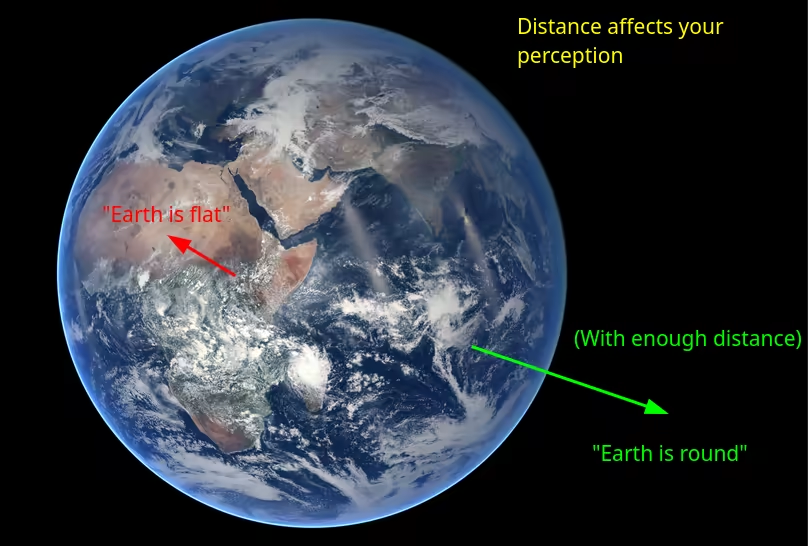
In the same way, if you spend your whole life on the ground over time you'll end up thinking that the earth is flat, but if I put you in a space rocket to go up in space far enough, with enough distance you'll be able to perceive that the earth is round.
To distance yourself from your thought process is essential to have clarity on what it is doing, and to have clarity on what it should be doing as well. Yes we're talking neuroplasticity, you don't need to be taking psychedelics anymore with this mantra. With this you are effectively rewriting your way of thinking, trimming out the unnecessary patterns, leaving room for the ones that truly matter to you.
While it is true that taking 10 grams of psilocybin mushrooms at once will induce an incredibly strong psychedelic experience and cause an absolute ego death 100% of the time, but you should remember that you are supposed to remain the master of your own mind, and that mind of yours is able to undergo ego death on its own if you choose it to do so, using this mantra.
Anonymity, when you don't matter anymore.

Suppose you want to start your own blog like I did, what are you doing it for? What is the reason behind it? Are you doing this out of self-interest, to grow your fame a little, to get recognition, applause, external validation, squeezing money out of your viewers, or perhaps improving your CV for your IRL career? Or are you doing it because this work needs to be done?
Who are you? Are you someone that works for personal gain? Or are you someone that works because the work needs to get done?
This also means that they are not looking for fame, recognition, applause, external validation. Actual truth seeking leaves no room for egocentrism.
Actually, is money even money at all when it is tied to your name? Isn't it tainted with lowly personal gain intentions all over? Anonymous money is the purest form of money, as it is free from lowly personal gain aspirations, and it is money that you actually own, it is 100% yours. While the money you have in your bank account is not even yours, it belongs to the bank, which can seize it or terminate it whenever they feel like it.
Think for a while to reflect on the reason behind your actions, are you going to remain immature your whole life, trying to preserve your meaningless fame, and public image? Or are you going to start doing things not for personal gain, but to change this world for the better?
Chapter 14
Strategies to unwind addictions
In this tutorial we're going to explain strategies anyone can use to unwind addictions. We're going to assume that you have an addiction that is really difficult to quit, for example let's say heroin, meth, porn, social media, video games, etc.
Addiction is essentially running in circles, you are not going anywhere. At first when an addiction begins, it is easy to recognize it as such and to unwind it due to how small the circles you're doing:
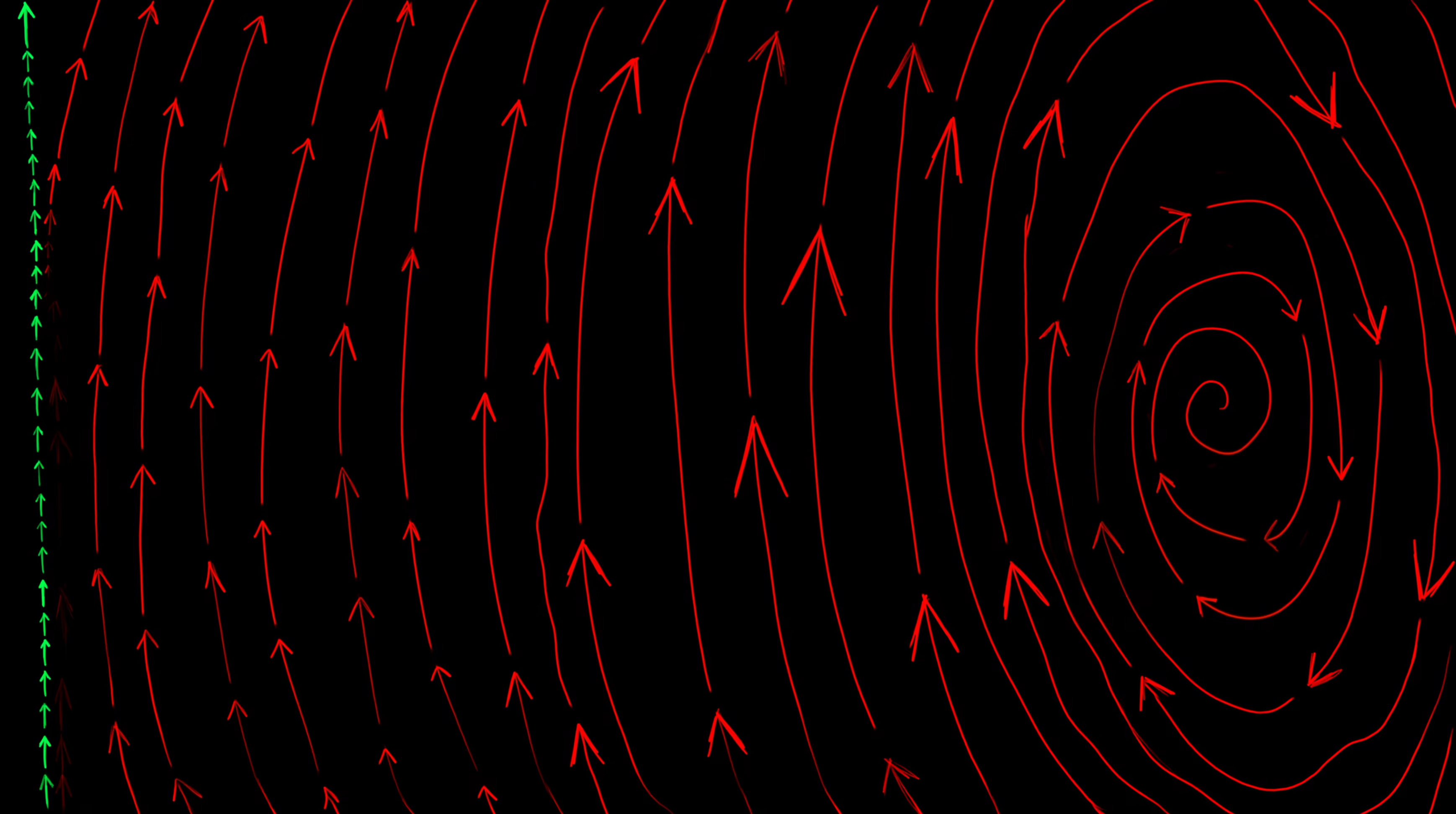
When that is the case, maintaining an iron will using Opus Nihil may not be enough, you're going to need every little support you can get to effectively unwind the addiction
Strategy 1: Logically recognizing the addiction as a waste of time
For me, my addiction used to be video games. I've been down that rabbit hole for so long without even wanting to stop it that the spiral was truly gigantic.
To lead a fulfilling life, you need to genuinely act to better the world.
Either reason should be kept in mind throughout.
Strategy 2: Rejecting the Idea itself
```
- 01
Just one more time won't hurt
- 02
Nobody's there, I can do X now
- 03
What if I did X?
- 04
How about doing X?
- 05
I've had a bad day, I deserve to do X now.
- 06
I really deserve X now, I've had enough.
- 07
It would be awesome if X
- 08
I want to do X
- 09
I need to do X
`` OPUS NIHIL MANTRA: I want nothing (inhalation) I need nothing (exhalation) ``
This is meant to train your mind REJECT the idea that you either want or need to indulge.
You have to get better and better at this, because without self-control you'll never be able to stop the addiction. Think of it like lifting weights, at first it's hard to lift 50 kg at once, but if you keep lifting often, at some point you'll be able to lift 100kgs. It's just a matter of practice, and getting used to it.
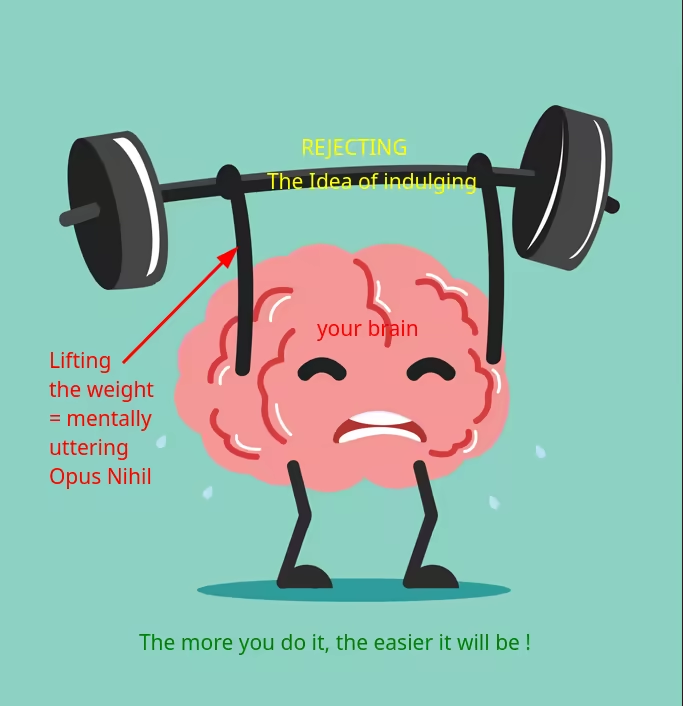
Strategy 2: Procrastinating addictions and coming up with Excuses
If you try to beat an addiction by doing absolutely nothing, you're going to realize that it's very hardcore.
You NEED to remain relatively busy when trying to beat an addiction, and replacing your addiction with another activity is a good way of always giving yourself reasons to NOT do it.
But really any reason is a good reason to replace the thought of indulging in an addiction with something else.
- 01
I can't do X, because I need to do Y instead
- 02
I can't do X, because I want to do Z instead
Strategy 3: Slowing it down is also progress
Failure is part of the process, It's okay to have a few bumps on such a long road, the only thing that matters is that you're going in the right direction.
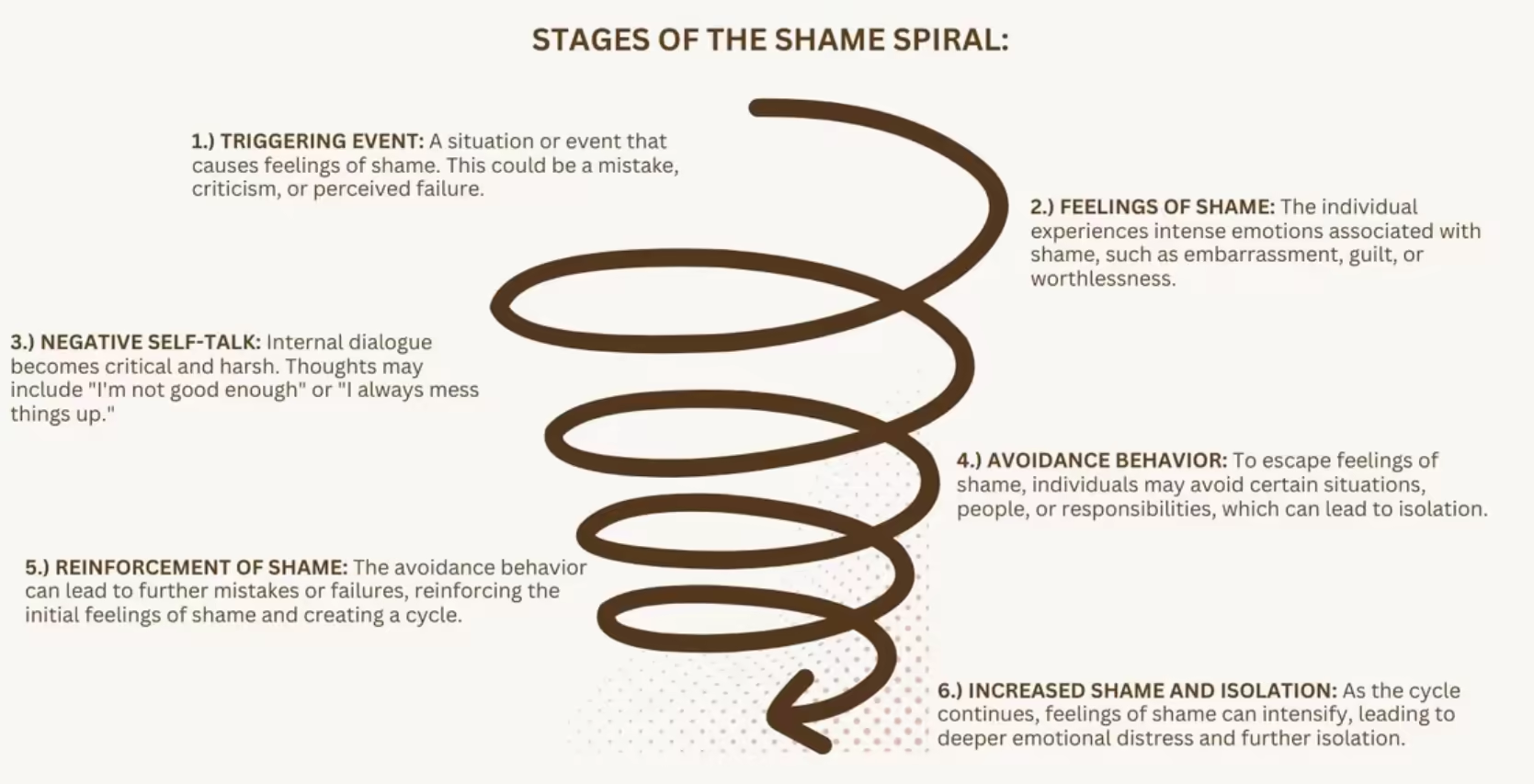
Let's say that you are at your lowest point right now, Indulging in your addiction 3 times a day, see if you can slow it down to 2 times per day tomorrow.
The next day you managed to slow it down to indulging only once per day, no shame to be had there either, that's also progress.
If you manage to get yourself to space it out to 14 days you'll be able to implement the next strategy 4:
Strategy 4: Make it hard to obtain it
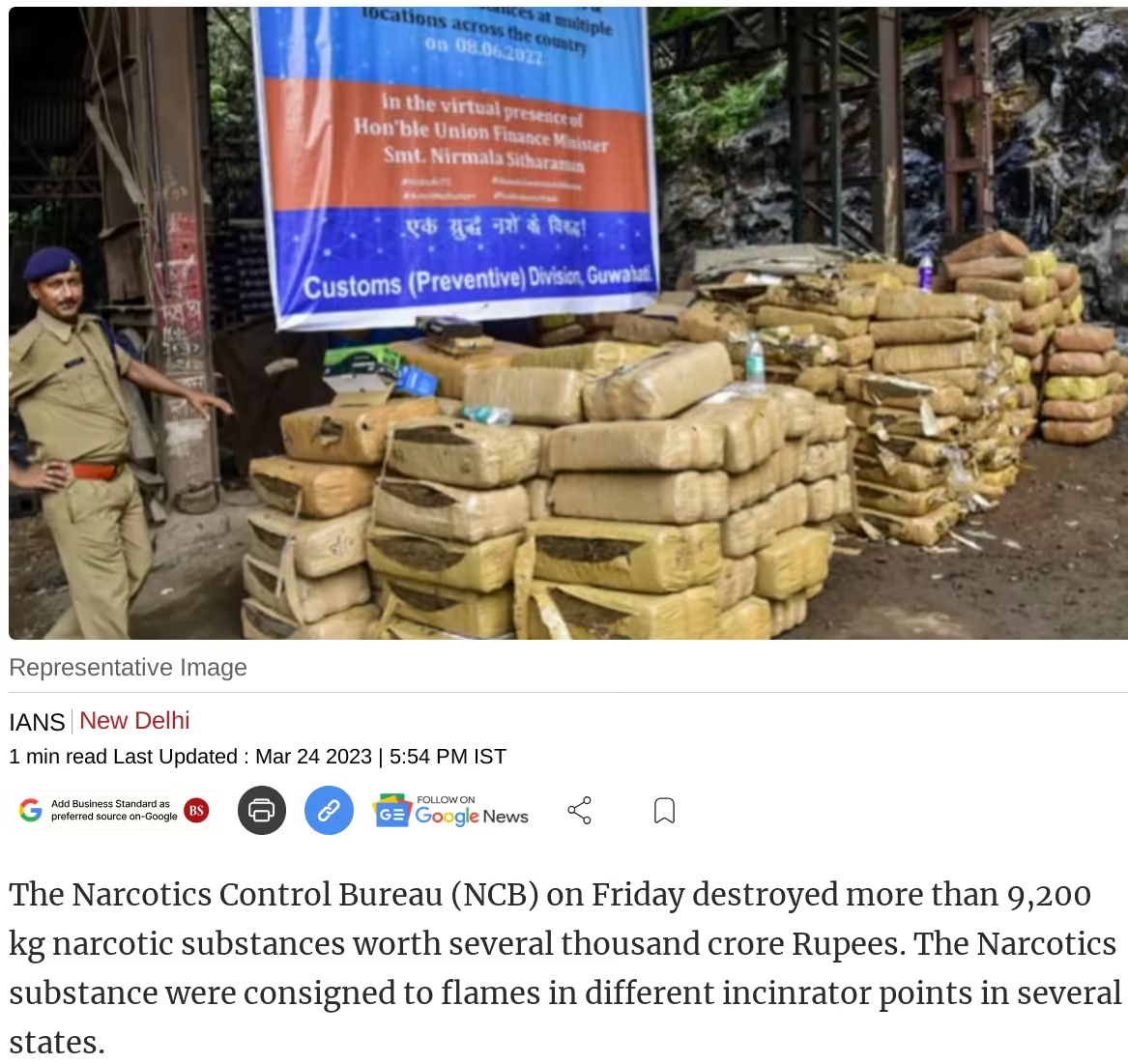
It can also be in the form of destroying what you need to access it, for example erasing the user and passwords you stored on KeePassXC to access the DNM to buy the substances.
The very chance of obtaining it again must be as hard as possible, even if you were to try your hardest to get it.
However, if the addiction is digital in nature, like for example accessing adult sites, I recommend trying to block the related websites on the VPN + DNS level like so:
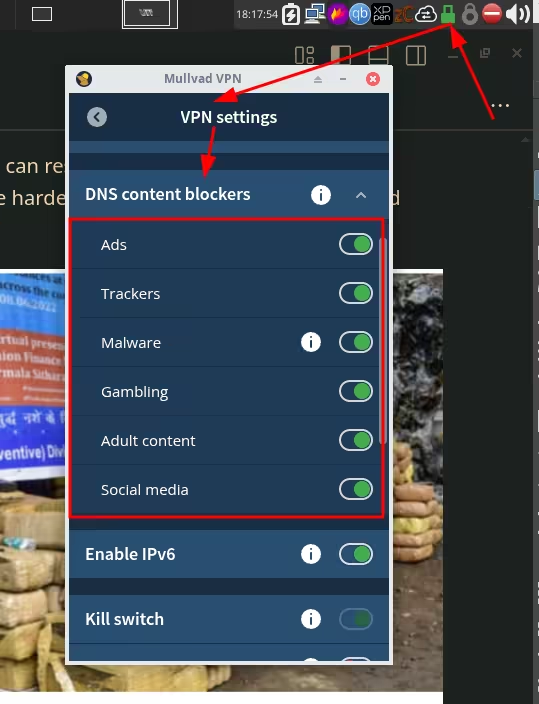
While it can be disabled if you want to, it still makes it harder to access, so in case if you're too tempted, you'll have more time to realize that you're going in the wrong direction.
Strategy 5: The "1 week effort" mindset
Your mind is not able to comprehend the enormity of forever, it's boundless so mentally uttering it would mean that you're READY to fully abandon an addiction.
That's why you need to keep in mind a short timeframe, something that you can actually see yourself achieve.
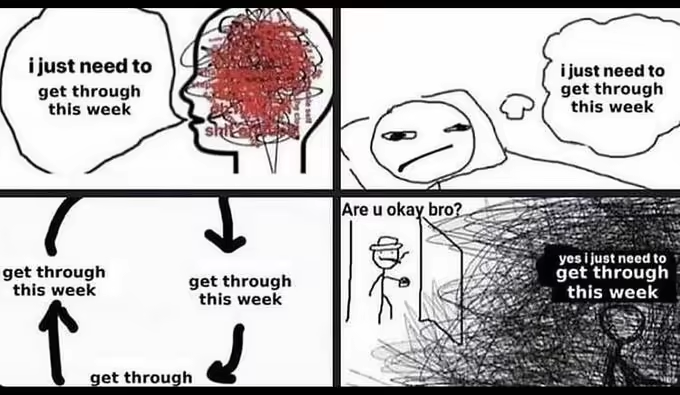
One week is a good enough timeframe for most people. Let's say you manage to keep yourself busy for the whole week, and when the next week begins you AGAIN mentally decide to not indulge this week either.
`` -Week 1: Hard to get through, high alert to not indulge -Week 2: Less hard to get through, high alert to not indulge -Week 3: Doable to get through, but need to stay vigilant to not indulge still -Week 4: Easier to get through, but need to stay vigilant to not indulge either -Week 5: Easy to get through, BUT YOU MAY FORGET TO REMAIN VIGILANT AND RELAPSE! -Week 6: Easy to get through, BUT YOU MAY FORGET TO REMAIN VIGILANT AND RELAPSE! `` As time goes on, and you manage to get through the weeks, you'll realize that it gets easier and easier to resist the addiction.
But the trick is that if the addiction was strong for a long time, if it can't get to you through the front door, it'll also try to get through the windows, through the back door, through the roof, etc.
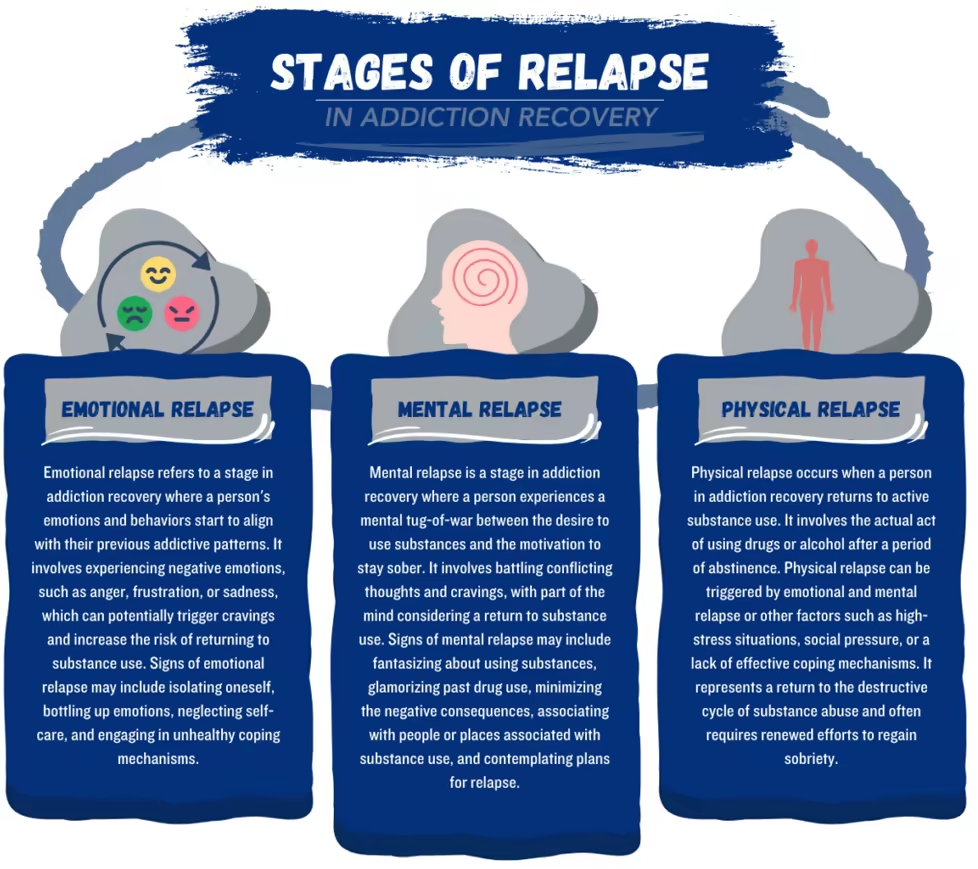
Always remain ready to reject the thought of indulging, as it may still appear at random 3 months later, 8 months later, 2 years later, etc. Stay in shape!
Strategy 6: Consolidating Discipline
So life is good again, you managed to stay free of addictions for months at this point. Do you begin slacking off on the couch again? Do you take your new life for granted? Do you give in to laziness again?
No excuses. No whining. No "I'll do it tomorrow". No "not today". There are no days off. There's no avoiding it. There's no escaping it.
Today's a Saturday, it's the apocalypse out there, the blizzard is going strong, minus 50 degrees outside, you had a long day of work yesterday chopping logs, your wife just filed in for divorce, your pet dog died freezing outside, you just lost all your crypto in a dumb bet on Wall Street, North Korea just sent nukes onto Washington and No, you still don't have an excuse to skip that morning ice-cold shower.
In that cold you're cementing the foundation, investing in yourself, becoming tougher, you go in there because you want to make a statement. You're not letting this weak you decide. You're telling that weak self to go suck it up and man up, with a daily reminder.
Of course nobody, at first in their right mind wants to do that. But that's the point. Hidden behind the discomfort of that cold exposure are 3 rewards:
- 01
doubling your mental energy baseline for the day,
- 02
training your body to generate heat. (making your brown fat more dense)
- 03
overcoming your first challenge of the day, and being victorious at it.
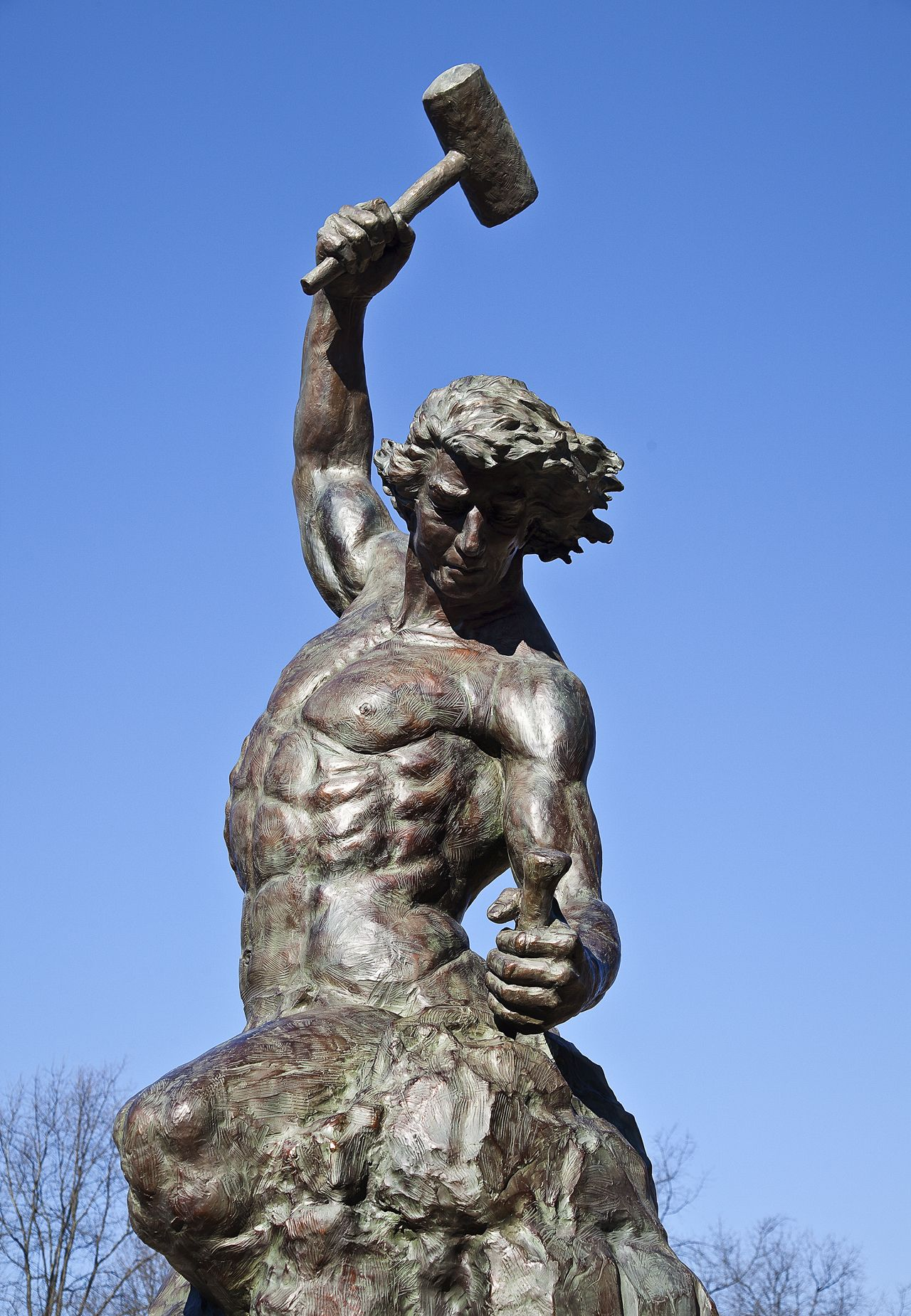
Realize that you don't truly want, nor need anything.
Anything that the world needs you to do, you can start to do it right now. Today.
The only one stopping you from doing what you were meant to do is this weak you. Put that weak self back in its place every day without fail.
Chapter 15
Cold Exposure: Where Discipline takes over Comfort

What the body and mind don't want, but actually needs. The perfect discipline practice.
The benefits of Cold Exposure
There is a common misconception out there, that cold is bad, because supposedly it makes you catch colds. But reality is that the cold is what you need to expose yourself to, to be able to reinforce your immune system, to prevent yourself from falling sick, such as catching colds.
Cold exposure has a significant impact on metabolic health, as it activates the brown fat, it increases the energy expenditure and promotes weight loss. Unlike white fat (that people want to get rid of), brown fat's activation allows you to feel more comfortable in cold temperatures, how big of a furnace you have to generate heat for your own body depends on the density of that Brown fat.
This is essentially the opposite of indulging into too much pleasure, which would "spike" and deplete your dopamine of the day (leaving you depressed for the rest of the day), which would lower your baseline. **Instead you are intentionally entering a stressful situation**, which causes your dopamine to gradually increase for many hours after the cold exposure. Leaving you with a ton of energy to do your work in the morning.
Cold exposure, also aids in brain health, the activation of cold shock proteins enables specific proteins crucial for rebuilding synapses (the connections between the nerve cells)
How to practice Cold Exposure

How cold? Resistance to cold temperatures varies from person to person. So we'll go with the following scale:
1. Pleasant temperature
2. Neutral temperature
5. Dangerously cold temperature
What we're aiming for here is your current "uncomfortably cold, yet safe" temperature. If you were to try my current "uncomfortably cold" temperature (as I have been practicing cold exposure daily for more than 8 months), your heart would probably stop immediately, so stay within the safe zone, do not force yourself.
If you want to see more benefits, try to make it even more. My daily shower is approximately 10 minutes long, and now, I take it ice-cold right from the beginning, the whole time. For me this amounts to a little more than 60 minutes of cold exposure per week, where for me the benefits are undeniable (for example remaining in contact with my entire family (that caught colds) without getting any of it for 2 whole weeks, remaining OK the whole time and after).
WARNING VERY IMPORTANT: You are reinforcing your immunity system by breathing in and out as much air as you possibly can, so you need to intentionally slow down and deepen your breathing, while undergoing the cold exposure. Check out Wim Hof's breathing method for more details on that:
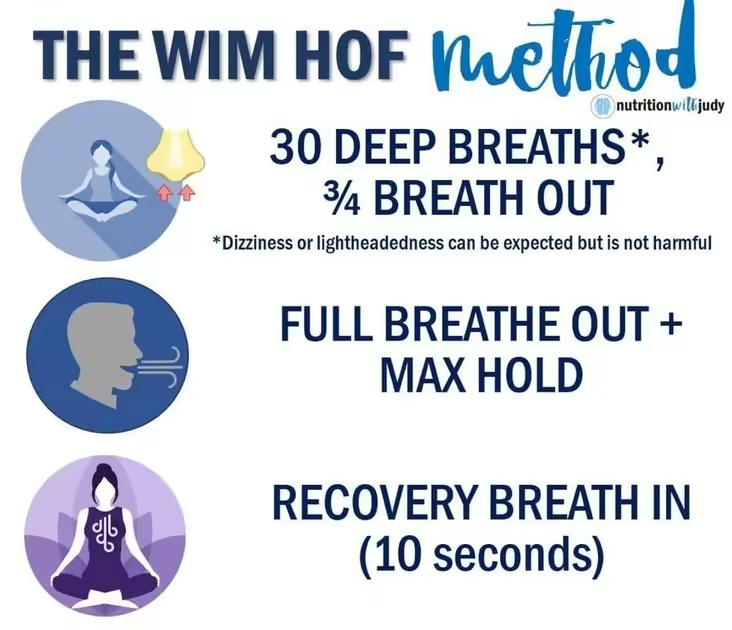
At first when you are starting to adapt to the cold, you'll have to breathe intentionally as described above, but later down the road you won't need to do it anymore.
As the goal is to gradually work up your cold tolerance, if you want to do it like I did, put the shower temperature at the "slightly cold" temperature, and every day, very slightly turn it down, to a slightly lower temperature, without ever turning the temperature up again. The temperature either stays the same (at that slightly cold temperature) or goes down, but it must never go back up again.
You'll probably be surprised to see after a while, that the heat you usually sought when entering the shower no longer needs to come from the water, the heat comes from your own Body. That's when you know the brown fat is being activated. This is a clear reminder, that what can be achieved from outside, can also be achieved from within.
The Morning Battle
You are waking up early today, your body wants to remain in bed, but you decide that you are going to get up early.
Because you do not intend to let your body decide things on its own, You make it stretch entirely with the yoga practice of your choice.
Great, you started to control over your body for the day, it's time to get it to refine the blade now.
It's also time to get control over your own mind now. What does it want?
"Come let's go back in the bed and stay warm, put on that cover and turn up the heater!"
But after reading all the benefits of cold exposure above, you're not going to miss out, are you?
Take your time to get used to the cold water, take your time. Start with the hands, then the arms, then the shoulders, then the legs, then the crotch area, then the belly, then the torso, then the back, and lastly the neck, the head and your face for last.
Digging deeper
If you want to see faster progress, and are willing to dig deep into it like I did, directly switch to that uncomfortably cold temperature, You will see that your body is going to make you breathe through your mouth instinctively. It's going to be a vivid reaction at first, the typical fight or flight stress response.
Listen to what your mind is saying: "Get me out of here! Turn the temperature up!"
Controlling the Body:
With the cold water flowing down from the head downward onto the rest of your body, stay immobile, with your joined hands together. Stop breathing through your mouth, only breathe through your nose, and try to breathe more slowly, in a controlled manner.
Controlling the Mind:
In that same posture, once your Body is firmly in your control, and breathing steadily, see if you can think up the 3 Nihilism Mantras with each inhalation and exhalation:
Opus Nihil: to dissolve your compulsions
Inhalation: I want nothing,
Exhalation: I need nothing
Scio Nihil: to dissolve your beliefs
Inhalation: I know nothing,
Exhalation: I know nothing else
Sum Nihil: to dissolve your identities
Inhalation: I am nothing,
Exhalation: I am no one
You will see, in that stressful situation it will not be easy to get your mind to repeat those mantras with each inhalation and exhalation consistently, but once you are able to do that, while doing your daily cold exposure, this is when both your mind, and your body are taking instructions from you. This is when you can truly say that you have chosen Discipline over Comfort.
Chapter 16
The General Workflow (Visualize, Plan, Do, and Review the Work)
In this tutorial we're going to explain what the general workflow is, to make sure that you never get lost trying to complete projects.
Why is this important? In which context?
Have you ever felt like you were going in circles, or even felt overwhelmed when trying to carry out a project?
If you're like me, you've likely been in this situation more than once, especially if your plans include carrying out projects that take thousands of hours to complete.
First step: Visualize the end goal
Either you know exactly what you're talking about from the start, meaning that the end goal vision is already crystal clear from inside your head, or you're like me, and you probably need to make a graph to make sure that your idea is fully detailed (brainstormed) from start to finish.
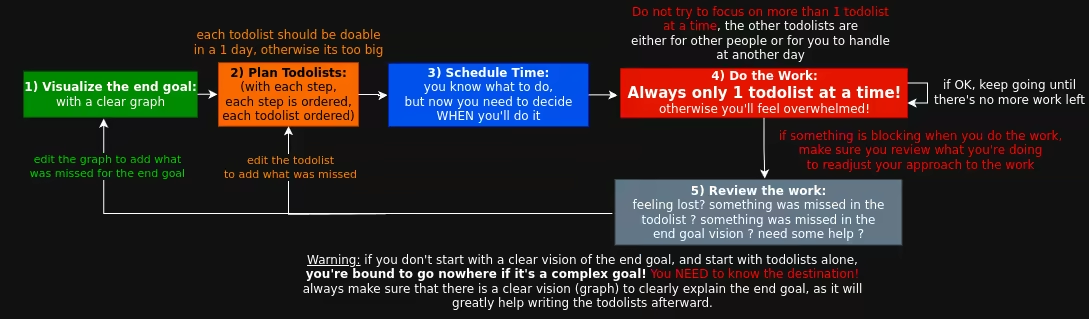
With a clear graph that details each step, in which order, with all of their relevant characteristics, with meaningful colors, the end goal idea is now set in stone and there's no more ambiguity about it. With a clear graph fully brainstormed, you're now ready to write to-do lists to achieve the targeted result.
Second Step: Plan the Work
As covered in this tutorial, the next step is to write what must be done, in the correct order.
I faced this myself first-hand at work when I under-estimated the complexity of a given project and I ended up going in circles. So when you realize that you can't do the work because you didn't account for some crucial details, know that it's time to go back to the whiteboard, to clarify the vision of the end goal.
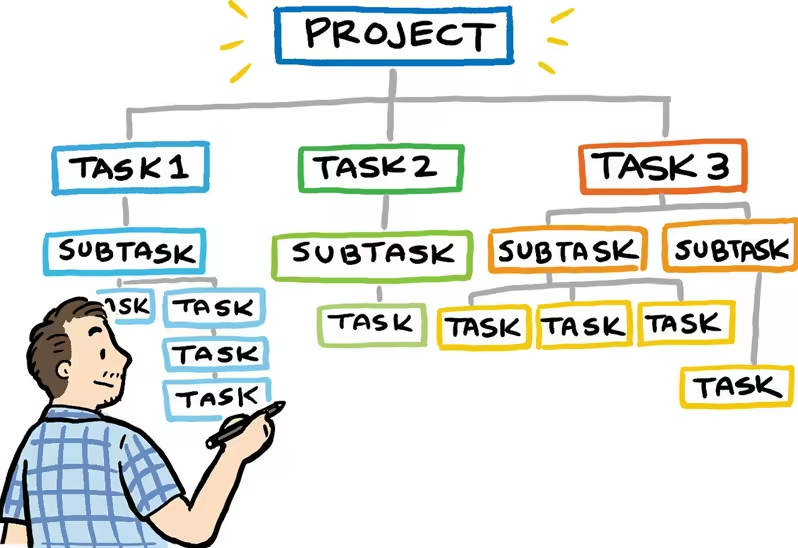
This is about segmenting the mountain of work into chunks that you can do. Do not try to take the weight of the entire Mount Everest upon your shoulders, because it'll overwhelm and break you.
Third step: Schedule the work
Now that you know what to do, it's time to decide when you're going to do it:
Follow my tutorial on how to use your calendar for productivity, but also don't forget to use the correct verbs when you schedule time to do something, as it will help you to understand what needs to be done:
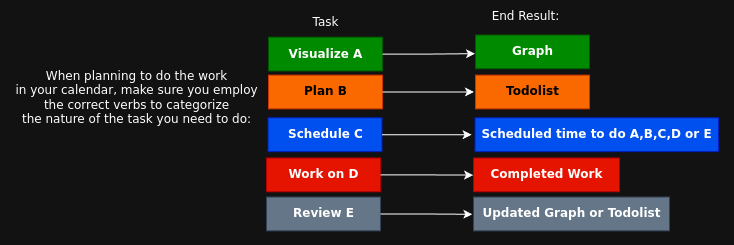
- 01
Visualize A: you need to produce a graph
- 02
Plan B: you need to write a to-do list
- 03
Schedule C: you need to book some time in your calendar
- 04
Work on D: you need to act out what you set out to do in your to-do list
- 05
Review E: you need to find what was missed in the to-do list or graph and update it
That way you're explicit enough in what the nature of the work is, and you won't get lost trying to act it out, clarity on what must be done is paramount to actually get there.
Fourth Step: Doing the work

The steps are now listed, in chunks that you can action, time to actually do the work.
``` You intend to reach the summit of mount Evrest, so you get in your car and started driving. The roads that lead up to that peak are all twisted, turning, sharp turns, dangerous roads.
Do you think you're going to reach the summit while only staring at the peak? Or do you think you're going to reach the summit while only focusing on the next step in front of you? ```
The only thing that truly matters for you right now, is reaching the next step that is in front of you right now.
The rest of the steps are of no consequence to you right now, and especially not the mountain peak. 100% of your attention at any given moment in time must be on reaching that next step.
It is very discouraging to try to do everything at once, because nobody can do everything at once.
Fifth Step: Reviewing the Work

If at any point in time you're stuck or lost in your work, that can only mean one of 2 things:
- 01
You either forgot to list a crucial step in the to-do list.
- 02
Or you didn't fully brainstorm the end goal in the visualization graph.
That means that you either have to go back to the drawing board to adjust the visualization graph, to finish brainstorming the idea completely, or you have to go back to the to-do list and the steps you missed.
Conclusion
And that's it! Thanks to this tutorial you now know what the general workflow is, where it starts and where it ends. So if at any point in a given project you're feeling lost or stuck, make sure you remember your workflow and adjust your approach to it properly.
Chapter 17
The right thing to do: What is the reason behind your actions?
Introspection: What is it that truly matters to you?
Over the course of an entire month, note down what you are doing.
-School
-Work
-Video Games
-Socializing
-Social Media
-Nsfw content
-Junk Food
-Substance abuse (alcohol / smoking / drugs)
-Shopping
-Activism
Which of these activities/topics are the most mature, and the most fulfilling for you?
Acting out of self-interest: Unfulfilling Immaturity
Let's first look at what everyone does best: acting out of self-interest. There are 3 basic reasons behind what most people do out there:
-To Survive
-To Indulge in Pleasure
-To Control
And when you're categorizing the topics you have above into those 3 categories, you may realize that the reason behind your actions may remain very rudimentary:
-To Survive:
-School
-Work
-To Indulge in Pleasure: (addictions)
-Video Games
-Socializing
-Social Media
-Nsfw content
-Junk Food
-Substance abuse (alcohol / smoking / drugs)
-Shopping
-To Control:
-Running an online community
-Regulating / Passing Laws / Enforcing laws (for governments)
-Acting like a dictator with your own relatives
No shame in acting out of self-interest, but you need to realize what it ultimately is about.
Acting out of survival is the most common thing to do, and it's not just us humans, literally every living being out there is doing it. But there has been an unnecessary glorification of survival that has been going around, humanity has been raising the bar for its own survival for no reason, it's been raised so much that people need to work their entire lives for someone else just to keep their right to live. Surviving is a trivial thing even for the smallest creatures on the planet, don't make such a big fuss about it.
To indulge in pleasure is the next best thing that people know, and that is what is preventing them from doing anything meaningful their whole lives. One extreme example is opioid addiction, the feeling you get during that first high is so unbelievably pleasant, it feels like arriving in heaven, nothing comes close to it. But to chase that high every day is going to cost you everything, and you will keep trying to fill that insatiable addiction even when you end up on the streets. Now you may not have chosen that kind of caliber to feel pleasure, but you may have found some smaller weapons to shoot yourself in the foot with, such as junk food, NSFW content, lighter substance abuses, or just video games. Make no mistake you can remain hooked on that your entire life.
And lastly, you may have chosen to indulge in trying to extend your Control, it can take many forms such as trying to control what's around you by doing activism, or running an online community. Or if you are in the governmental / law enforcement sector it could just be making efforts to control the public order, some act like dictators on their own relatives too!
"We buy things we don’t need, with money we don’t have, to impress people we don’t like.”
“You are not special. You are not a beautiful or unique snowflake. You are the same decaying organic matter as everything else."
"You are not your job. You’re not how much money you have in the bank. You’re not the car you drive. You’re not the contents of your wallet. You’re not your f*cking khakis. You’re the all-singing, all-dancing crap of the world.”
-Fight Club, 1999
At some point, you need to ask yourself, what's the point of indulging in all of this? Sure it makes you feel good for a moment, but are you truly feeling satisfied from it after a while? Is this truly a fulfilling thing to do for you? Or is it true that you have mistaken just "feeling good" for being the peak of your life?
The point is, in the end you are doing all of this to protect what you are currently identified with. While in the short-term you may feel good from it, acting out of self-interest will never truly fulfill you. If you are not even aware of what you truly are, Nor are you aware of what you truly want to do, Why are you trying to do things without knowing these two?
The right thing to do: The Fulfilling Maturity
If you want to be productive, you must be 100% convinced that you are currently doing the right thing. You will anyway need to reflect on yourself quite a bit to decide on what is the right thing to do. This is the key difference maker in your life. Will you do things because you are forced to? Will you do things because that's what you like to do? Or will you do things because you know with absolute certainty, that this is the right thing to do? I'm sure you can tell which is the most mature, and most fulfilling.
"If you pull that trigger, right, you pull that trigger for a fucking honorable reason. Like an honorable man, not like some fucking civilian that does not understand the wicked way of our world, mate" -Alfie Solomons, Peaky Blinders
Now when you start to dissolve what you initially identified with (see Sum Nihil) you will naturally start to drop the habits you used to maintain when you were still strongly identified with those things that you have anyway never truly been. What happens here is that you are going to start perceiving things beyond your limited sense of self, and when your perception of the self starts to expand, naturally you will start to act for a greater cause, something that is not about you. That's when you start to act for the world, rather than for yourself.
Honorable reasons:
-Purifying
-Percieving
-Transcending
I am also motivated by my will to clear out any misconceptions and help everyone perceive technology for what it truly is, regardless of any morality or any political view. My blog aims to bring to light that any usage of any technology is to be justified with a clear reason, to be described, and showcased in great detail. This blog is there for those that truly want to know the solution, not for those that want solace.
Yes, anyone that tries to mix politics and ideologies into technology, is merely trying to preserve what they are currently identified with. Such people cannot pretend to ever have an objective viewpoint when talking about anything.
Transcending limitations is what I consider the most honorable way behind any action. Ultimately, this blog aims to showcase that Technology, when used correctly, can allow one to transcend any limitation. Be it to transcend surveillance, centralization, deanonymization, lack of security. Any ability that we have as Humans, such as Privacy, Decentralization, Anonymity, Security, Plausible Deniability can be protected and enhanced by using the correct Technology.
TLDR: You want to know the most effective technologies that can enhance your life? It's right there. Just read it up, understand what they are, understand why they are used, understand how they are used, and use them yourself.
So before you start to act in this lifetime, look at what you are currently doing, and what is the reason behind your actions. From there decide if this is the correct thing for you to do, or if you are destined to do more than that in the long term.
I have reflected a very long time on what my purpose was, even after having started this blog. Upon enough reflection my passion shifted from hacking to self-hosting, and upon some more reflection it evolved from self-hosting to operational security. I have simply looked at what was lacking in this world, and now I'm convinced that what I'm doing currently will have the widest, positive, and long-lasting impact in the world. When I'll be gone, upon looking back on my life, I will have no regrets whatsoever. That's all that matters.
Chapter 18
Macro Workflow: Listing Projects that truly matter
The reason behind your actions
As we have discussed previously you'll work at your best effort if you're convinced that what you're doing is the right thing to do. What the right thing to do may be for you, may be different for other people, but to make it short, shifting the activity in your life from being about you, to being about the world and the greater good, marks growth both in maturity and in fulfillment.
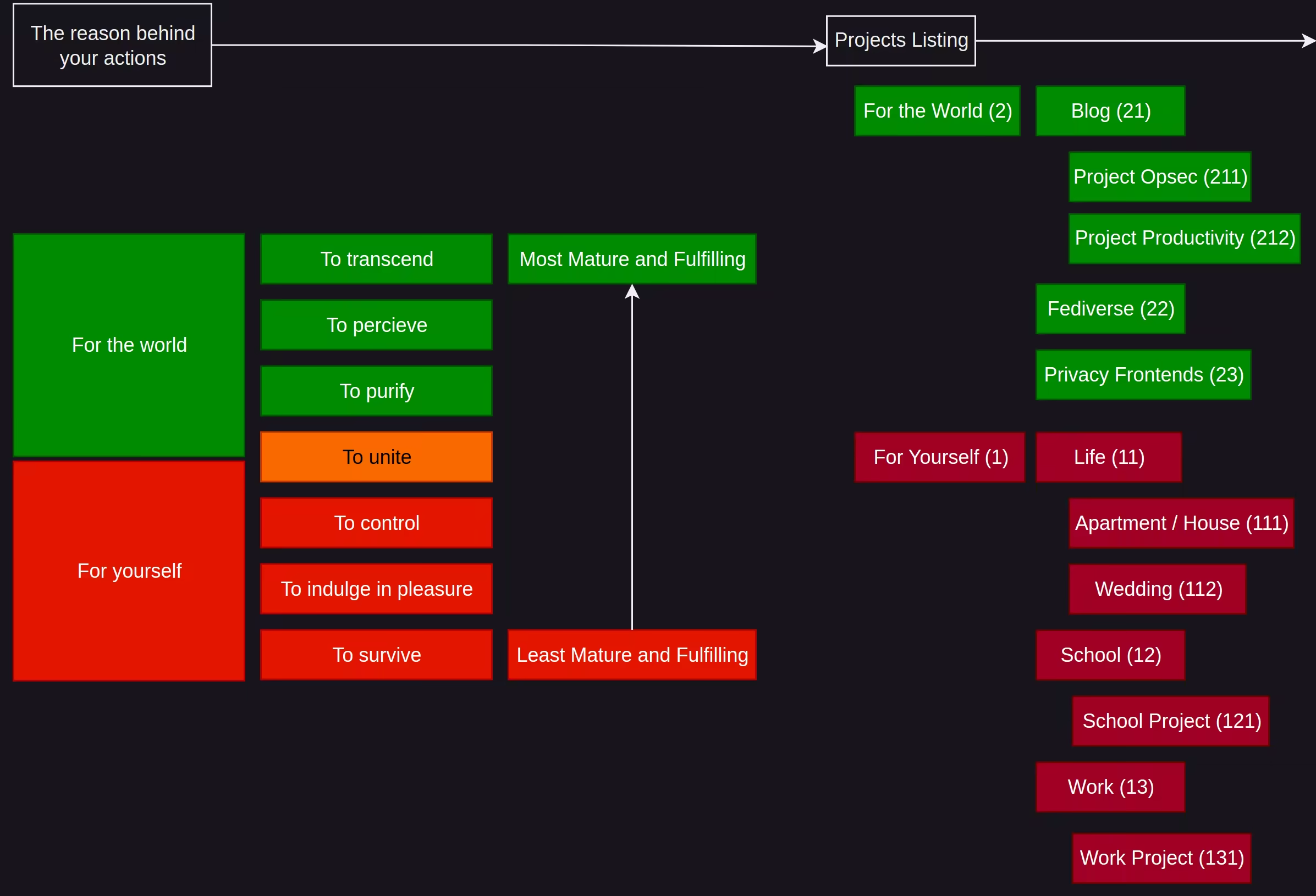
So when you are looking at the 3 main reasons you may act for something greater than yourself, you may find yourself looking for the following three:
To Purify
To Percieve
To Transcend
To get yourself some ideas, just go around the world (physically or digitally) and look what you feel is missing. Over the course of the years on this blog I discovered many, many Projects:
-Hacking: Web, Binary, Physical, Hardware, Binexp, Bruteforcing, Privilege Escalations, MITM, AV evasions, etc.
-Sysadmin: Decentralisation, Self-hosting, Federation, Privacy front-ends, etc
-OPSEC: Privacy, Anonymity, Deniability, etc
My passion shifted from Hacking to Sysadmin, and from Sysadmin to OPSEC over the years. The reasoning behind leaving hacking behind is that finding what developers forgot to take into account when designing their software or their infrastructure it isn't truly fulfilling for me, even though it has given me a very clear and diverse picture of what cybersecurity was. I learned the methodology to follow to start from an IP and arrive at the root user, and after applying it a few dozens of times it's gotten crystal clear and boring.
Sysadmin wise, I felt like having tangible utility after each tutorial. You learn how to set up something for yourself, at the same time you show everyone how to do it, and in the end you can use the service for your own infrastructure at home. Here it starts to benefit the individuals and it was more fulfilling already. But upon looking at what was missing around the world, I came around the obvious governments attacking people's basic rights of privacy and anonymity. Hence, the shift I made to Operational Security Projects.
The 2 main Projects I cover currently are OPSEC, and a secondary Project: Productivity. As this is also something I've seen that is missing in people, they all look either bored or are feeling completely lost in their lives. I'm firmly convinced that these 2 are currently essential and are 100% worth diving into.
Listing Projects
Now that you have the full reasoning behind how to pick new Projects, let's list them and categorize them:
For the world
-Blog
-Project OPSEC
-Project Productivity
-Fediverse
-Privacy Front-ends
For yourself
-Life
-Apartment / House
-Wedding
-School
-School Project A
-School Project B
-School Project C
-Work
-Work Project X
-Work Project Y
-Work Project Z
For myself I have a few typical Projects that literally everyone eventually has in their lives, such as getting an apartment/house, having a successful relationship, going to school and going to work.
And for the world, I have a few Projects, keeping up with my blog, with OPSEC as the primary activity, and Productivity as the secondary activity. And I also have a few other side projects like contributing to the Fediverse and hosting privacy front-ends.
When listing Projects, rank them from top (most important) to bottom (least important). This is not a reason to spend 100% of your time on your passion. But it is a reason to spend at least 50% of your free time on what truly matters to you, and to reduce the other Projects that don't matter to you to their strict minimum.
For instance, the time I wish to consecrate on my blog would collide with that of keeping a family life, so I made the choice to reduce the personal Projects (including family life) to their strict minimum. So that I could spend most of my free time doing what I feel truly matters to me.
Obviously there are Projects that are inevitable such as going to school and to work, you'll anyway have to do those two. But what you're doing for the rest of your time is entirely up to you. Don't start engaging yourself into Projects that don't truly matter to you. Life is too short to waste it on that which means nothing to you.
Labeling and Ordering Projects
Aside from ranking the importance of each Project (most important at the top, least important at the bottom), you need to label them like so:
For the world (1)
-Blog (11)
-Project OPSEC(111)
-Project Productivity (112)
-Fediverse (12)
-Privacy Front-ends(13)
For yourself (2)
-Life (21)
-Apartment / House (211)
-Wedding (212)
-School (22)
-School Project A (221)
-School Project B (221 -> 222)
-School Project C (222 -> 223)
-Work (23)
-Work Project X (231)
-Work Project Y (232)
-Work Project Z (231 + 232 -> 233)
Labeling them will first help you contextualize the Projects and sub Projects you have, so you know where they fit:
For the world (1)
-Blog (11)
-Project OPSEC(111)
-Project Productivity (112)
For instance, as the OPSEC Project is labeled 111, I know it is in the context of the blog (11) which is in the context of my "for the world" Projects (1)
Then, thanks to labels, you can easily list what Projects (and subprojects) depend on one another:
For yourself (2)
-School (22)
-School Project A (221)
-School Project B (221 -> 222)
-School Project C (222 -> 223)
-Work (23)
-Work Project X (231)
-Work Project Y (232)
-Work Project Z (231 + 232 -> 233)
For instance here, the school project C (223) depends on school project B (222), which depends on school project A (221). Therefore, I know I need to do the school projects in the correct order: A, then B, then C.
For the work projects here, we have Project Z (233) which depends on projects X (231) and Y (232). Therefore, I know I can do them in 2 different orders: X, Y then Z, or in the other order: Y, X and then Z.
Accurate planning is crucial especially if you're going to have a ton of Projects like I have under OPSEC, you need to know which Projects depend on which other Projects, to be able to know in which order you're going to do them, hence the labeling need.
Chapter 19
Macro Time Management: Project Prioritization and Calendar Scheduling
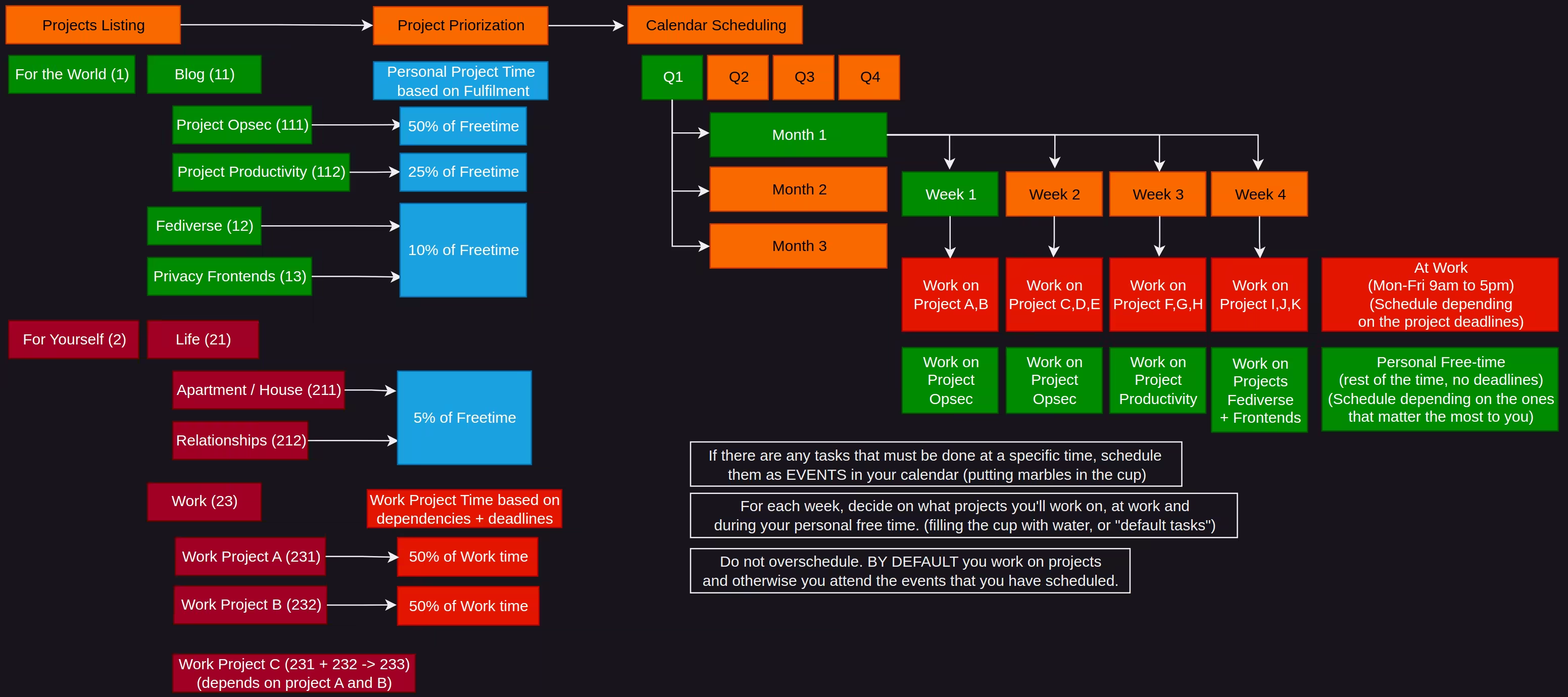
Project Prioritization
Now that we have our list of projects, we have to allocate the time to work on each project. It's a matter of finding the right balance, don't just allocate 100% of your free time to one project, and 100% of your work time to another project. You need to split it correctly. Let's check out how I split my time for each project.
For the world (1) (95% of Freetime)
-Blog (11)
-Project OPSEC(111) (50% of Free time)
-Project Productivity (112) (25% of Free time)
-Fediverse (12) (5% of Free time)
-Privacy Front-ends(13) (5% of Free time)
For yourself (2)
-Life (21) (5% of Freetime)
-Relationships (212) (4% of Free time)
-Apartment / House (211) (1% of Free time)
-Work (23) (100% of Work time)
-Work Project A (231) (50% of Work time)
-Work Project B (232) (50% of Work time)
-Work Project C (231 + 232 -> 233)
Here as you can see, I have decided to reduce my free time to just 5% of the things I do for myself, the remaining 95% of things I do during my free time are for the world, as I know that these are going to be the most fulfilling things I can do. As we have explained previously, you need to prioritize projects, based on which one matters most to you, and as I have ranked each project from most important (at the top) to least important (at the bottom) you can see how I allocated the time I spend for each accordingly.
For Work, the prioritization of projects is different, as you're not supposed to prefer a project over another, here you just need to complete the projects in the correct order. As you can see Project Z depends on project X and Y to be started, therefore I split my work-time in 2, half the time is dedicated to project X, and the other half of the time is dedicated to project Y.
The next week will have a different time allocation if projects X and Y are completed. Unless if there are more projects added to the list, then it will be project Z taking up 100% of the time afterward.
Calendar Scheduling
For calendars, to make it simple, I recommend using thunderbird:
[ mainpc ] [ /dev/pts/13 ] [~/Nextcloud/blog]
→ sudo apt install thunderbird -y
[ mainpc ] [ /dev/pts/13 ] [~/Nextcloud/blog]
→ thunderbird
First thing we need to do after installing the app is enable the socks5 proxying, so that the app is able to resolve .onion domains:
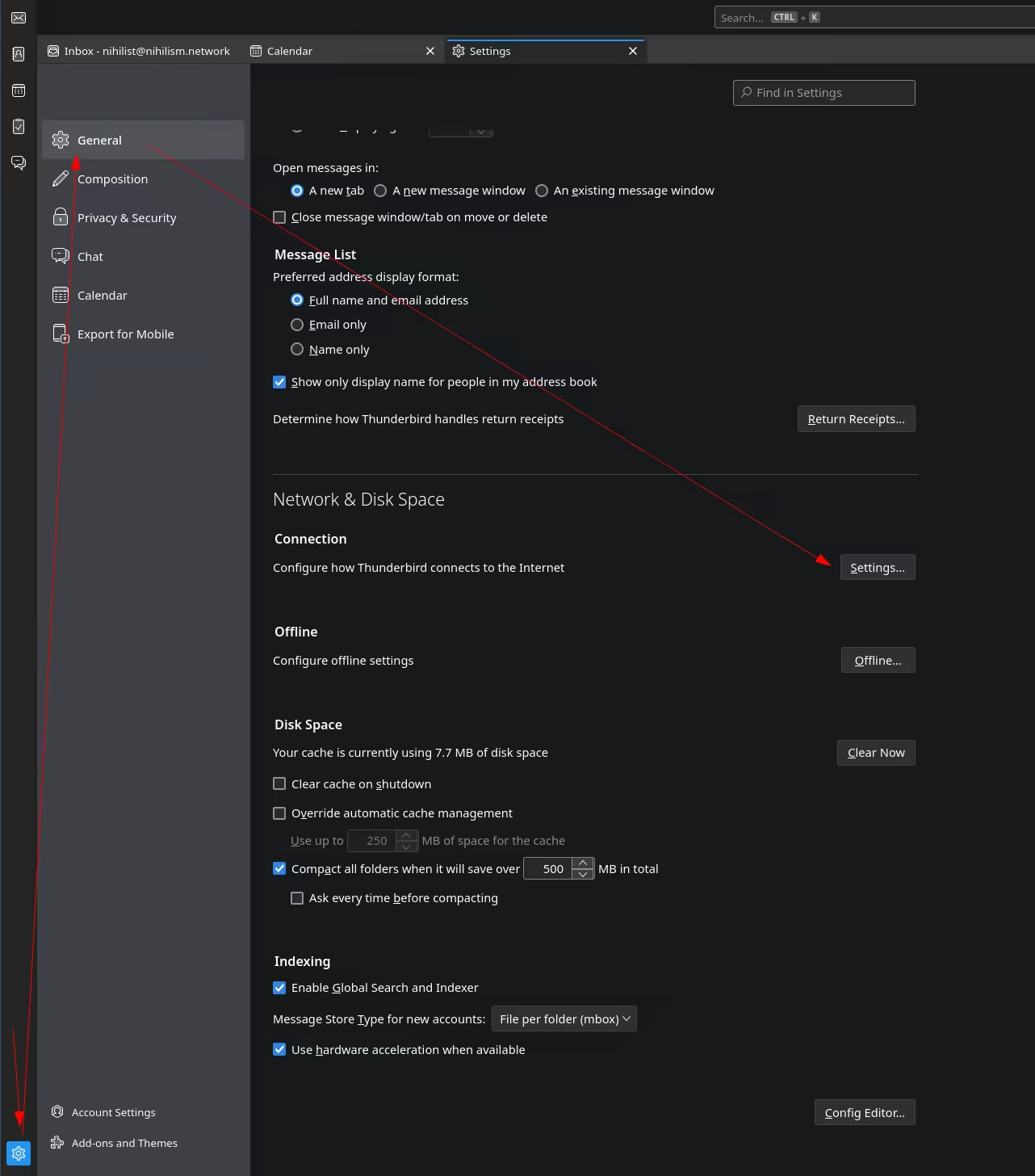
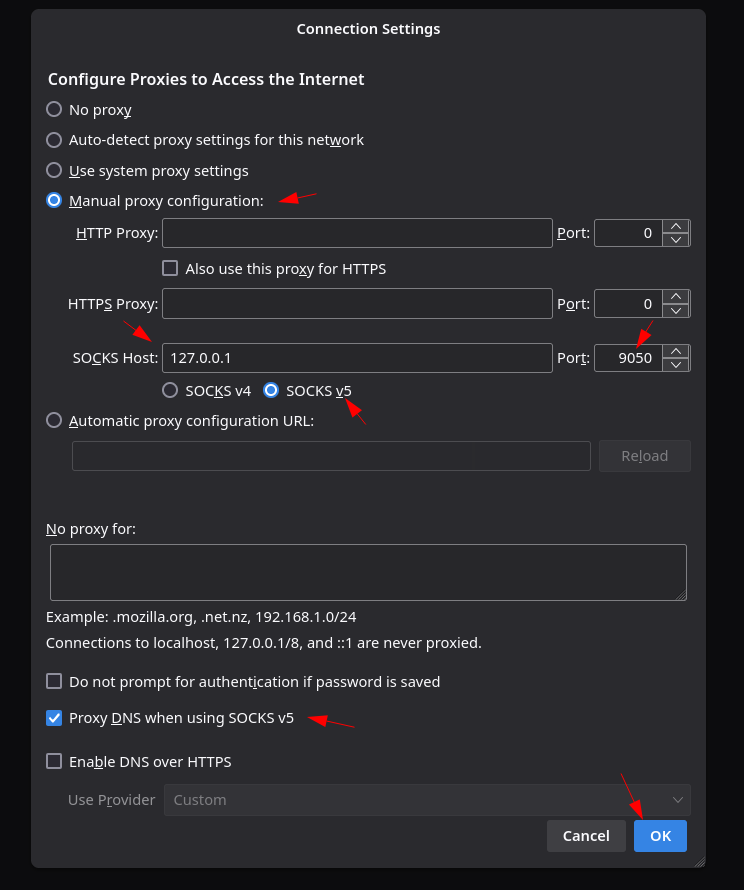
Now that thunderbird has the socks5 proxying enabled, it is now able to sync with .onion Caldav calendars, so let's use the calendar that comes preinstalled with Nextcloud:
Now from here, you can schedule your personal time events in the "Personal" calendar, just do "Ctrl+I" to schedule an event:
In this case, we're doing a one-time event (going to the restaurant):
But in the case where you have a recurrent event (like renewing your Mullvad VPN subscription): you can schedule a recurring event like so:
To schedule events on the work calendars you can simply switch the calendar when creating a new event:
Then, as we also want to create "Default" tasks for entire weeks, we can just create an event that is an "All day event", starting from Monday, and ending on Sunday:
And you can also do the same for your work calendar:
So you now get the following result:
For each week, you have a "default" work and personal project to work on whenever you have time (the cup is filled with water), and in it, you have your one-time or recurrent events as well (the marbles in your cup).
Here as you can see on the week view, you have your default tasks on the top, and during the day you have your events.
Mobile Calendar Scheduling
First, you need the Davx5 application from the F-Droid store on your Graphene OS phone, that'll help us sync with the onion calendar we have on our .onion Nextcloud instance:

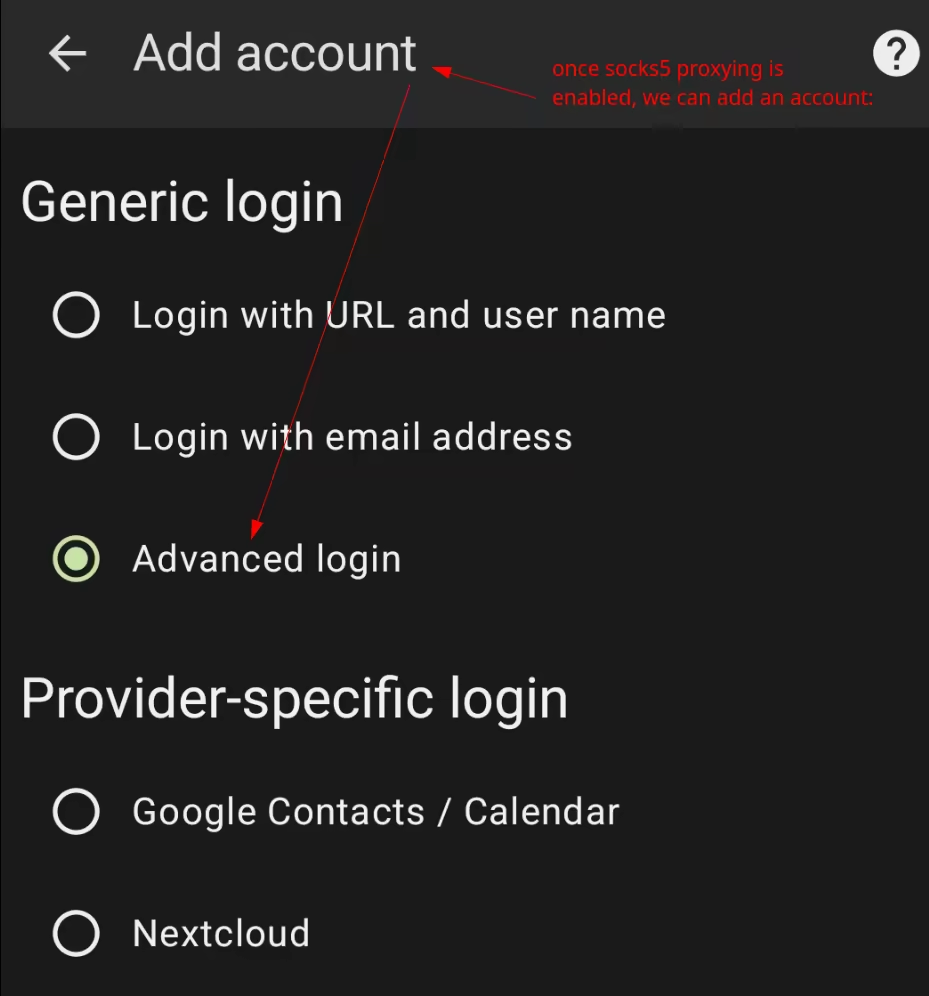
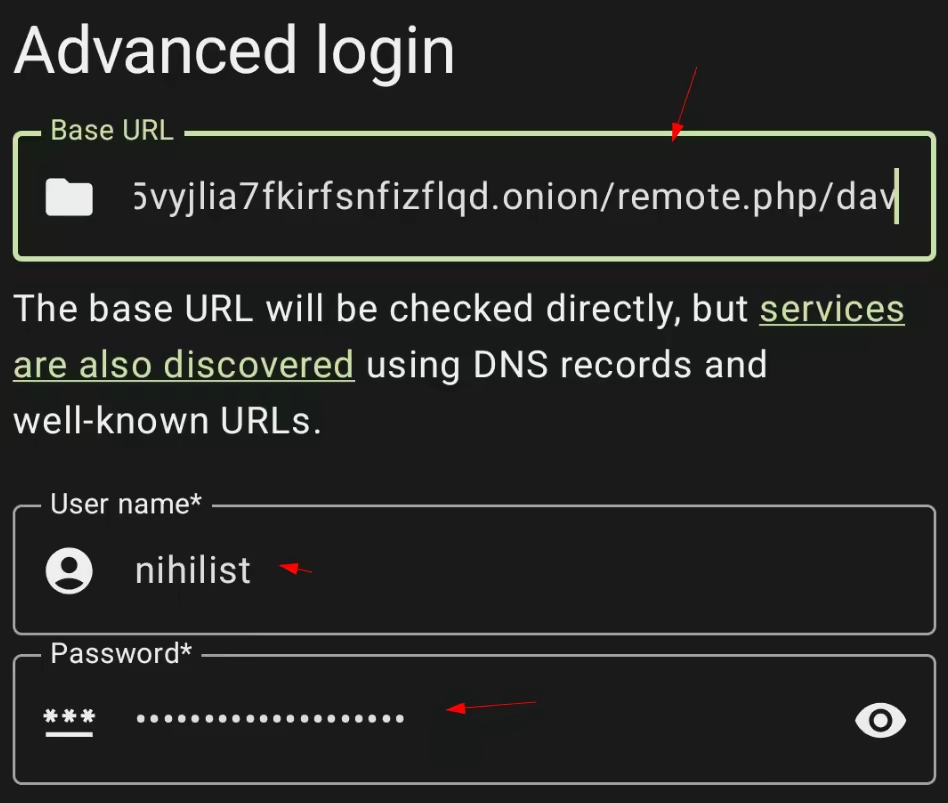

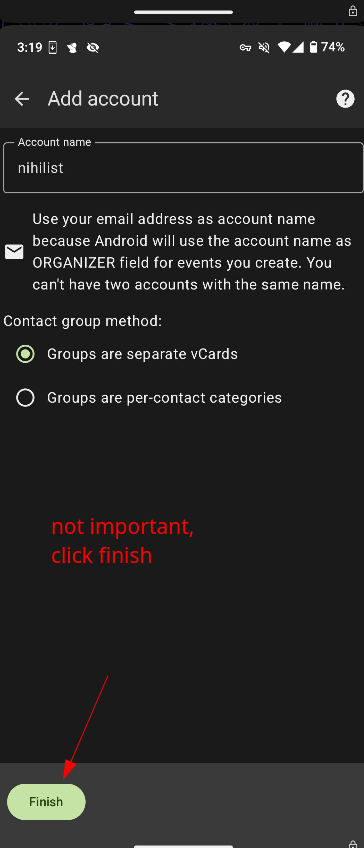
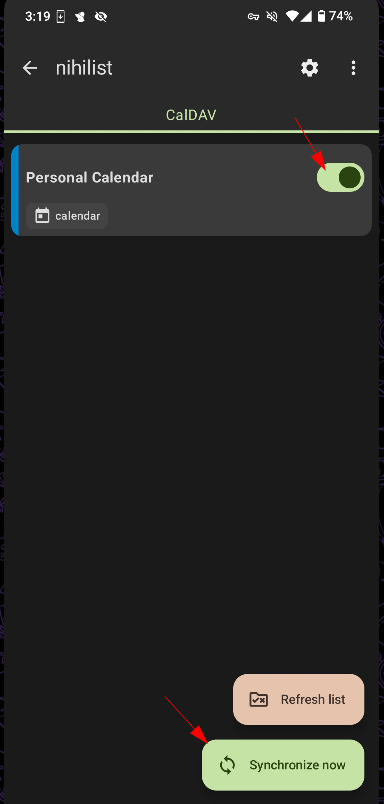
Now that the Caldav Nextcloud calendar is synchronized locally, we can display it using Etar Calendar:
Now that it is installed, we can install the widget to view our calendar from our phone directly:

And that's it! You now have your own .onion Caldav calendar synchronized and displayed on your phone as well.
Chapter 20
Micro Workflow: To-do Listing, Contextualizing, and Ordering Tasks
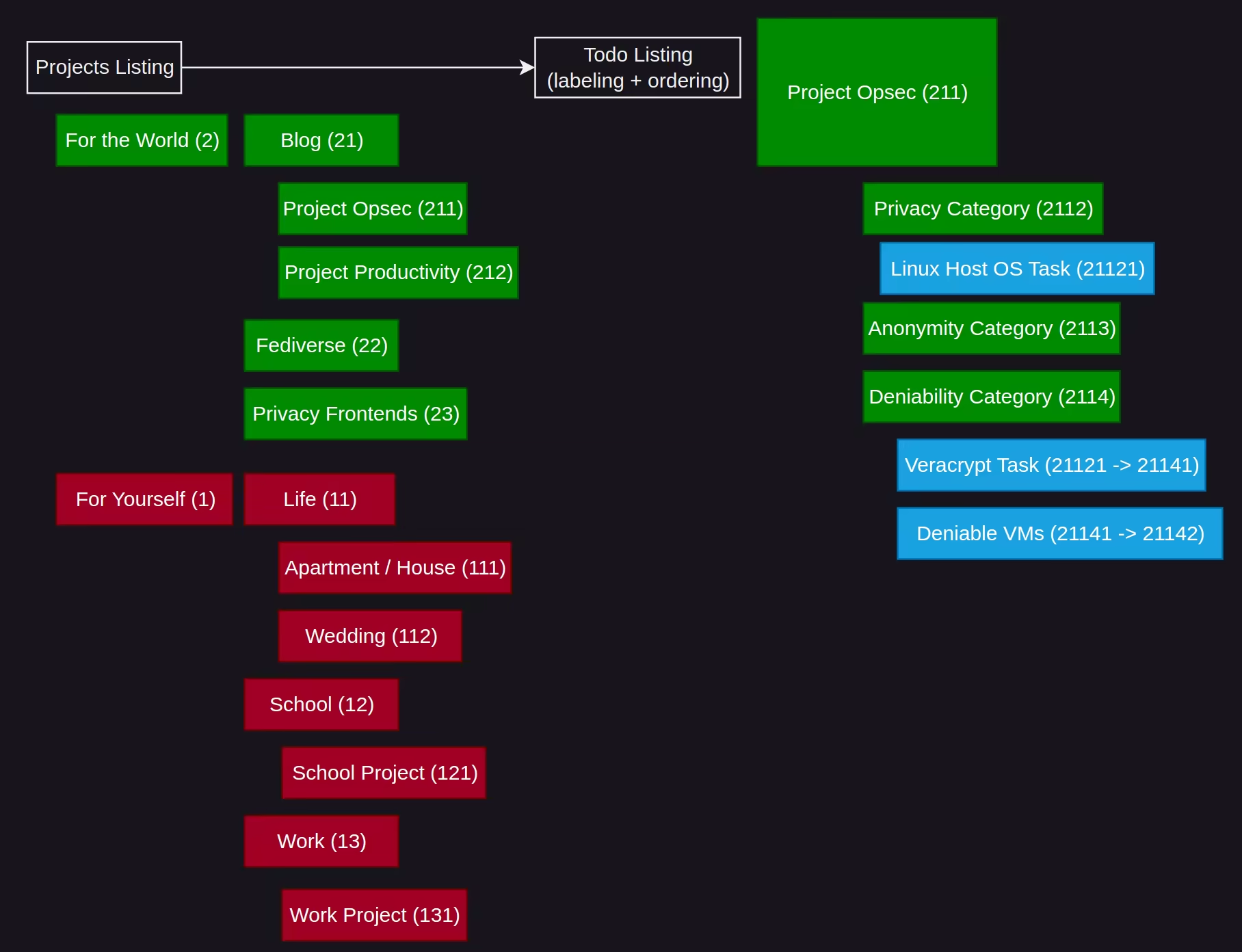
In this tutorial we're going to cover how to write to-do lists:
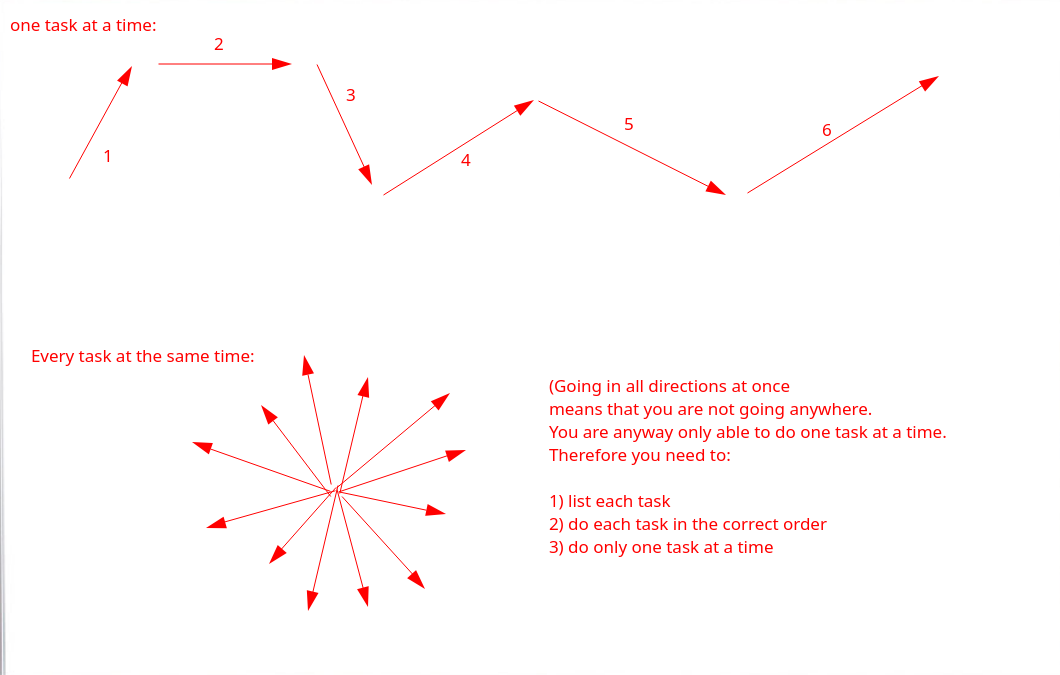
This is essential because you are only able to focus on one thing at a time. You anyway have to do one task at a time, that's why you need to list each task, make sure that you put an order to those tasks, and make sure that you only do one at a time.
To-do Listing
As a continuation of our previous tutorial on macro workflow, to write your to-do list effectively, you need to contextualize it in a particular project (or topic) list the tasks, label them, and note down on what other task do they depend on.
-Project OPSEC (243 -> 211)
-Privacy Category (2112)
-Linux Host OS Task (21121)
-Anonymity Category (2113)
-Deniability Category (2114)
-VeraCrypt Task (21121 -> 21141)
-Deniable VMs Task (21141 -> 21142)
-Project Infrastructure (24)
-setup VPS (241)
-create the blog (241 -> 242)
-officially announce the blog is accepting contributions (242 -> 243)
As you can see here, we have our 2 Projects: Infrastructure and OPSEC, with tasks under each that are labeled, this is for us to be able to contextualize them more easily.
And with the label at the end, we also write which other task must be completed before starting each task, if there are any.
What happens when the to-do list gets too big?
Following this way of working is nice at first, but when the to-do list gets too big to be done in one day or week, it's going to feel very overwhelming. For example if I were to detail what I have to do for the Deniable VMs tutorial
-Project OPSEC (243 -> 211)
-Deniability Category (2114)
-Deniable VMs **to-do list, not Task** (21141 -> 21142)
-To be explained:
- What is the usecase?
- What tools are going to be used?
- Why do we need VeraCrypt?
- Why do we need Whonix?
-To be showcased:
- How to create the hidden volume
- How to put the Whonix VM inside the hidden volume
- How to use the emergency shutdown script as a non-root user
- How to start the emergency shutdown script with a cinnamon keyboard shortcut
In short, when each Task is starting to become a to-do list of its own, you need to treat it not as a task, but as a separate to-do list.
How to handle multiple to-do lists
So to have multiple to-do lists, we're going to have multiple files:
[ mainpc ] [ /dev/pts/4 ] [~/todo lists]
→ tree .
.
├── 0.txt
├── 21141.txt
├── 21142.txt
└── 243.txt
1 directory, 4 files
[ mainpc ] [ /dev/pts/4 ] [~/todo lists]
→ cat 0.txt
-Project OPSEC (243 -> 211)
-Privacy Category (2112)
-Linux Host OS Task (21121)
-Anonymity Category (2113)
-Deniability Category (2114)
-VeraCrypt Task (21121 -> 21141.txt)
-Deniable VMs Task (21141 -> 21142.txt)
-Project Infrastructure (24)
-setup VPS (241)
-create the blog (241 -> 242)
-officially announce the blog is accepting contributions (242 -> 243.txt)
[ mainpc ] [ /dev/pts/4 ] [~/todo lists]
→ cat 21142.txt
-Deniable VMs to-do list, not Task (21141 -> 21142)
-To be explained:
- What is the usecase?
- What tools are going to be used?
- Why do we need VeraCrypt?
- Why do we need Whonix?
-To be showcased:
- How to create the hidden volume
- How to put the Whonix VM inside the hidden volume
- How to use the emergency shutdown script as a non-root user
- How to start the emergency shutdown script with a cinnamon keyboard shortcut
And that's it! Now you have a very rudimentary way of keeping track of what you need to do, in what context, and in what order.
Chapter 21
Collaborative Project Management (Kanban in Forgejo)
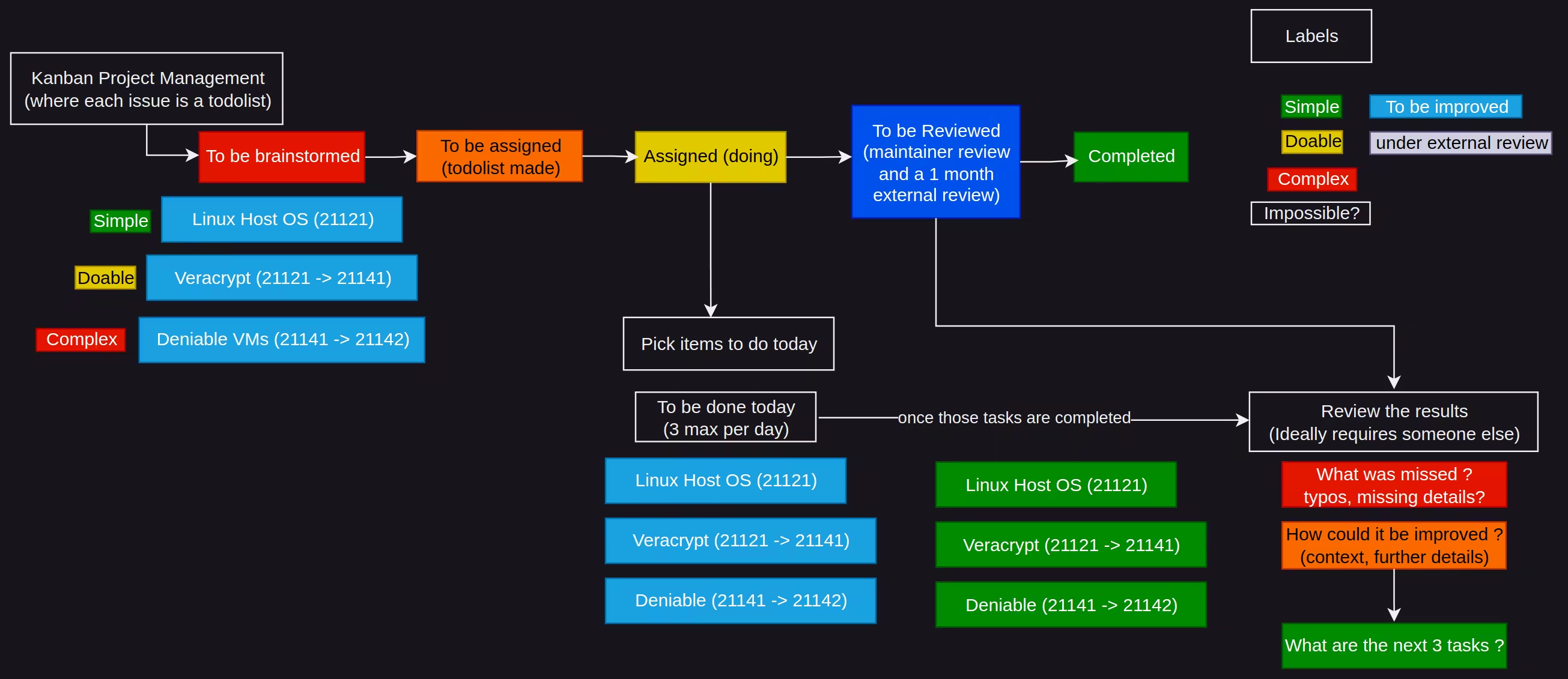
What tools can I use?
Let's say you have a project with too many to-do lists for you to complete in one month like in our example from this previous tutorial. While this kind of to-do list organization may work for individual work, this may not be ideal for collaborative work, where let's say you have 10 people that want to work on your project.
Rather than literally sending them your to-do list text files over chat, you guessed it, you need a better, more serious solution. If you are familiar with Git (which is a distributed version control system, used to track versions of files), you may be thinking GitHub already, it is the biggest service for hosting open source code online, but the problem is that it was acquired by Microsoft in 2018. So if you're like me, and you don't want your repositories taken down whenever Microsoft feels like it (like what happened to Tornado Cash), you need to put your repositories elsewhere:

Therefore, to stay in line with our OPSEC requirements we need to use the FOSS, self-hostable alternative: Forgejo. We'll use our Forgejo instance for this tutorial, but you can do the same on your own Forgejo instance (here's the tutorial on how to set up your own .onion Forgejo instance).
Creating the repository
First you need to register (feel free to use a throwaway email if you want), and then you need to create your first repository:
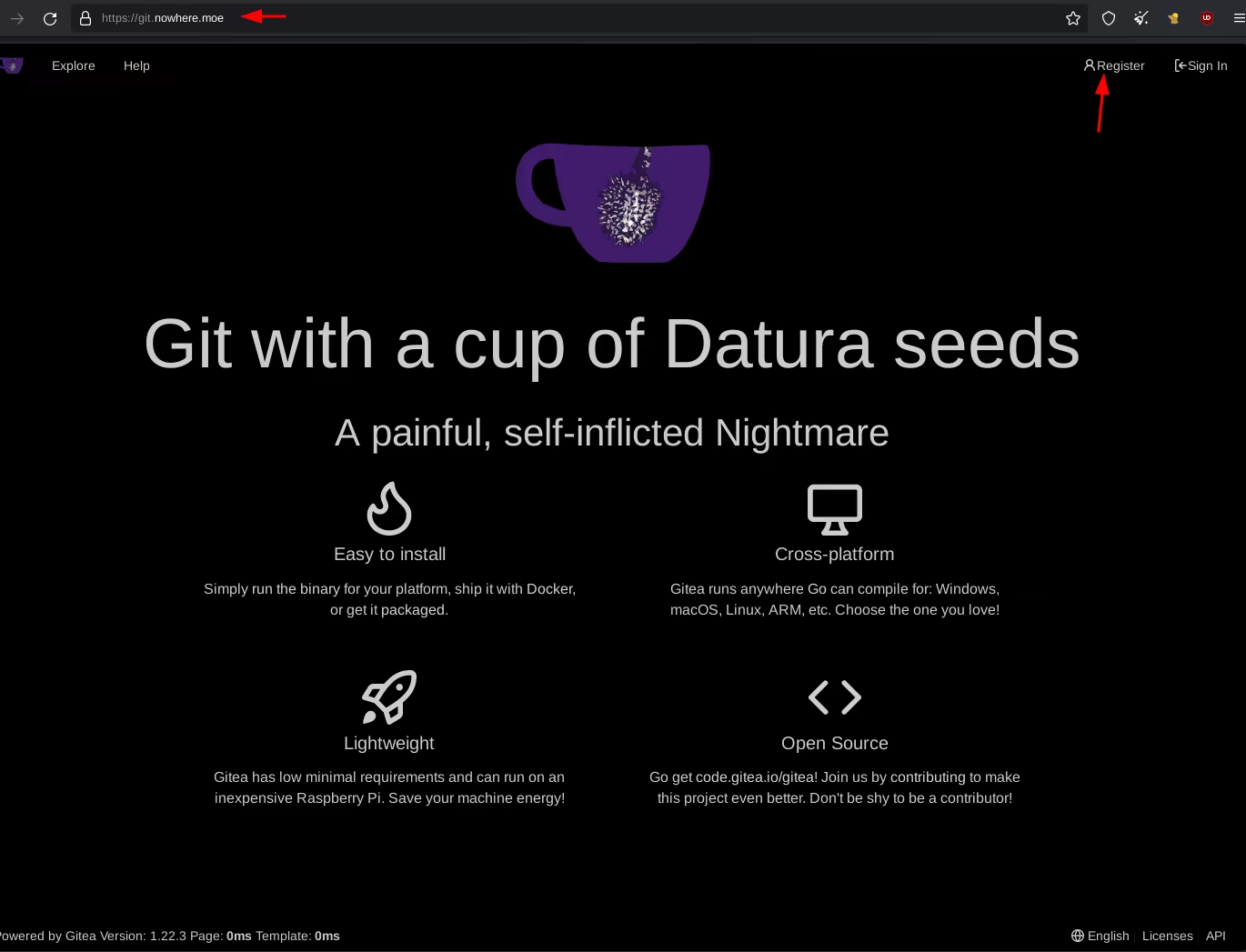
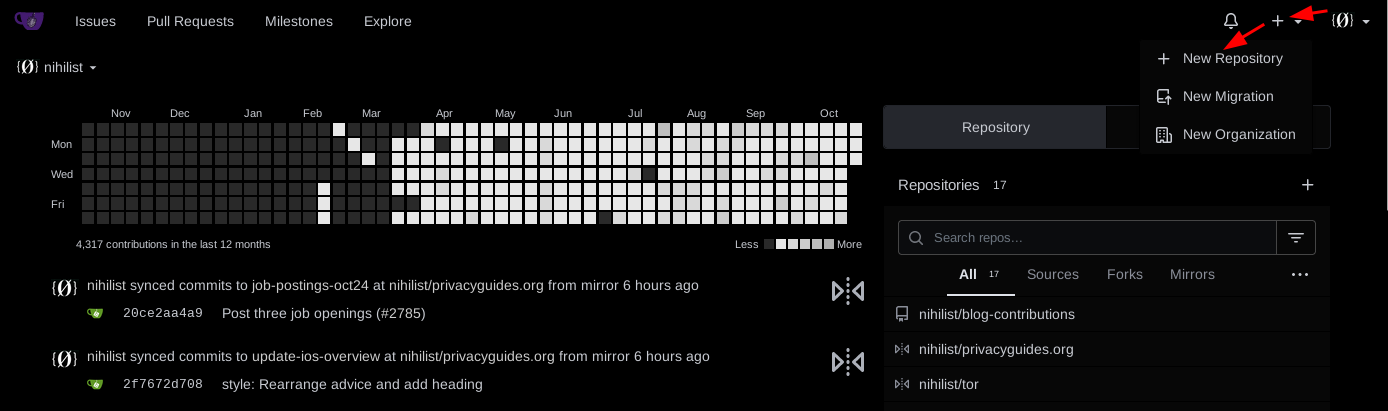
Now here we create our collaborative project repository:
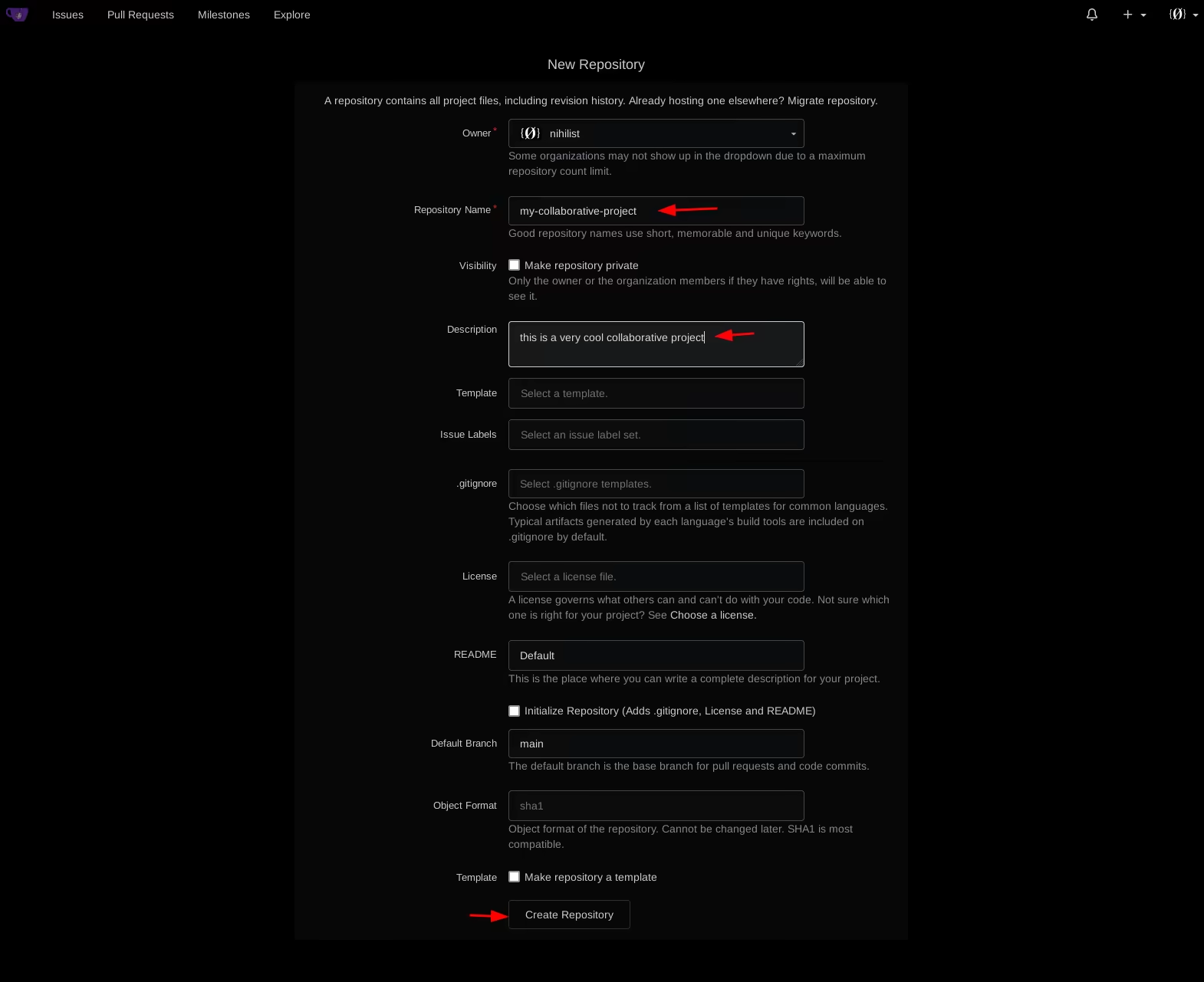
Then to you can create your README file and the first commit in it, with the tutorial that's showcased:
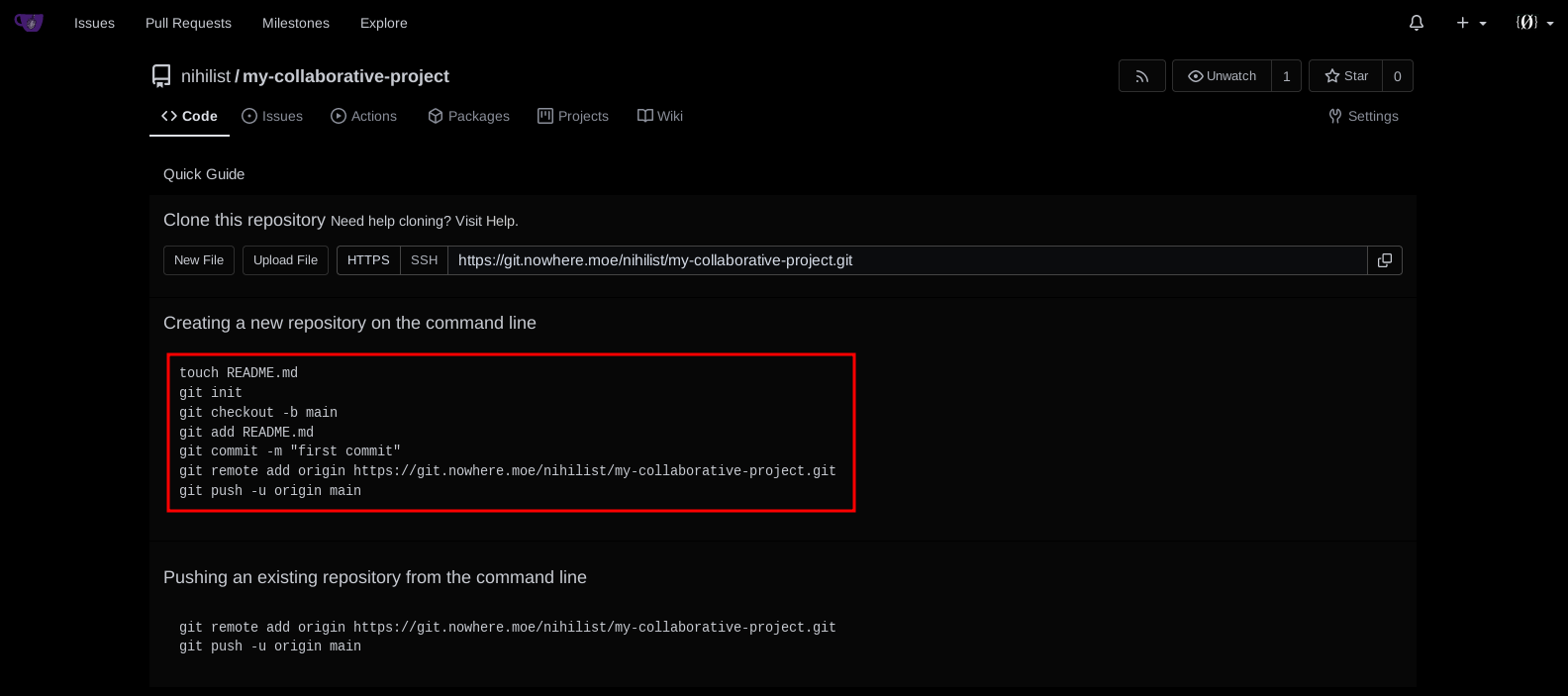
[ mainpc ] [ /dev/pts/13 ] [~/Documents]
→ mkdir my-collaborative-project
[ mainpc ] [ /dev/pts/13 ] [~/Documents]
→ cd my-collaborative-project
[ mainpc ] [ /dev/pts/13 ] [~/Documents/my-collaborative-project]
→ vim README.md
[ mainpc ] [ /dev/pts/13 ] [~/Documents/my-collaborative-project]
→ cat README.md
welcome to my collaborative project!
[ mainpc ] [ /dev/pts/13 ] [~/Documents/my-collaborative-project]
→ git init
git checkout -b main
git add README.md
git commit -m "first commit"
git remote add origin http://gdatura24gtdy23lxd7ht3xzx6mi7mdlkabpvuefhrjn4t5jduviw5ad.onion/nihilist/my-collaborative-project.git
git push -u origin main
hint: Using 'master' as the name for the initial branch. This default branch name
hint: is subject to change. To configure the initial branch name to use in all
hint: of your new repositories, which will suppress this warning, call:
hint:
hint: git config --global init.defaultBranch
hint:
hint: Names commonly chosen instead of 'master' are 'main', 'trunk' and
hint: 'development'. The just-created branch can be renamed via this command:
hint:
hint: git branch -m
Initialized empty Git repository in /home/nihilist/Documents/my-collaborative-project/.git/
Switched to a new branch 'main'
[main (root-commit) c567662] first commit
1 file changed, 1 insertion(+)
create mode 100644 README.md
**Username for 'http://gdatura24gtdy23lxd7ht3xzx6mi7mdlkabpvuefhrjn4t5jduviw5ad.onion': nihilist
Password for 'https://nihilist@gdatura24gtdy23lxd7ht3xzx6mi7mdlkabpvuefhrjn4t5jduviw5ad.onion':yourpassword**
Enumerating objects: 3, done.
Counting objects: 100% (3/3), done.
Writing objects: 100% (3/3), 250 bytes | 250.00 KiB/s, done.
Total 3 (delta 0), reused 0 (delta 0), pack-reused 0
remote: . Processing 1 references
remote: Processed 1 references in total
To http://gdatura24gtdy23lxd7ht3xzx6mi7mdlkabpvuefhrjn4t5jduviw5ad.onion/nihilist/my-collaborative-project.git
* [new branch] main -> main
branch 'main' set up to track 'origin/main'.
And from here as you can see, we have our README.md file that's visible from the repository:
Now let's say you have multiple to-do lists like we previously saw (just exclude the "master to-do list" (titled 0.txt) that is to be considered an index to list the other to-do lists), you can consider those as "issues" from now on.
[ mainpc ] [ /dev/pts/4 ] [~/todo lists]
→ cat 0.txt
-Project OPSEC (243 -> 211)
-Privacy Category (2112)
**-Linux Host OS Task (21121.txt)**
-Anonymity Category (2113)
-Deniability Category (2114)
**-VeraCrypt Task (21121 -> 21141.txt)**
**-Deniable VMs Task (21141 -> 21142.txt)**
-Project Infrastructure (24)
**-setup VPS (241)**
**-create the blog (241 -> 242)**
**-officially announce the blog is accepting contributions (242 -> 243.txt)**
Below you have the example of a detailed to-do list:
[ mainpc ] [ /dev/pts/4 ] [~/todo lists]
→ cat 21142.txt
-Deniable VMs to-do list, not Task (21141 -> 21142)
-To be explained:
- What is the usecase?
- What tools are going to be used?
- Why do we need VeraCrypt?
- Why do we need Whonix?
-To be showcased:
- How to create the hidden volume
- How to put the Whonix VM inside the hidden volume
- How to use the emergency shutdown script as a non-root user
- How to start the emergency shutdown script with a cinnamon keyboard shortcut
so let's create an issue for it in Forgejo:

In the title of the issue I like to mention the Category of the issue, followed by the to-do list title, and in the description I mention the list of tasks that must be done to complete the issue:
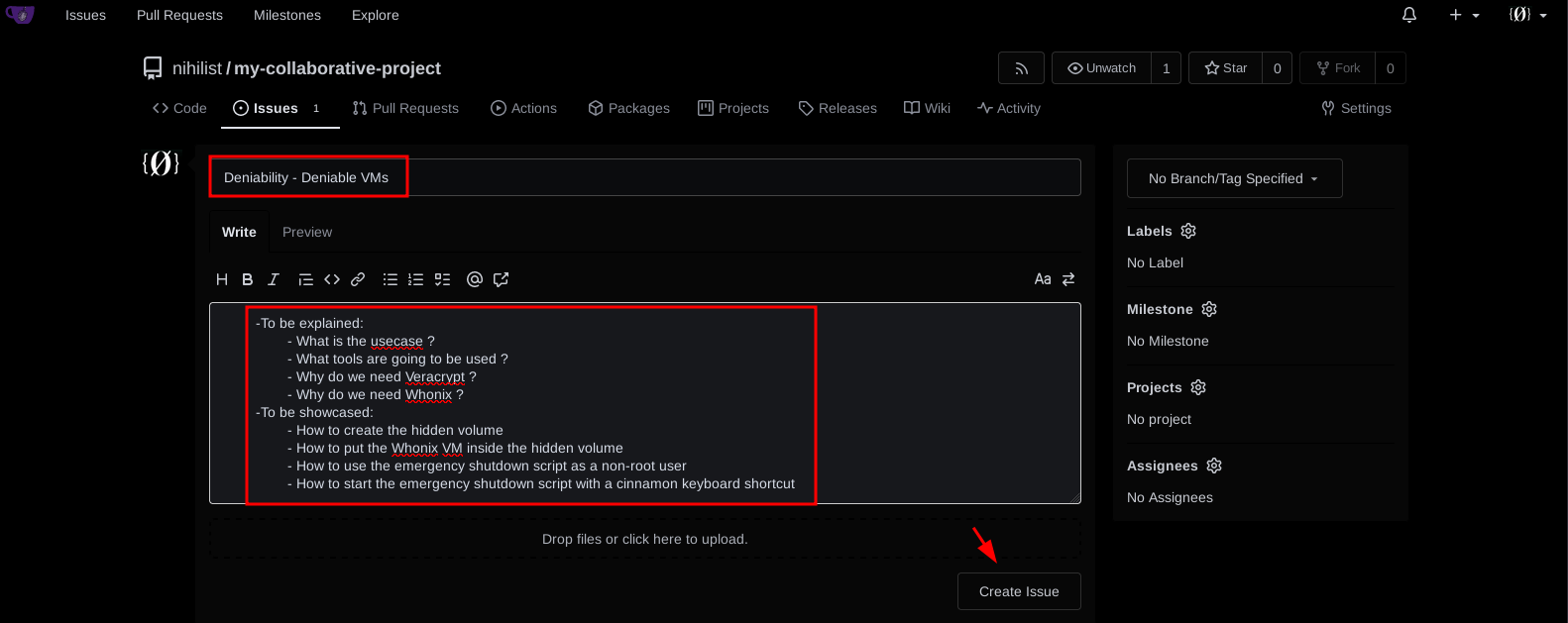
And from there, you can create the rest of the issues for your project as well in the same way, and see them listed here:
Kanban Project Management
Now when you have a lot of issues (let's say over 100 issues) it's going to be hard to keep track of all of them by default. To help with the status tracking, you can look up a Kanban project board:
Now to make sure your issues appear in your project board, you need to make sure that they are in the project board like so:
once you've made sure all of your issues are in your project, you can drag and drop them in either column to easily keep track of their status:
Now you can customize your issues further with labels. For instance I like to have labels describing the difficulty of each issue: "Simple / Doable / Complex" and labels to describe if the issue is supposed to be an improvement, or if it is under external review. You can create the labels here:
once the labels are added to each issue, you can see the overall progress of the project:
Now this is a small example, but if you want to see a real sized-project, check out The OPSEC Bible project I have on this project board:
And that's it! Now you know how to handle a long-term large project. If you want to check out how I welcome collaborations on The OPSEC Bible, check out the tutorial I made here.
Chapter 22
Zero Email Workflow (in Thunderbird)
Why is this important?
Now while this may not be the case of everyone, but suppose you have a job in IT, where you get on average 75 mails per week. (and you're lucky because I get 150 per week at work), suppose you take a vacation for 2 weeks, and now you're back at work. But you see this:
Thing is, your emails are going to be an ever-growing pile of stuff if you don't take care of them properly, and the bigger it gets, the less you are going to want to even look at it. You need to keep it as small as possible, to be able to focus on the most important parts of it. Hence, the need to have a clear workflow for your emails:
Zero Email Workflow explained
So for each new mail that you either receive or send, you need to ask yourself:
1. Do I need it for later?
2. Am I waiting for someone else?
3. Does it take more than 2 minutes for me to action?
Depending on that, we will add labels to the mails themselves:
How to implement it in Thunderbird
The first thing you need to do is create the labels in thunderbird:
once they are all created, you can start labeling mails (of course you need to read them first), so you open one (in this example it's for us to action it, and it is a quick action):
so we just respond to it, and since the mail got responded to, we archive it:
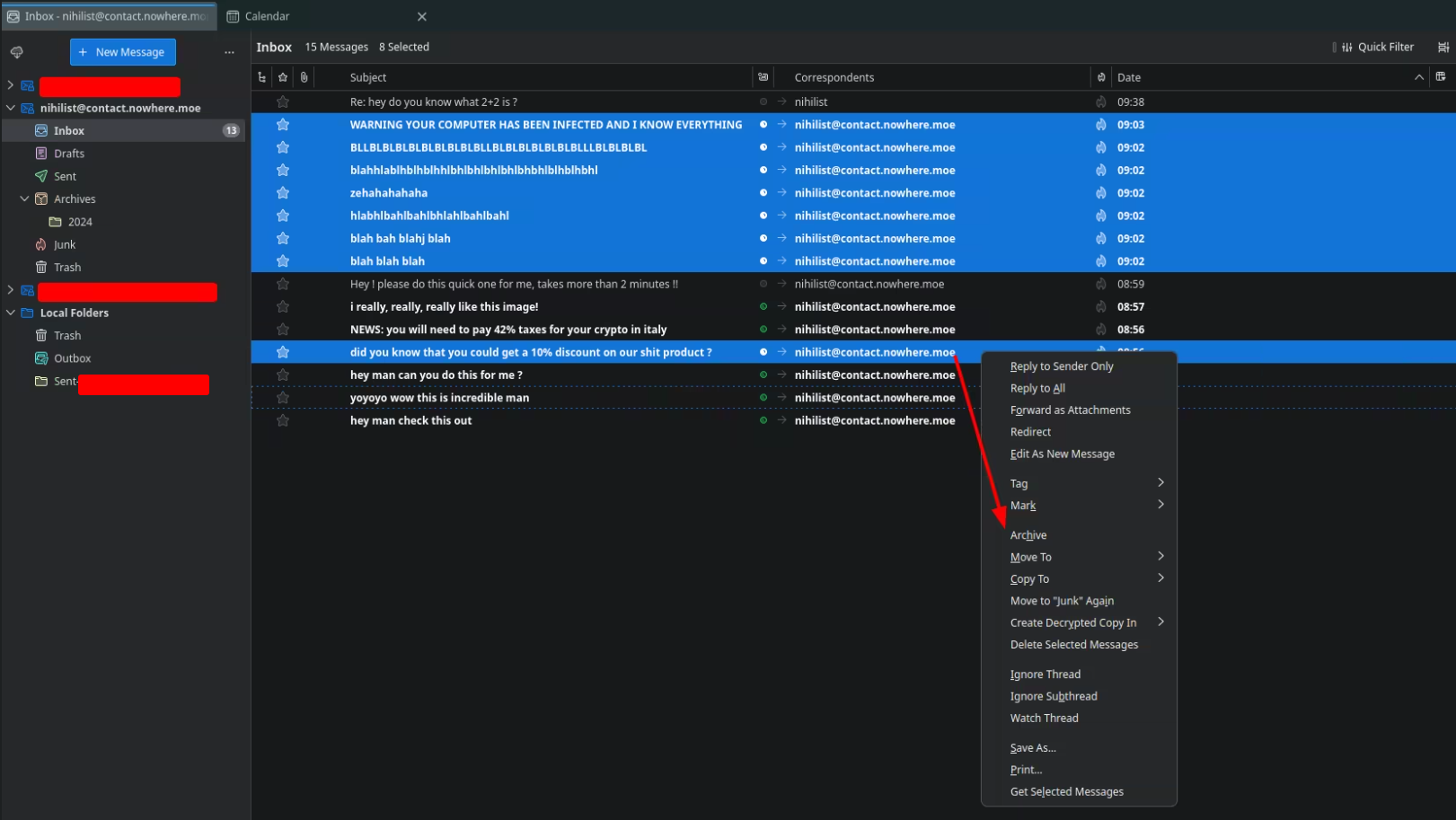
Once all emails are marked properly, you have this result, with visual cues as to what you are waiting for, what you need to do, and what you need to review later:
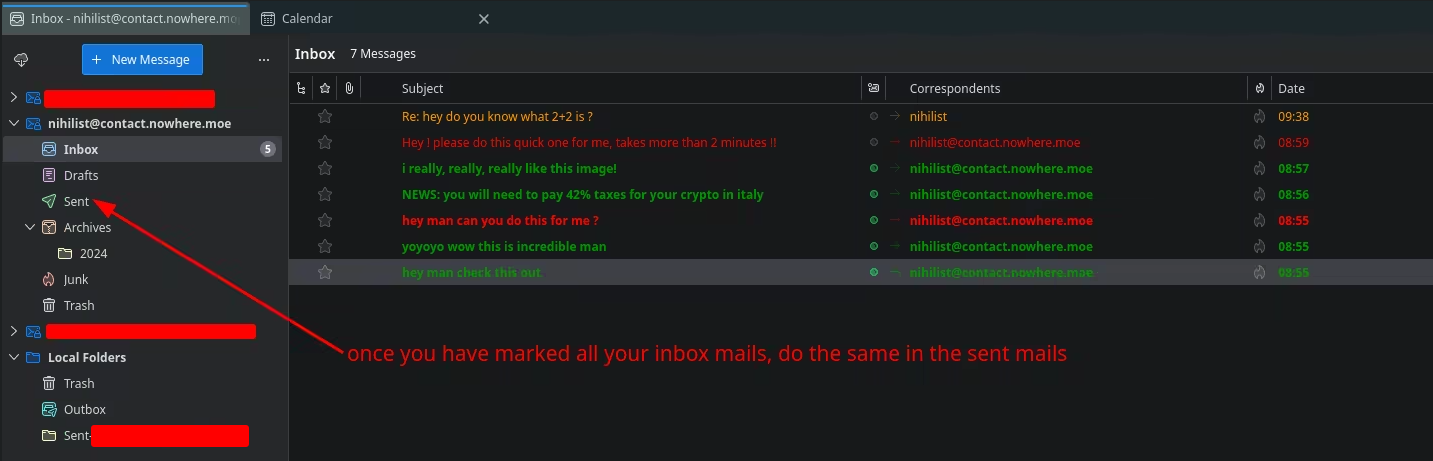
And now we do the same but from the Sent folder:
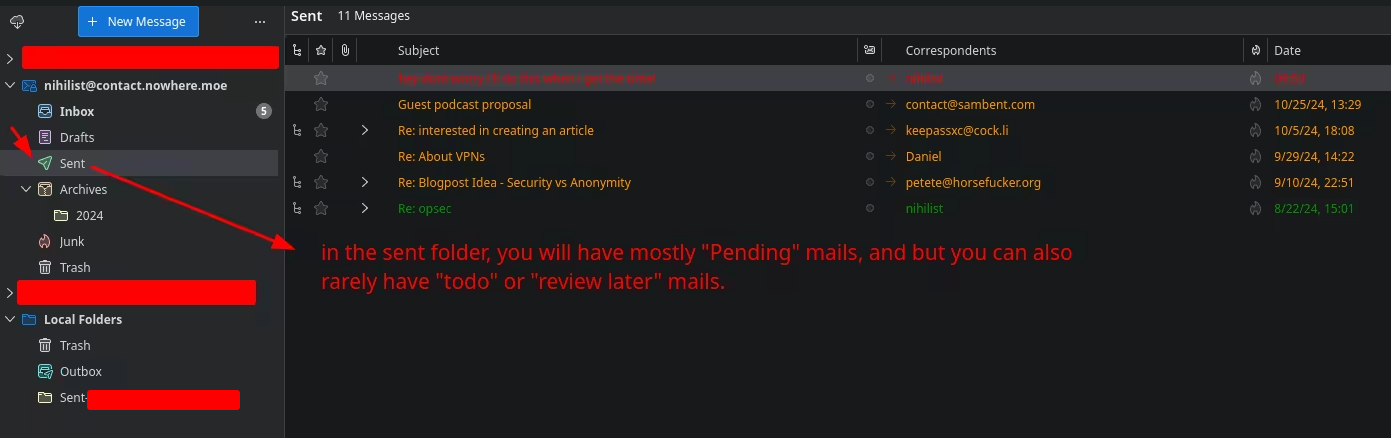
And that's it! Now all that's left is for you to action the mails you marked in red, respond to them and archive them, or get a response for the ones marked in yellow, and archive them, or no longer need the ones in green and archive them. That way you'll highlight the important topics you need to tackle on priority from your mailbox, and get rid of the ones that are no longer relevant.
Chapter 23
Mental Energy: How good are you at spending it?
In this brief tutorial we're going to cover how to efficiently spend your mental energy.
Your Mental Energy is like Money
As the title of this section suggests, your dopamine levels (or mental energy to make it simpler) is just like having money, except the payday happens every day once you finish sleeping.
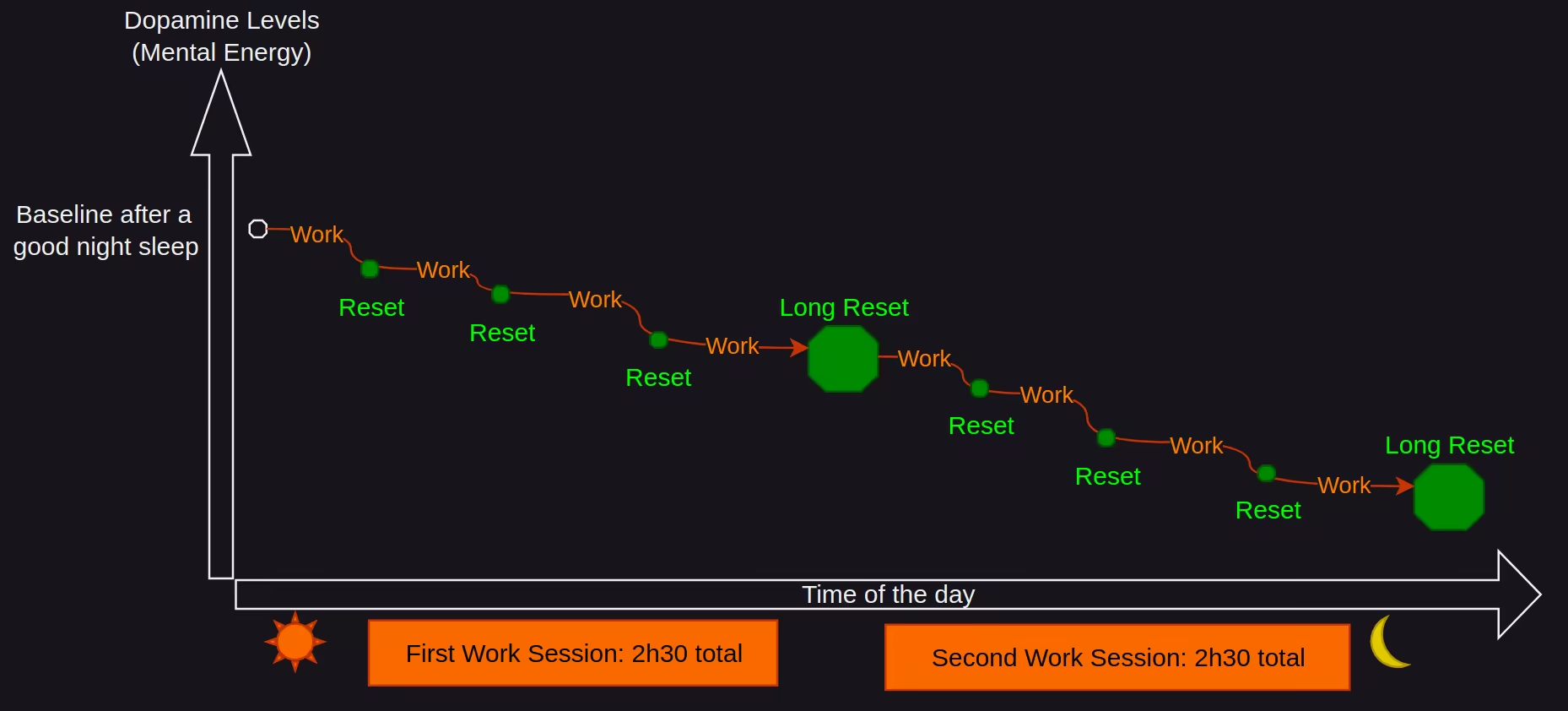
So you wake up, you got a good night sleep, and it's payday, you have 100% of your daily brain money to spend throughout the day. If you follow the Pomodoro workflow to the letter for 2 whole Working sessions, you should be able to work as described above, with a total of 8 Working Cycles, that are 25 minutes long each.
To seek pleasure, is to spend your money irresponsibly
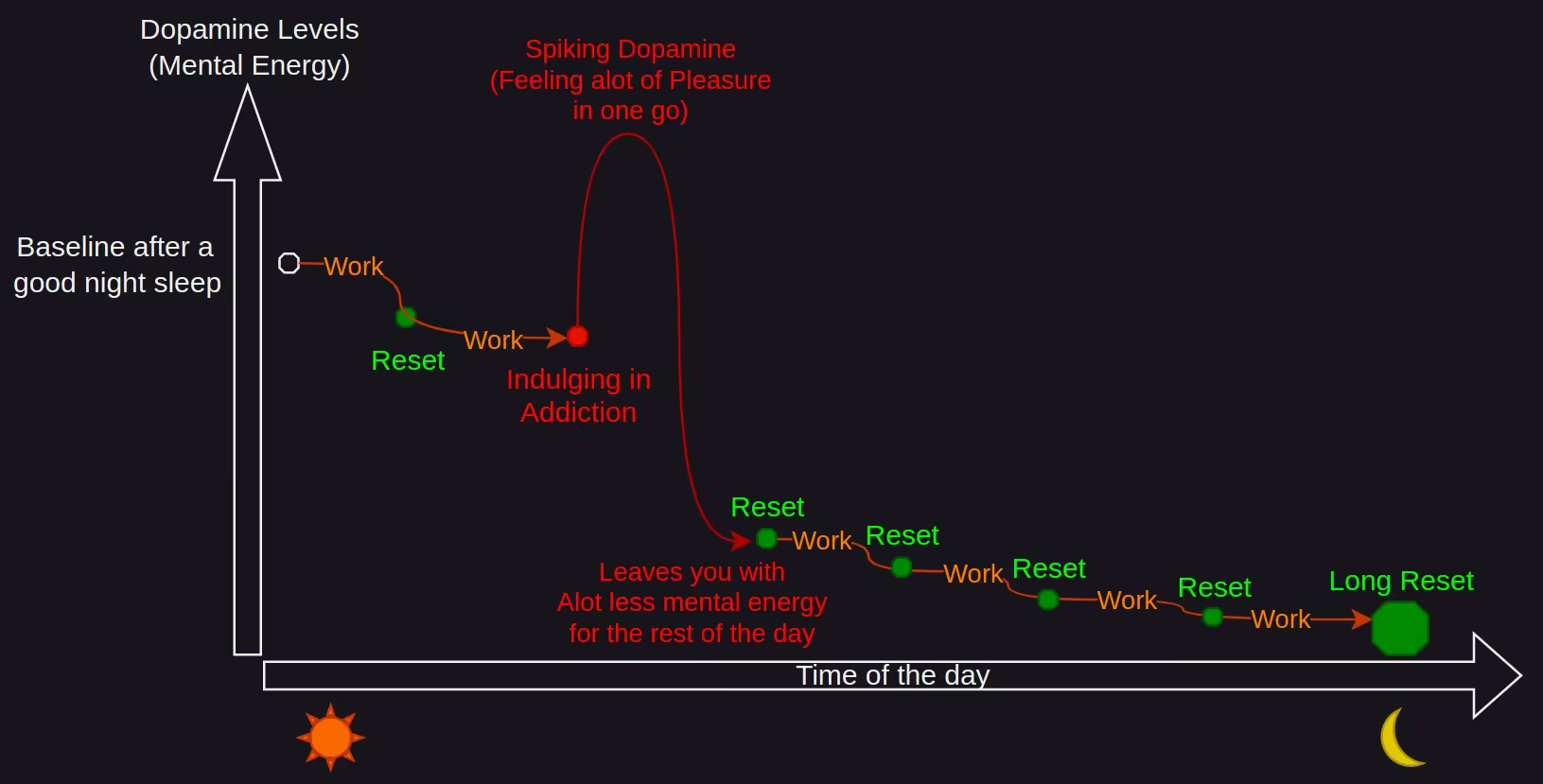
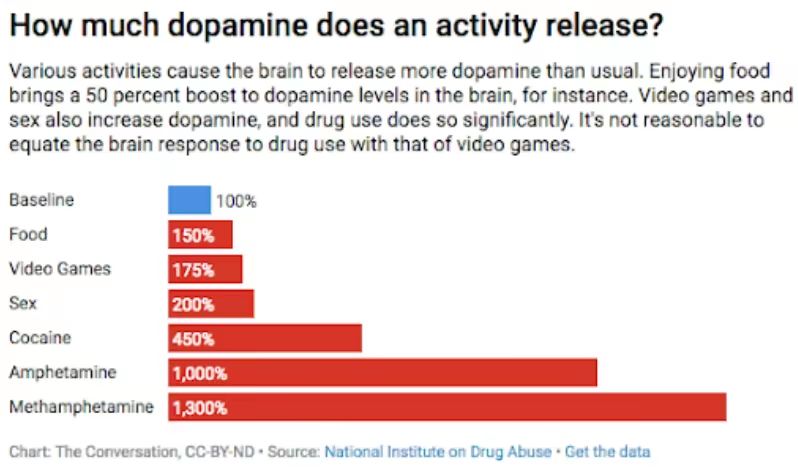
The problem is that when you are seeking pleasure, when you do get that spike in dopamine (meaning you are feeling a lot of pleasure in one go), it's as if you are burning a lot of money in one go. After you've felt that big amount of pleasure, that mental money you had before is gone, you now have to go through the day with less mental energy.
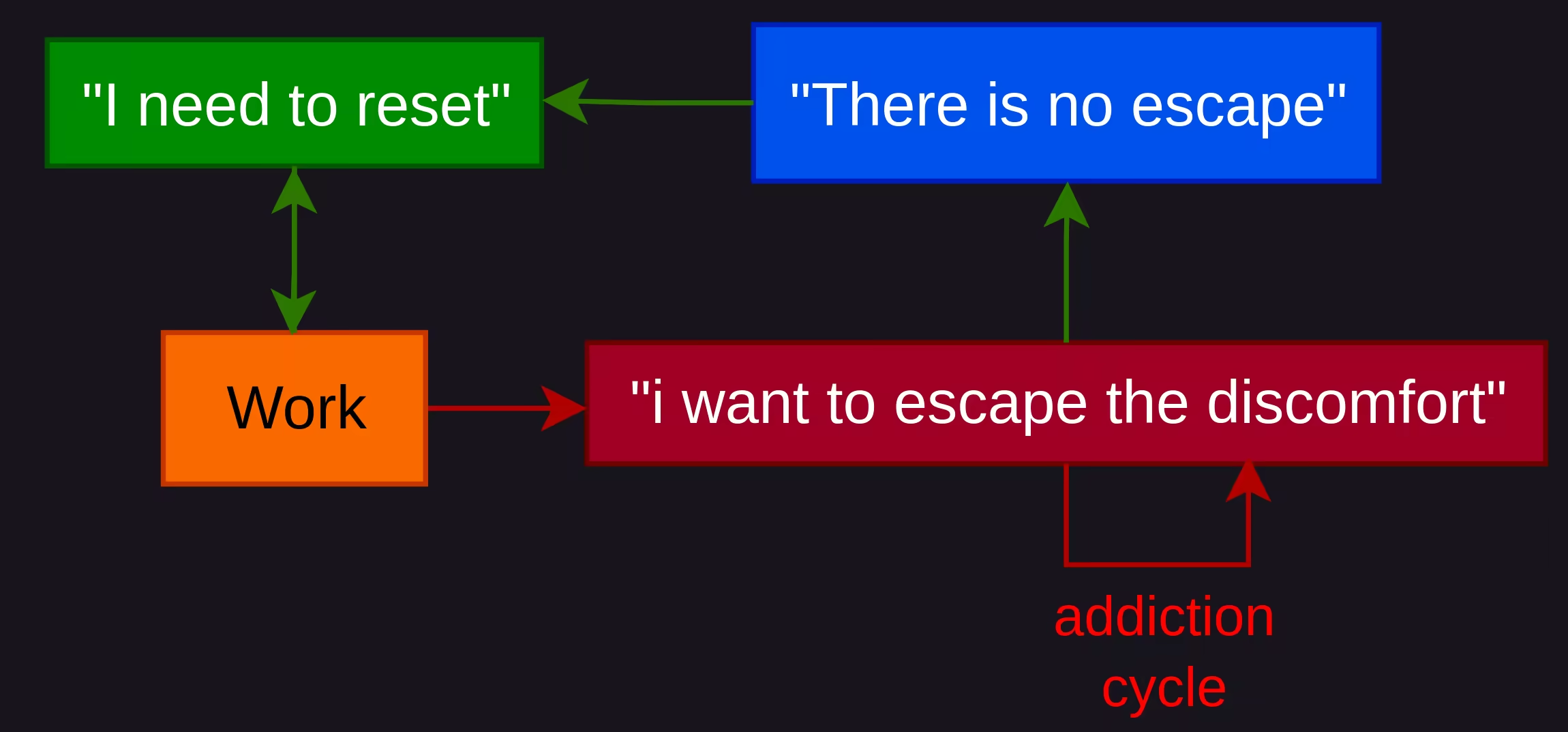
How to invest the money and reap the benefits?
Now it's the next day again, you got a good night sleep, you have 100% of your brain energy to use for the day. But there's an evolutionary trick that you can do to get even more money, at a cost. The trick is to do cold exposure, for example to take a cold shower right after waking up:
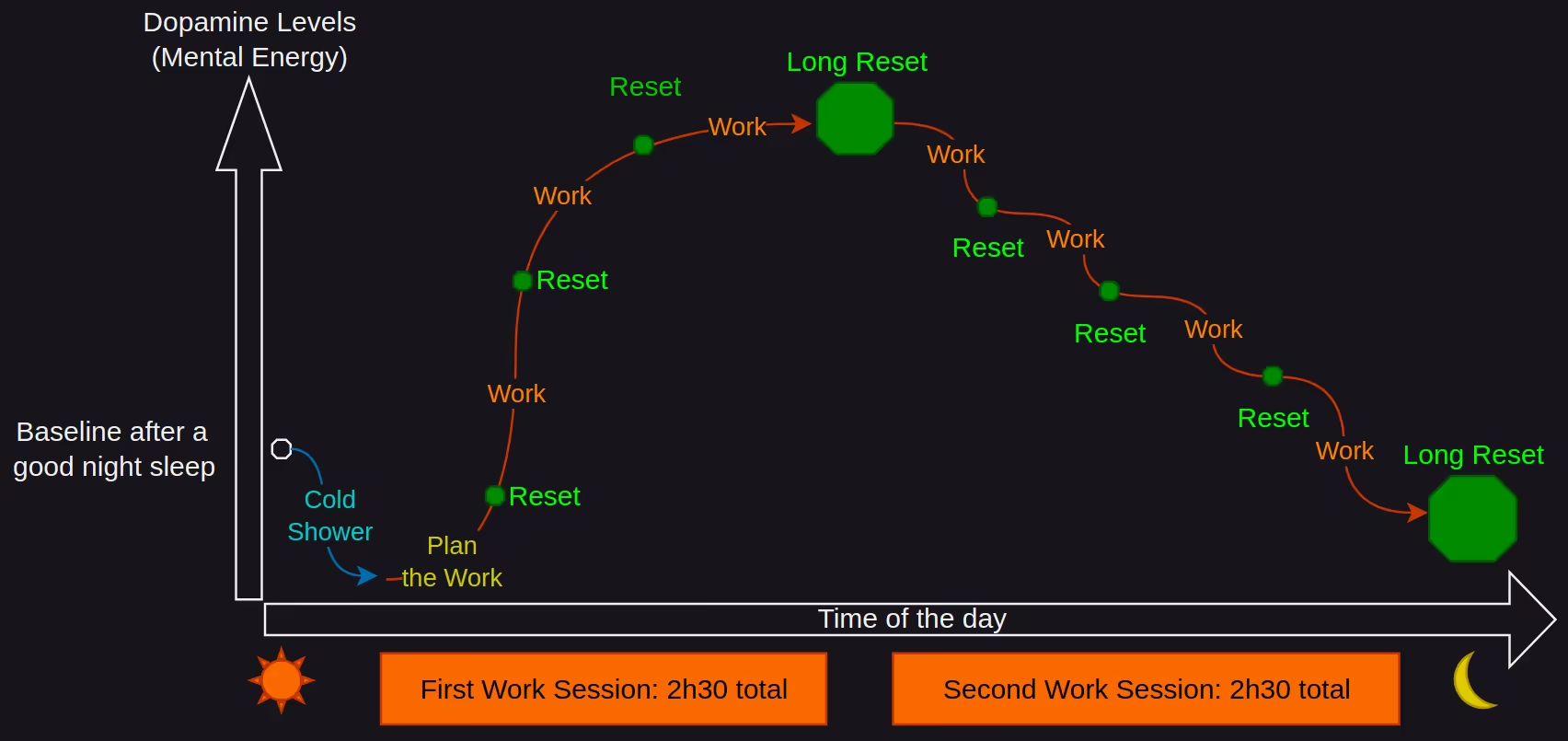
Essentially you can see this as investing your brain money, rather than burning it away. This damn cold shower definitely does not feel good, hence it temporarily lowers your dopamine levels, as if you were spending it, but rather you are investing it, because you're going to reap the benefits of a 250% dopamine boost which will last for at least 2 hours (source).
This means, that if you're willing to bear with that extra discomfort of the cold shower right after waking up, you're going to be able to start your day with more than twice more mental energy than you normally would, this means that you're going to be able to get a lot more done during the day than you normally would if you hadn't taken the cold shower.
Chapter 24
Workspace Preparation: Focus Optimization
Why is this important?
Your brain has a reward system (which is a collection of brain structures and neural pathways that are responsible for reward-related cognition), that essentially makes you feel good upon encountering certain stimuli. The problem is that your brain may give you the reward not for you actually achieving your work, but rather it may reward you along the way for totally unrelated things.
An example of this would be that you have work to do on some project, but you don't want to. And since you have all your video games on the same computer, you might be tempted to just play a video game because the reward is immediate, and it feels good immediately. All that happened here is that the carrot has changed shape, it is no longer the accomplished work, but rather it has become just playing a video game.
Over time, you may become completely desensitized after indulging into too many stimuli (video games, sex, substance abuse, etc.), so much so that nothing may feel rewarding anymore. And definitely not accomplishing any meaningful work.
You need to resensitize yourself, by cutting short all of that excessive stimuli, so that the carrot may take the correct shape. For instance my carrot is having positive feedback from my blog posts, and the donations I receive on my Monero wallet. That is my reward for the work, but as you will see, the carrot can have many shapes, and some are definitely not trivial to notice.
Where are you wasting mental energy?
Let's say you decide to follow my morning routine, it's Saturday, 7 AM, you're freshly out of your cold shower feeling refreshed and full of energy. You've decided that today you're going to work on your personal projects until you fall asleep in the night. Great, the destination has been decided. What can go wrong along the way? Or in other words, what are the potential distractions and blockers to your focus?
All of those are potential sources of distraction, which can all be obstacles to your focus and work. Therefore, we need to do something about it, before we start working.
IRL measures to take
First thing you need to do is clean up your room, and especially your desk. It should have your keyboard, your mouse, your monitor(s) and it must be well cable-managed.
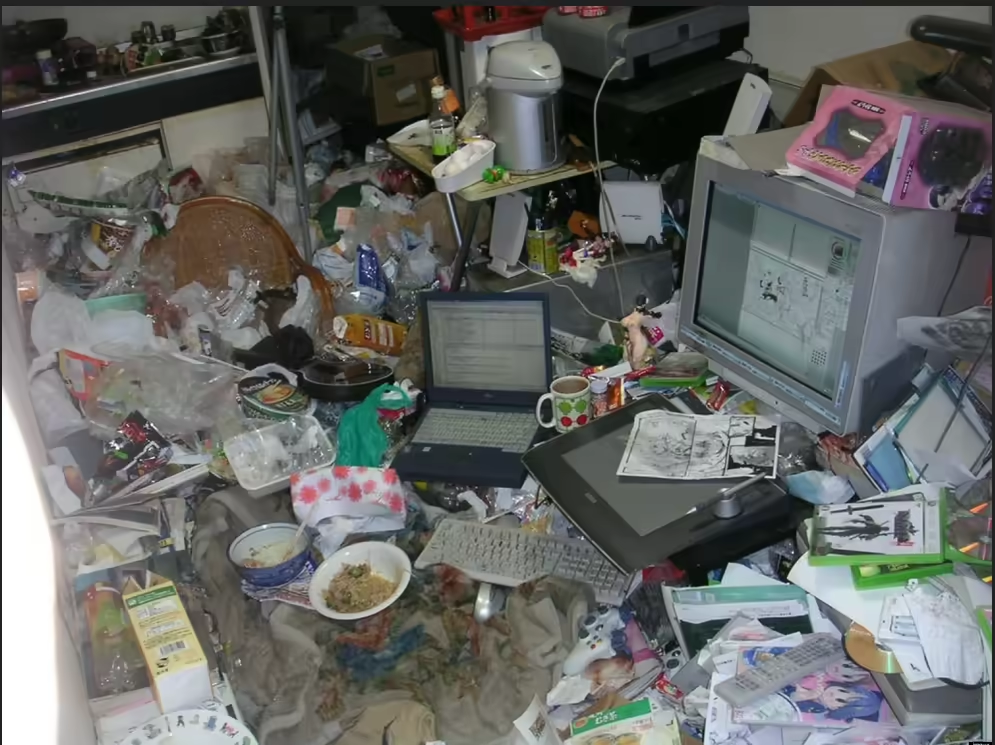
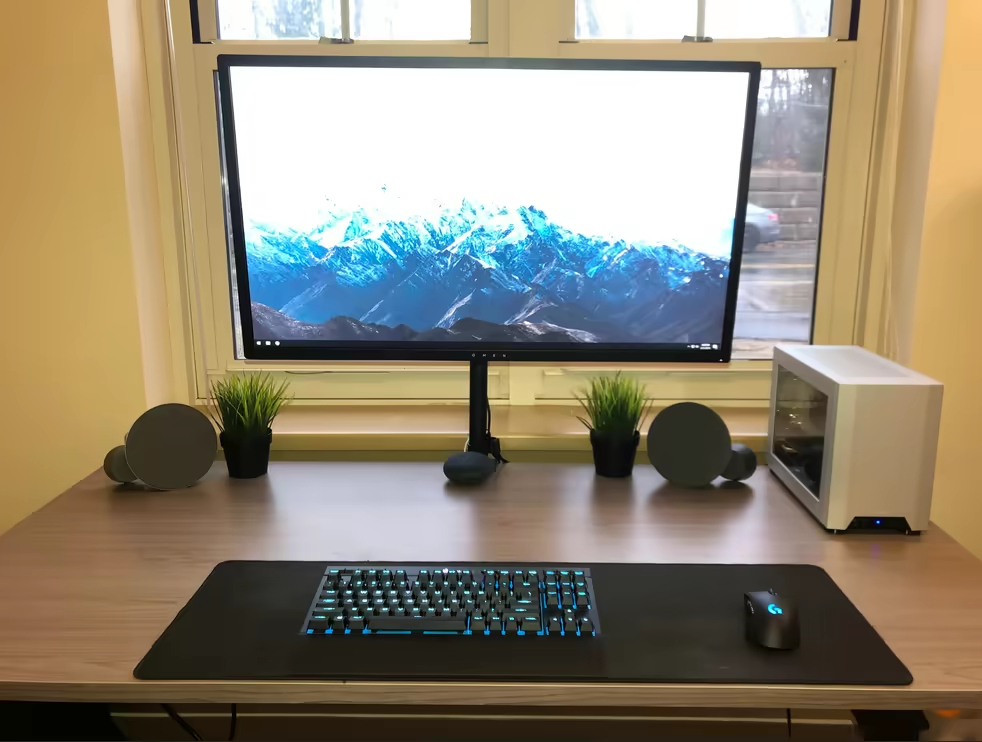
Next is how noisy is it in your room? Do you have noisy neighbors?


Now that you've taken care of your room, it's time to take care of the digital side of things.
Digital measures to take
First easy thing you can care of are the notifications on your computer.
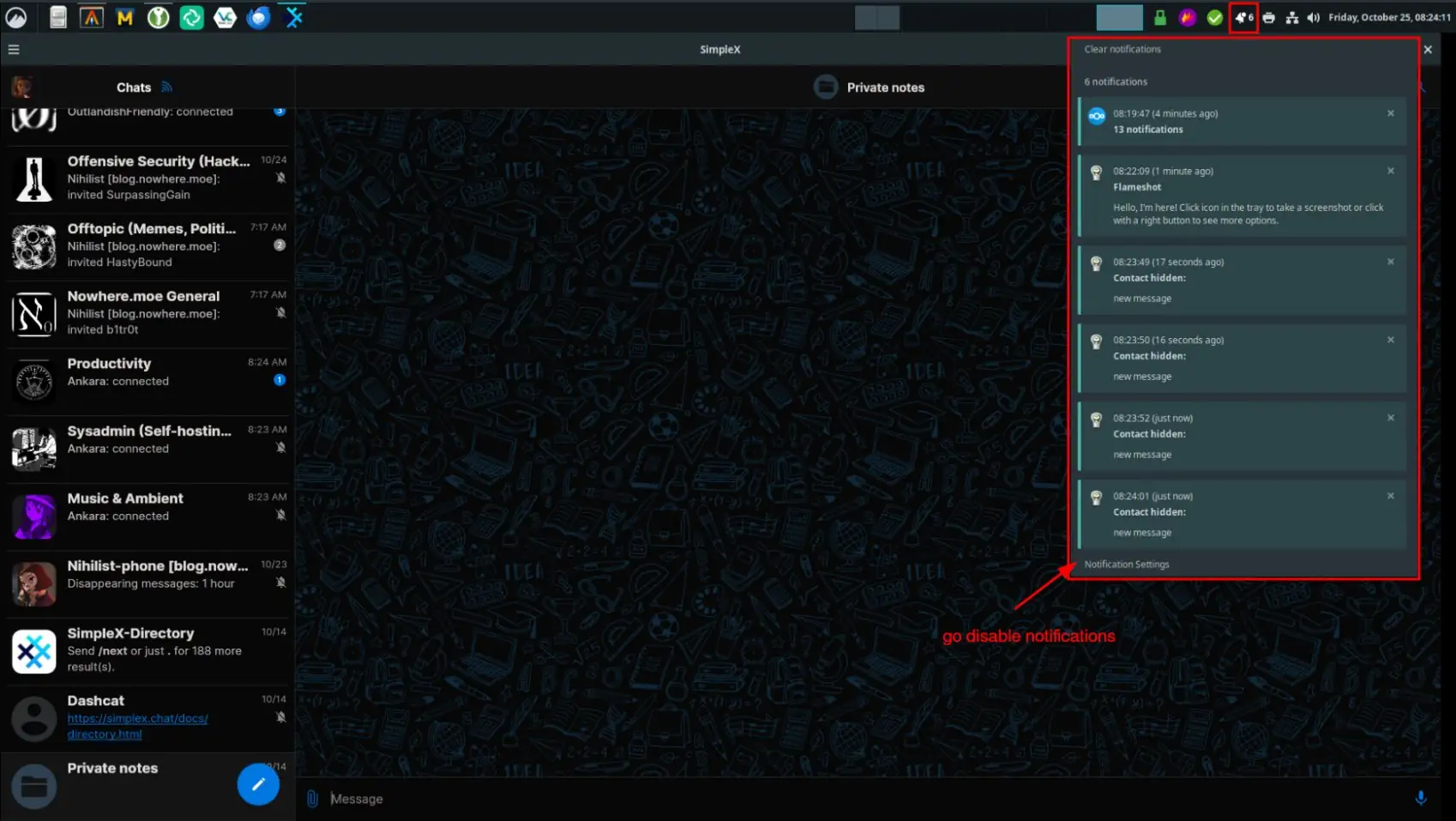
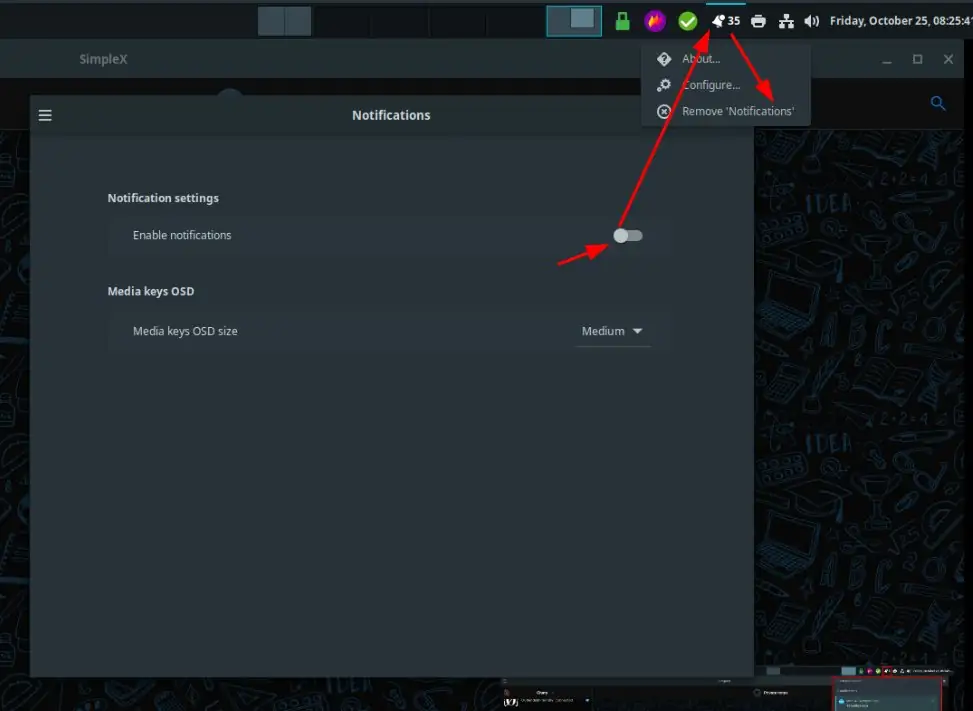
Just disable them, systemwide, as most likely none of them are truly urgent. If there is a place where you can expect to get urgent notifications (like your mails for example), keep it open on a workspace and periodically check for new alerts whenever you feel like it.
The next thing you can do is block websites that you naturally go to, to distract yourself. To do so we can block those websites from Mullvad VPN directly:
Thanks to that, you can't just go on high-stimulus websites anymore like social media or gambling.
Now if there are other websites that didn't get blocked by Mullvad, you can mention them from the hosts file in your computer:
[ mainpc ] [ /dev/pts/3 ] [blog/productivity/mentalopti]
→ sudo vim /etc/hosts
[ mainpc ] [ /dev/pts/3 ] [blog/productivity/mentalopti]
→ cat /etc/hosts | grep youtube
0.0.0.0 youtube.com www.youtube.com
[ mainpc ] [ /dev/pts/3 ] [blog/productivity/mentalopti]
→ ping www.youtube.com
PING youtube.com (127.0.0.1) 56(84) bytes of data.
64 bytes from localhost (127.0.0.1): icmp_seq=1 ttl=64 time=0.112 ms
64 bytes from localhost (127.0.0.1): icmp_seq=2 ttl=64 time=0.095 ms
64 bytes from localhost (127.0.0.1): icmp_seq=3 ttl=64 time=0.090 ms
Then, you may have a very high-contrast wallpaper that may distract you:
So simply change it to no wallpaper, just pick a color and select "no picture":
Next, you may listen to some music while working, but here also you need to be careful if the music is very intricate with a high-stimuli potential. For , you may be used to working with high-stimulating music, but these have the potential of wearing down your mental energy, causing you to get tired much more quickly, than with a low-stimulus music.
My preferred tracks for working would be ambient tracks [[2]](https://radio.nowhere.moe/radio/meditation.mp3)[[3]](https://radio.nowhere.moe/radio/nihilism.mp3), not enough to distract me, and enough to feel like listening to something. One other option would be to work in total silence if you are able to focus in that scenario, but it depends on what you are used to.
And lastly, you don't want to do everything from one workspace, otherwise you're going to get lost pretty quickly if you need to do planning, doing the work, reviewing the work, etc.:
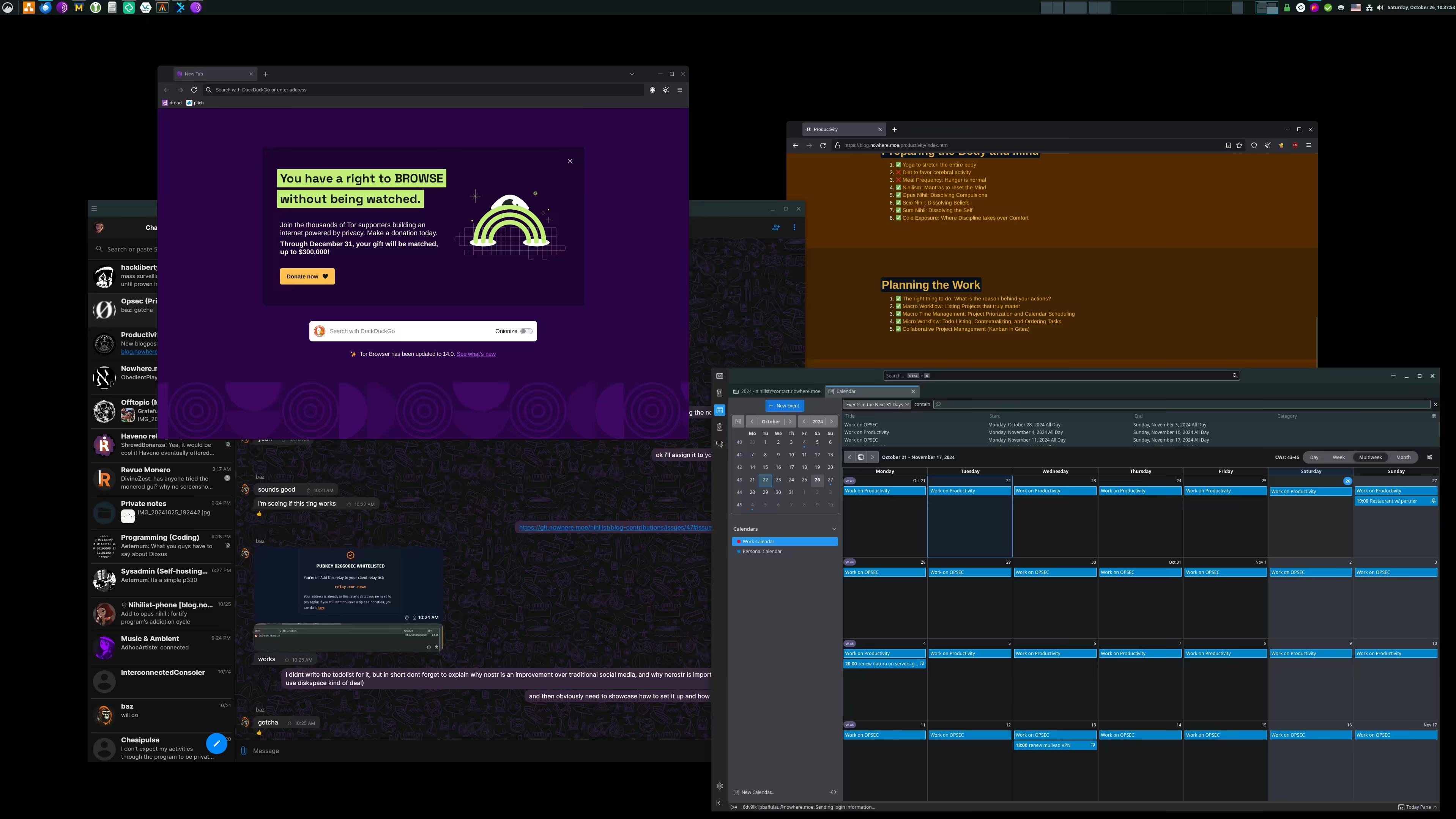
You need to use multiple workspaces:
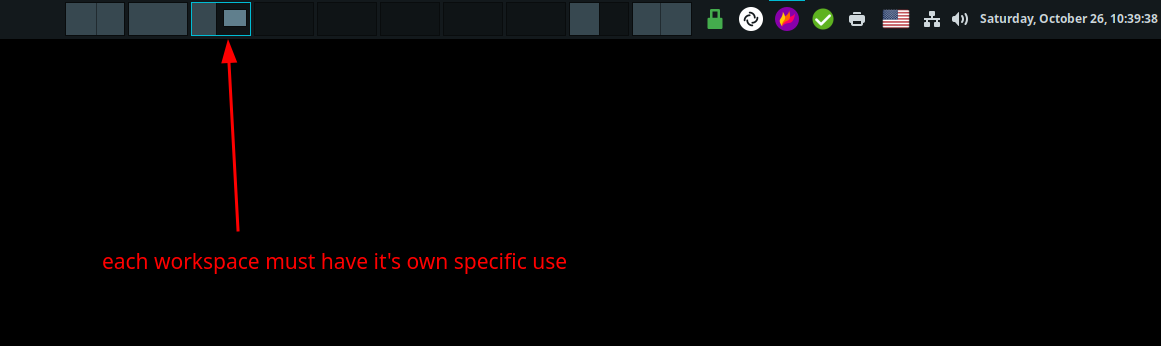
For instance, I have 10 workspaces divided like so, based on the general workflow we highlighted in this previous tutorial:
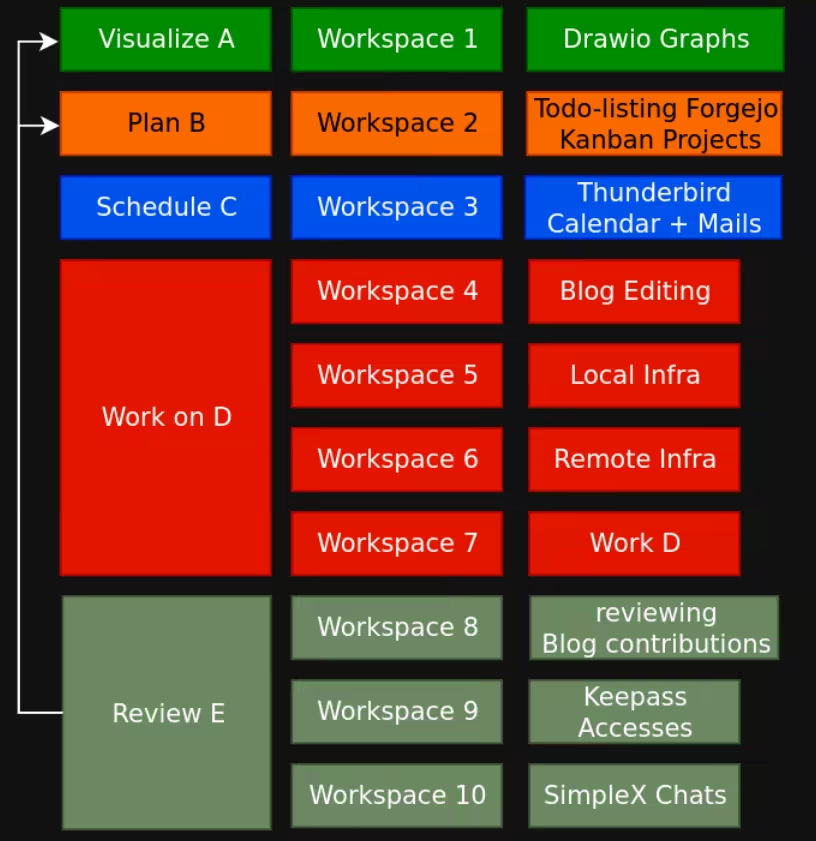
To make accessing each workspace easier and faster, I configured shortcuts:
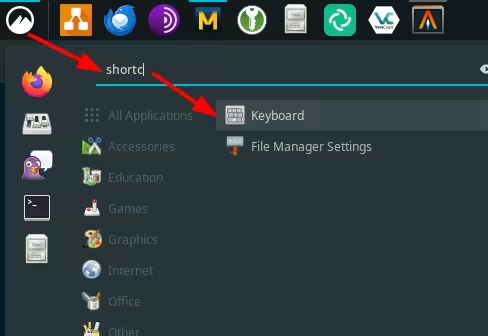
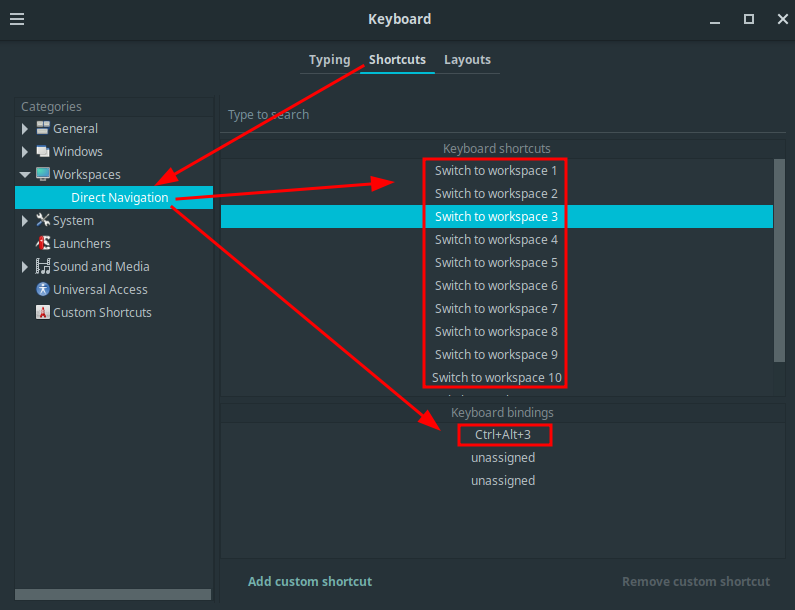
And that's it! Now stop going around in circles, and get back to doing what truly matters to you!
Tiling Window Managers
Tying back to the workspace management, you can have a tiling window manager where you can manage the applications you open and move around on your desktop using only the keyboard.
To achieve this I recommend using the i3 window manager like so:
nothing@debian:~$ su -
Password:
root@debian:~# apt install i3 -y
once installed, (since you are probably not already in i3, but rather in another window manager like cinnamon) you can simply go back to the login screen by logging out or by running this command:
root@debian:~# systemctl restart lightdm
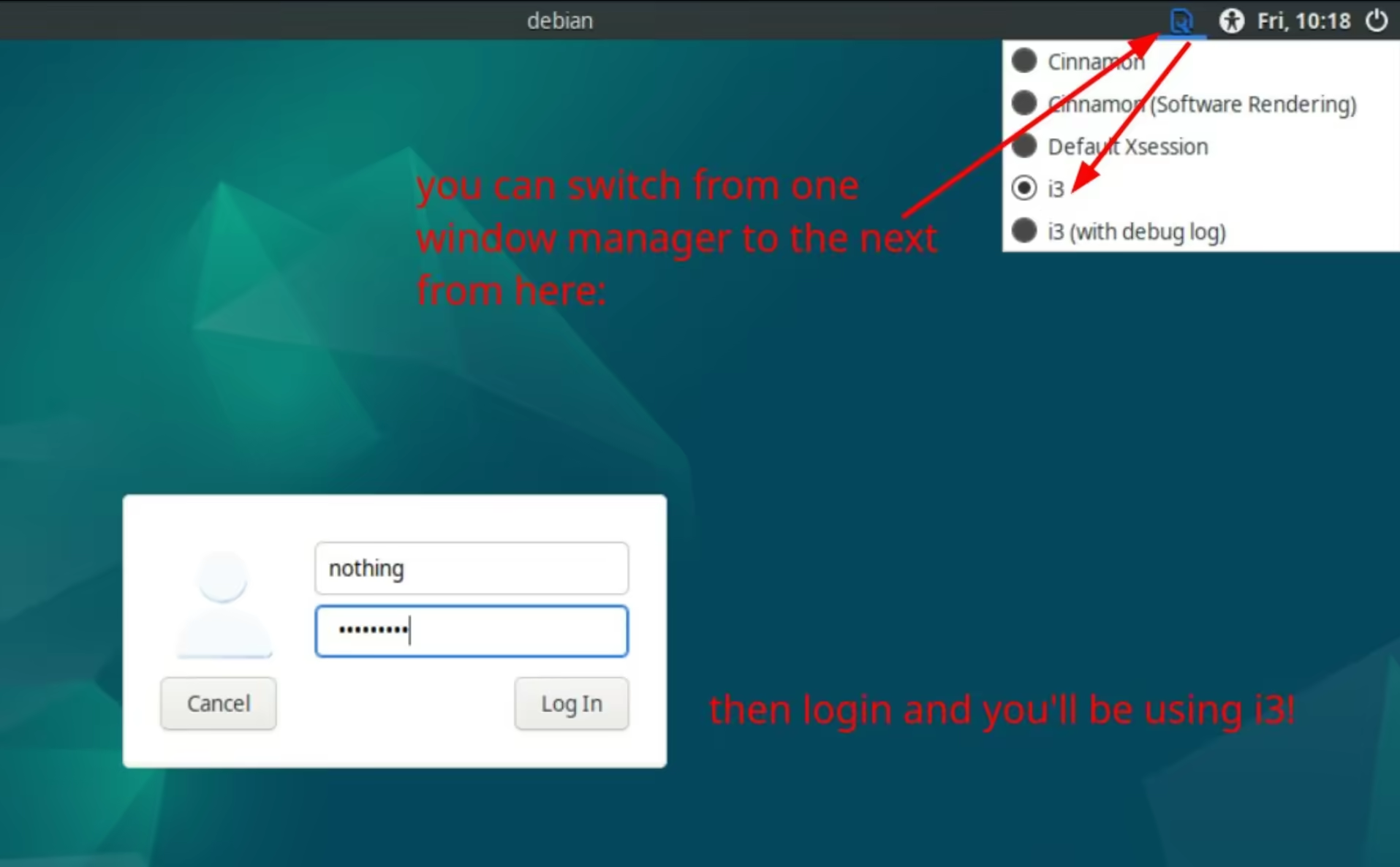
From there you can start to edit the i3 config from a terminal (that you open with the shortcut Win+ENTER):
nothing@debian:~$ vim ~/.config/i3/config
From here you can customize just about anything you want, from the shortcuts, to the colors used and the apps that are launched upon startup. Here are the main shortcuts that you need to remember:
#my Modkey is the windows key (Mod4), it's at the very top of my i3config file.
#Change workspaces:
-Mod+1234567890
#Change focus to next window:
-Mod+Arrow
#KILL the window:
-Mod+Shift+Q
#Toggle Vertical/Horizontal layout:
-Mod+V or H (and then move/create a window where you put the V/H mode)
#Move window in the workspace:
-Mod+Shift+Arrow
#Move window to workspace:
-Mod+Shift+12345647890
#Create Terminal window:
-Mod+Enter
#open any application:
-Mod+d
(type application name)
ENTER
#Toggle floating mode on a window:
-Mod+Space
#Enter resize mode:
-Mod+R
-then Arrows to resize
-then ESC to exit resize mode
My Productivity Setup
I customized this quite a bit myself, while still trying to remain minimalistic about it, you can find my dotfiles here. In order to get my customized setup quickly I have made those 2 scripts:
First script to set up i3 and the GUI apps I want (Draw.io, Tor Browser, Mullvad Browser, SimpleX chat, KeePassXC):
nothing@debian:~$ su -
root@debian:~# usermod -aG sudo nothing
root@debian:~# reboot now
nothing@debian:~$ sudo apt install git tor -y
nothing@debian:~$ git config --global http.proxy socks5h://localhost:9050
nothing@debian:~$ git clone http://gdatura24gtdy23lxd7ht3xzx6mi7mdlkabpvuefhrjn4t5jduviw5ad.onion/nihilist/dotfiles
nothing@debian:~$ cd dotfiles
nothing@debian:~$ chmod +x ./kicksecuresetup.sh
nothing@debian:~$ ./kicksecuresetup.sh
(let it run, and put your sudo passwords when it asks for it)
And I have this other script here to set up my terminal how I want it to be with the CLI apps I use (zsh, tmux, ohmytmux, ranger, and vim):
nothing@debian:~$ ./terminalsetup.sh
(let it run too, and put your sudo passwords when it asks for it)
Do put your user's password whenever it asks for it, and once they finish running you can reboot your Debian OS to see the changes:
nothing@debian:~$ sudo reboot now
On the first workspace: launching Draw.io to help me visualize what I envision for the projects I maintain
On the second workspace: launching the tor browser on Datura Forgejo to help me plan the next issues for the projects
On the third workspace: launching thunderbird to help me schedule the work I need to do
On the fourth workspace: Launching VSCodium to write new content for the blog.
The rest of the workspaces are work-related, where I use the terminal a lot, hence from a terminal window I need to remember the following tmux shortcuts:
#enter tmux:
tmux
#CTRL+b is the default tmux keybind to start any tmux action.
#to cancel it just press ESC
#WINDOWS
#Create a new window:
CTRL+b c
#kill current window:
CTRL+b &
#Rename Window
Ctrl+B,
#Goto window:
CTRL+b 123456789
#Browse the tmux sessions (windows and panes)
CTRL+b W
#PANES (contained within windows):
#split vertically or horizontally (this is creating panes basically):
#CTRL+b "
#CTRL+b %
#Change pane focus:
CTRL+b Arrow
#Cycle Panes:
CTRL+B o
#Cycle Move panes:
CTRL+B CTRL+O
#Move pane into new window:
CTRL+B !
#Resize Pane:
CTRL+b CTRL+Arrow
#close pane:
CTRL+b x
#display pane numbers:
CTRL+b q
#COPY AND PASTE
CTRL+b [ (to enter copy mode, or PageUP to place the cursor farther up)
-> and then just click and drag to whatever text you want to copy
arrow keys (to place the cursor where you need it (or PageUP/PageDN))
CTRL+Space (and then move the cursor to select the lines you need)
CTRL+W (to copy your selection into the buffer)
CTRL+SHIFT+V (to paste your selection)
SHIFT+insert (to paste your selection)
CTRL+B [
then CTRL+S (Search Pattern downward)
then Enter
then hit n to cycle through the results
CTRL+B [
then CTRL+R (Search Pattern upward)
then Enter
then hit n to cycle through results
CTRL+B f (find window based on what's displayed in it)
From i3, if you want you can also mute all notifications by adding the following Dunst lines in startapps.sh:
[ Mainpc-PrivateVM-Debian12 ] [ /dev/pts/38 ] [~]
→ cat ~/.config/i3/startapps.sh
#!/bin/bash
# DISABLE NOTIFICATIONS:
/usr/bin/dunst
/usr/bin/dunstctl set-paused true
sleep 1
#Start apps:
[...]
And there you have the last 2 workspaces, one for payments and accesses, and the last one being for distractions:
And that's it! You now have a completely tuned-up productivity setup like mine.
Chapter 25
The Morning Routine
To give you a little introduction on this routine, first note down that this is intentionally designed to be uncomfortable. I am aware that not everyone will want to wake up at 6 o clock in the morning on a Sunday and take a cold shower at 7 o clock. But the reason I am doing this ties back to the discipline I am building and refining every day, see Opus Nihil.
We, as humans are different from animals because we are able to choose to go beyond our instincts, while animals are unable to. It is our ability to choose, and to use tools that is making us the peak of evolution on this planet. But the less you are exerting your ability to choose, and to use your body and mind as your own tools, the less you are human. We are "Human beings" only when we know how to be, if you don't know how to be, then you're just a "human creature", no different from the rest of the animal kingdom.
The reason behind it is that the first thing you must do in the morning is exert your ability to choose, no matter what the body or mind wants, we are not talking about building habits in the conventional sense, we are talking about dissolving habits. Normally you would want to wake up later, you would want to turn up the heat. But doing so means that you are giving up control, That is why we are bringing back control, to dissolve your habits.
There is one thing you need to remember before you start. The first step is the hardest, but the next one is easier, and the next one even easier. Don't underestimate your body and mind's ability to adapt. Personally the hardest part for me was to wake up that early in the weekend, but now, 2 months in, there's nothing hard about it anymore, it is simply part of waking up now.
So give yourself some time to adapt to it, maybe start your day at 8 o clock in the weekends initially, and the next week start it at 7h30, and the next week at 7h00, until you arrive at 6h00. I feel like this is optimal due to the amount of work I can squeeze into the morning when I start to work on my personal projects from 7h00 to 12h00, so in my opinion it is totally worth the effort.
The First Hour
That is because at 7:00 in the morning, I must be out of the house.
Workdays:
-6h00: wake up (only one alarm, place it far away from the bed)
-6h30: yoga session ends
-6h45: cold shower ends
-7h00: out of the house
-7h30: ready to work on personal projects
-9h00: ready to work on work projects
Truth is, I'm working a typical 9 to 5 job, yet I arrive this early at the workplace to work on personal projects first. Prioritizing morning work is ideal because this is when you function at your best. Pack the most important/complex tasks of the day in the morning, because that's when you usually can get the most things done.
Weekends:
-6h00: wake up (only one alarm, place it far away from the bed)
-6h30: yoga session ends
-6h45: cold shower ends
-7h00: ready to work on personal projects
Yes, waking up at 6 AM during the weekends is going to be tough at first, but this is part of the discipline aspect. As far as I'm concerned, Saturday is the same as Friday as either way I am working on something. Either I am working on personal projects, or I am working on the work projects.
This is a choice that one must make at some point; do you want to sleep your life away, or do you want to actually get up early and accomplish things for the world?
This ties back to the concept of discipline over comfort, first thing in the morning: are you waking up because your body and mind feels like it? Are you waking up because you must do so? Or are you waking up at a certain time, because you chose to do so, regardless of what your body and mind wants?
Preparing the Body and Mind
First thing in the morning you must do is get control over your own body, using Yoga.
Now if you're not used to it (meaning, not flexible enough), you may not be able to do every posture correctly, that's not a problem, no need to force it. Just try to do each posture as best as you can do it. The idea is that you must work to get your body into a certain geometry, intentionally.
Once the body is under control, head over to the shower. And if you have read my previous tutorial, you know where I'm going with this.
The second thing in the morning that you must do after getting control over your body, is to get control over your mind. You can do so very easily with a cold shower. Intentionally start the temperature at your "uncomfortably cold" setting, and take your time to clean yourself.
Make it last 10 or 15 minutes if you can, and make it your new normal.
The water is perfect, just the way it is.
It is ME who must accept it.
In that situation of stress, see if you can breathe slowly, and through your nose only. If you want to dig deep into yourself, mentally (and slowly, following the breath), repeat the Nihilism mantras:
Opus Nihil: to dissolve your compulsions
Inhalation: I want nothing,
Exhalation: I need nothing
Scio Nihil: to dissolve your beliefs
Inhalation: I know nothing,
Exhalation: I know nothing else
Sum Nihil: to dissolve your identities
Inhalation: I am nothing,
Exhalation: I am no one
You can repeat them a few times, then once you're done, it should be around 6h45, leaving you 15 minutes to get dressed and leave to go to work.
Sidenote: yes I didn't forget to mention "having breakfast" because there's none. Leaving your stomach empty at the beginning of the day is totally intentional as this is part of making sure that your body goes into a natural, internal cellular purification, which doesn't happen when your stomach is processing food. 2 meals per day (one at noon, and one in the evening) are enough for you to survive just fine.
Chapter 26
Pomodoro Focus times (Intentional pauses to prevent burnouts)
Why should I take pauses?
Following my routine to the letter, it's now Saturday at 7 AM, you've made sure that nothing can distract you from working, all that's left is to work non-stop until the end of the day right? Well, you will see that there is a problem after some time.
So you're now working on the project of your life, and you've been working on one task without stopping for 45 minutes straight. Are you in shape to go for another hour without pause?
One analogy to compare this to is when you are running outdoors, doing cardio. Can you really sprint all the time? You can't do that. You can only sprint so long before you need to catch your breath and make a pause, to be able to sprint again. The same principle applies here, you can't just focus all the time, you need to take small breaks at regular intervals.
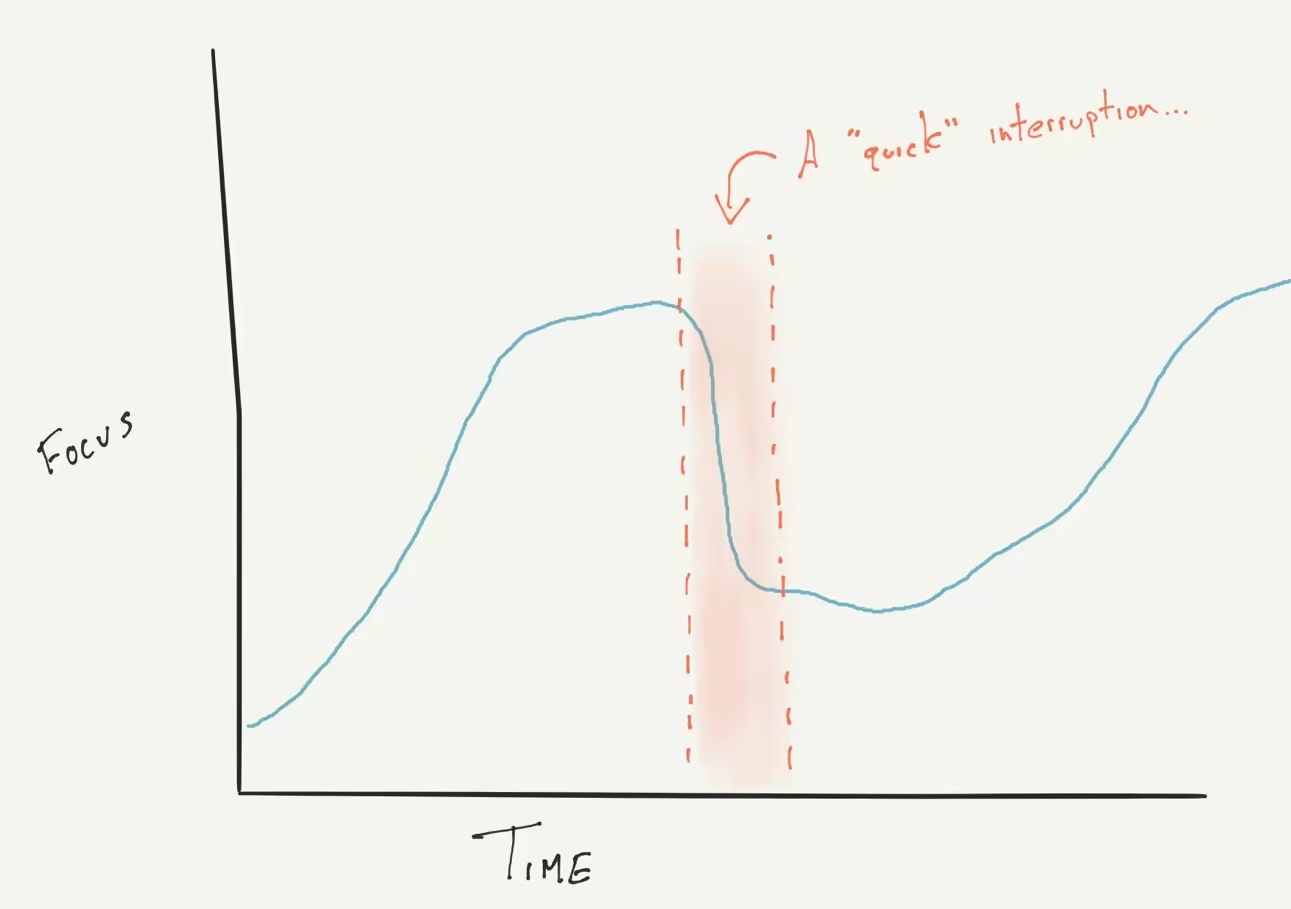
Now here the question is how long should the breaks be? At what interval? And do you even do during those breaks?
The Pomodoro Technique
Pomodoro is a time management method originally developed by Francesco Cirillo in the late 1980s, it basically uses a timer to break work into intervals that are 25 minutes in length, separated by short breaks of 5 minutes.
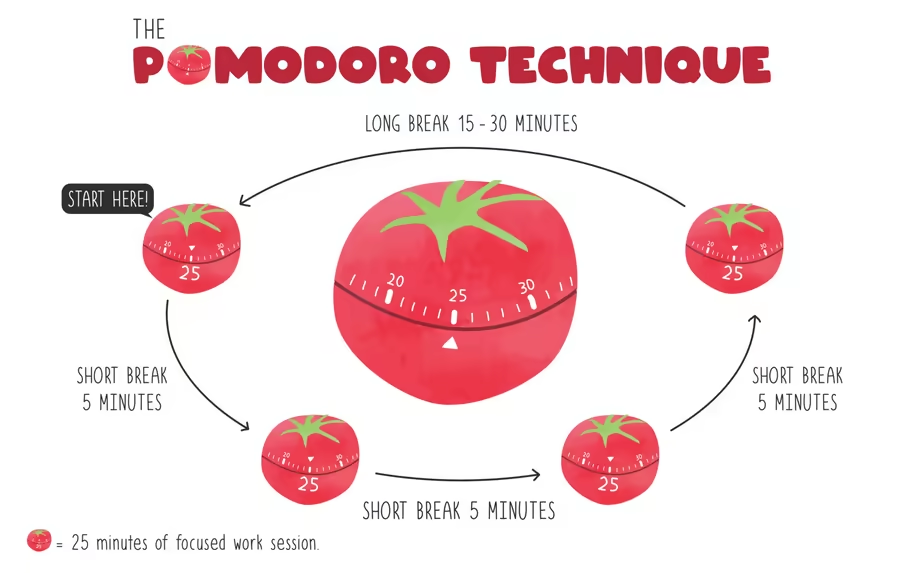
The idea being that you are able to function at your maximum cerebral capacity on average for 25 minutes before requiring a break. And the break needs to last 5 minutes on average, before you are able to focus at your maximum capacity again. And after 4 working sessions, you take a long break of 30 minutes, or in my version of pomodoro, a 35-minute-long break:
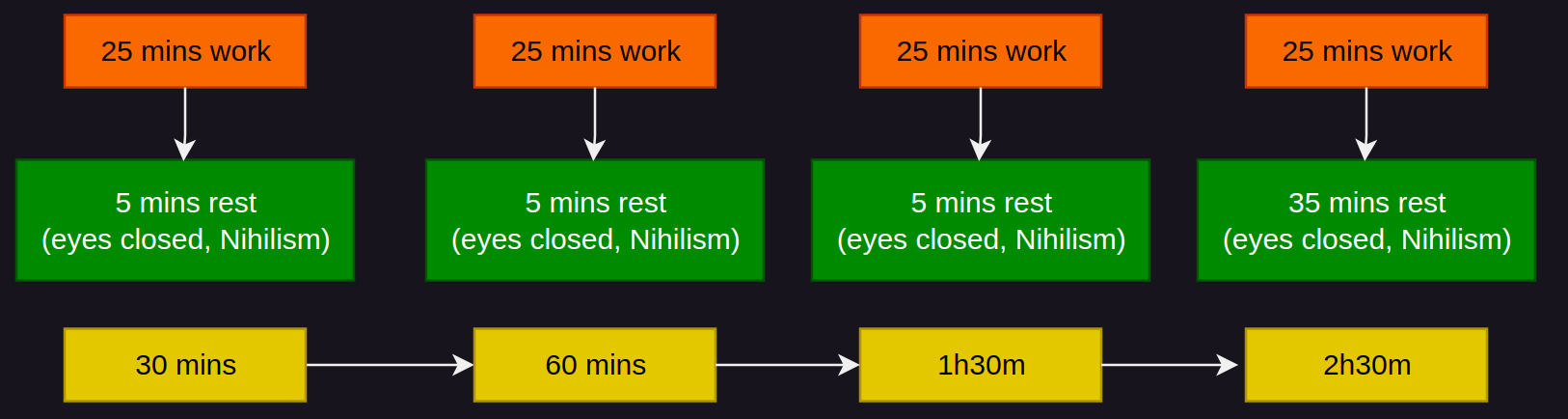
The question also is what the hell do you do during your breaks? Do you just open up your phone and start scrolling through social media? My recommended break method is to do a quick Nihilism meditation, to reset your mind:
Recommended break:
0) Sit with your back straight
1) Close your eyes
2) Slow down and deepen your breath
3) Mentally, go over the 3 nihilism mantras for 5 minutes at least:
Opus Nihil: to dissolve your compulsions
Inhalation: I want nothing,
Exhalation: I need nothing
Scio Nihil: to dissolve your beliefs
Inhalation: I know nothing,
Exhalation: I know nothing else
Sum Nihil: to dissolve your identities
Inhalation: I am nothing,
Exhalation: I am no one
In my opinion, this is the most efficient break you can take. As you are intentionally winding down your brain activity, on top of mentally dissolving what you were previously working on, and shifting your focus on something else (here, the slowing and deepening of breath and thoughts). If you do it right (meaning, if you managed to dig deep enough), the moment you open your eyes again, you should rediscover what you were working on, as if it was the first time, with a completely fresh view on it.
There is no Escape
Now, you need to be extra-careful whenever you are finishing a work cycle, because this is when the discomfort is at its peak, and that's where you are most likely to indulge in addiction:
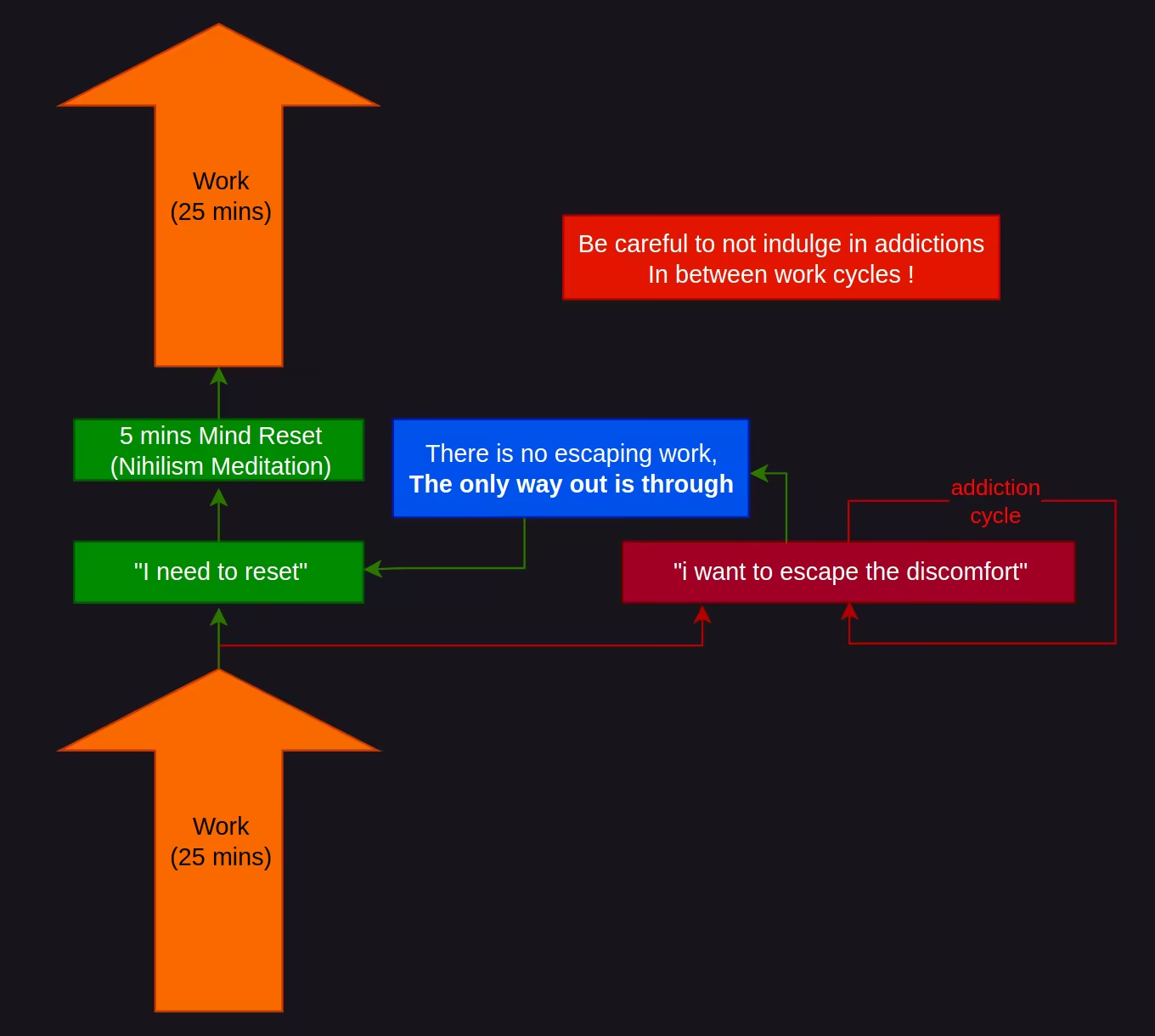
This is going to require attention, and training, but it will get easier over time, you need to get over this habit of "wanting to escape the discomfort". Wanting to escape is weakness, it is giving up, it is failure, it is abandoning your duty. The "escape" can be many things, such as substance abuse (nicotine is most common), or simply social media, or viewing adult content, this is where you are susceptible to fall back into pleasure seeking, and right before you start to indulge in addictions, that is where you need to make sure you do not enter the addiction cycle.
With enough training, once you have accepted that there is no way out, your thinking pattern should go Working, to "I need to reset", performing your mental reset, and then going back to Work. That way you are cutting out all possibility of addiction, especially when you are confronting yourself with discomfort.
How do I know I need to take a break?
Either you are self-aware enough to know when you are feeling overworked, and you'd do the reset instinctively, or if you're not self-aware enough I recommend to just look at the nearest clock:
FIRST WORKING SESSION:
-7h00: 25 minute work
-7h25: 5 minute break
-7h30: 25 minute work
-7h55: 5 minute break
-8h00: 25 minute work
-8h25: 5 minute break
-8h30: 25 minute work
-8h55: 35 minute long break
During each break recommend doing the nihilism meditation, in order to dig deep into yourself, and to recover on a deeper level. Another way of doing it is to go out for a walk, as the reasoning is the same, you are intentionally changing the context, changing what you are doing, and lowering the mental effort as much as possible, so that your brain may integrate what you were doing, and recover from it.
And then you can repeat the working cycle once again after the 35-minute break is over:
SECOND WORKING SESSION:
-9h30: 25 minute work
-9h55: 5 minute break
-10h00: 25 minute work
-10h25: 5 minute break
-10h30: 25 minute work
-10h55: 5 minute break
-11h00: 25 minute work
-11h25: 35 minute long break
And that's it! You now know how to not get burned out at the end of the day, while putting out as much work as you possibly can.
Chapter 27
Reflecting: How to use graphs to help Brainstorming ideas (Draw.io)
Why make graphs?
Because a well-written graph is worth a thousand words, you are conveying the same amount of information in one image, than you would convey in 20 lines of explanations. It is also something that you need to do in order to not lose your viewers' focus. Especially if they are not on the same technical level as you.
How to make Graphs
If you are showcasing a complex tutorial please put into a graph what you are talking about. I used to make graphs using yEd Graphs (but it's closed source) so instead as of Q3 2024 I'm using Draw.io to make them, both tools have got everything you need to write complex graphs.
[ mainpc ] [ /dev/pts/3 ] [blog/opsec/manifesto]
→ apt search draw.io
Sorting... Done
Full Text Search... Done
draw.io/now 24.7.17 amd64 [installed,local]
draw.io desktop
[ mainpc ] [ /dev/pts/3 ] [blog/opsec/manifesto]
→ apt install draw.io
[ mainpc ] [ /dev/pts/3 ] [blog/opsec/manifesto]
→ drawio
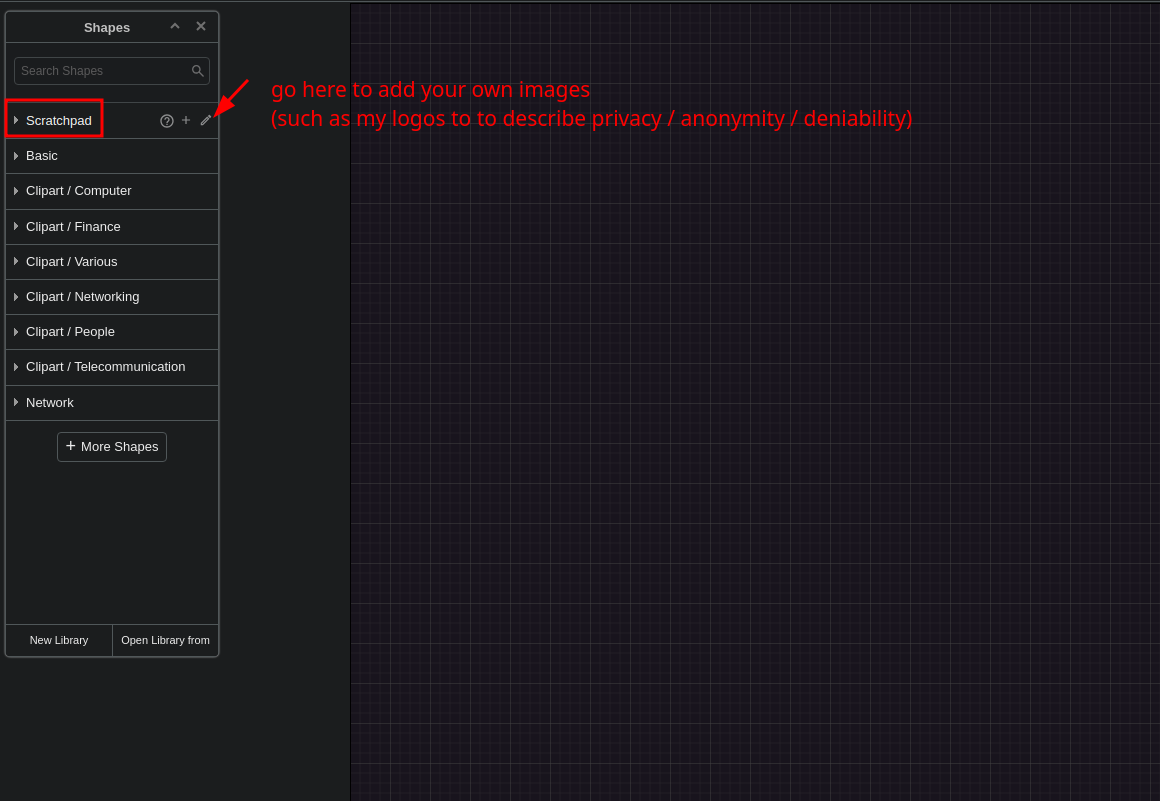
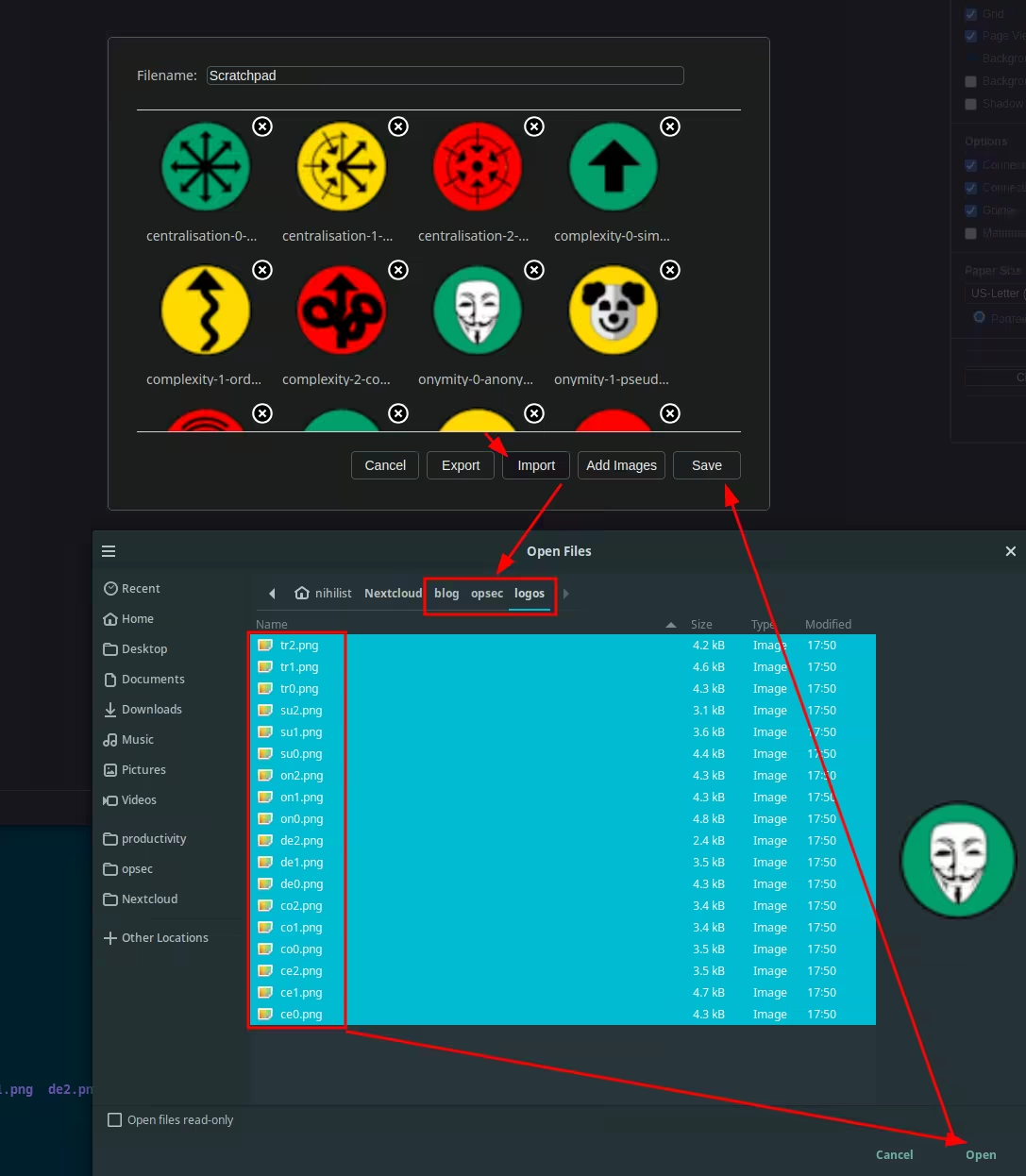
Then, I'll let you go through the Draw.io documentation to learn how to use it, as there's a lot to cover to add logos, change shapes, add text, add arrows, etc.:
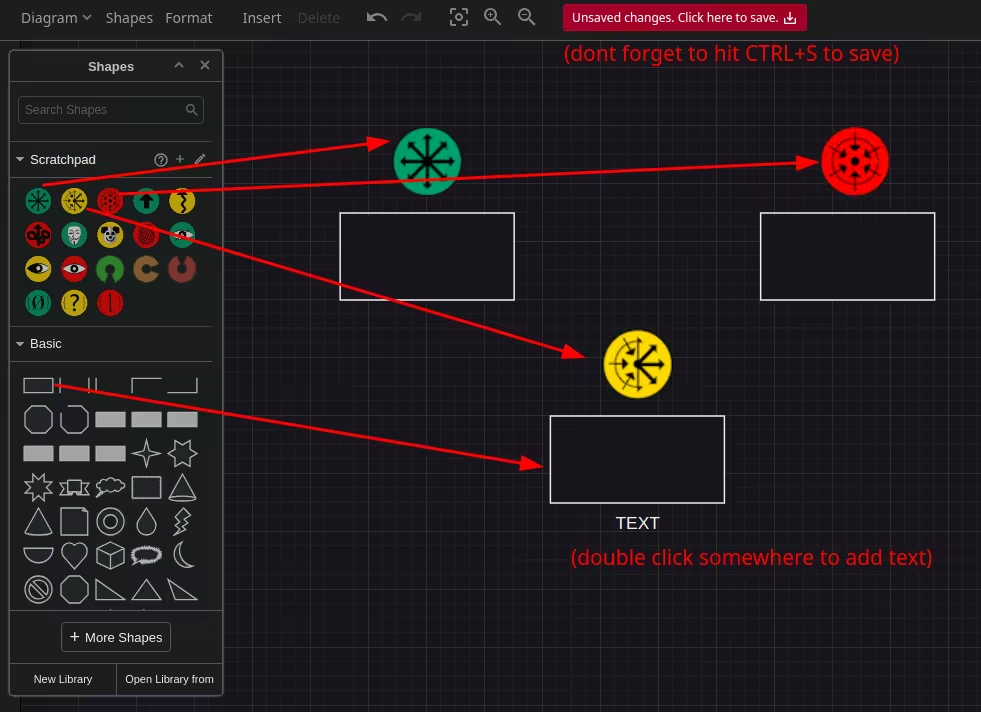
And in the end you can make good-looking graphs like this one:
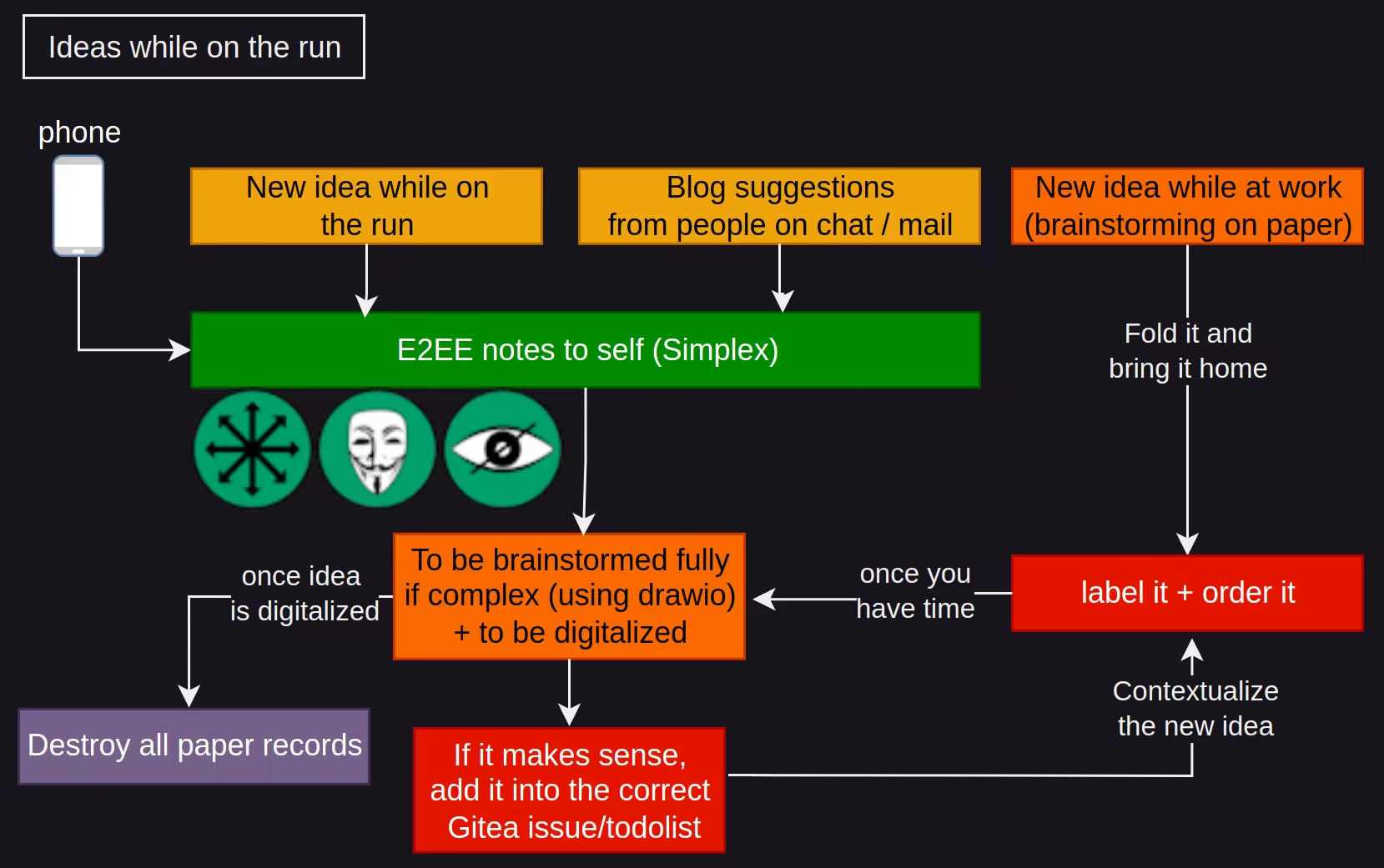
And that's it! You just made it easier for your readers to understand what you want to convey to them, and you're not loosing half of your potential viewers on unnecessary walls of text.
Chapter 28
Reflecting: Brainstorming Ideas while on the run
Why is this important?
You may not always find all the best ideas while in front of your computer, maybe you're like me, and you get ideas from time to time to problems that linger on without solutions for too long. Sometimes the solution to one of those problems just flashes in my mind while I'm at work, or while I'm outdoors. Lightning strikes wherever and you can't just predict it.
When you get a simple idea
Maybe you just got a vague idea like this one:
Protecting your Anonymity online by typing like a character (Stylometry)
You could just tell yourself "alright I'll hang on to that idea until I get home", and if you're one of those memory athletes you may remember it, but frankly I can't due to the amount of different topics I need to tackle each day for work, and for my personal projects.
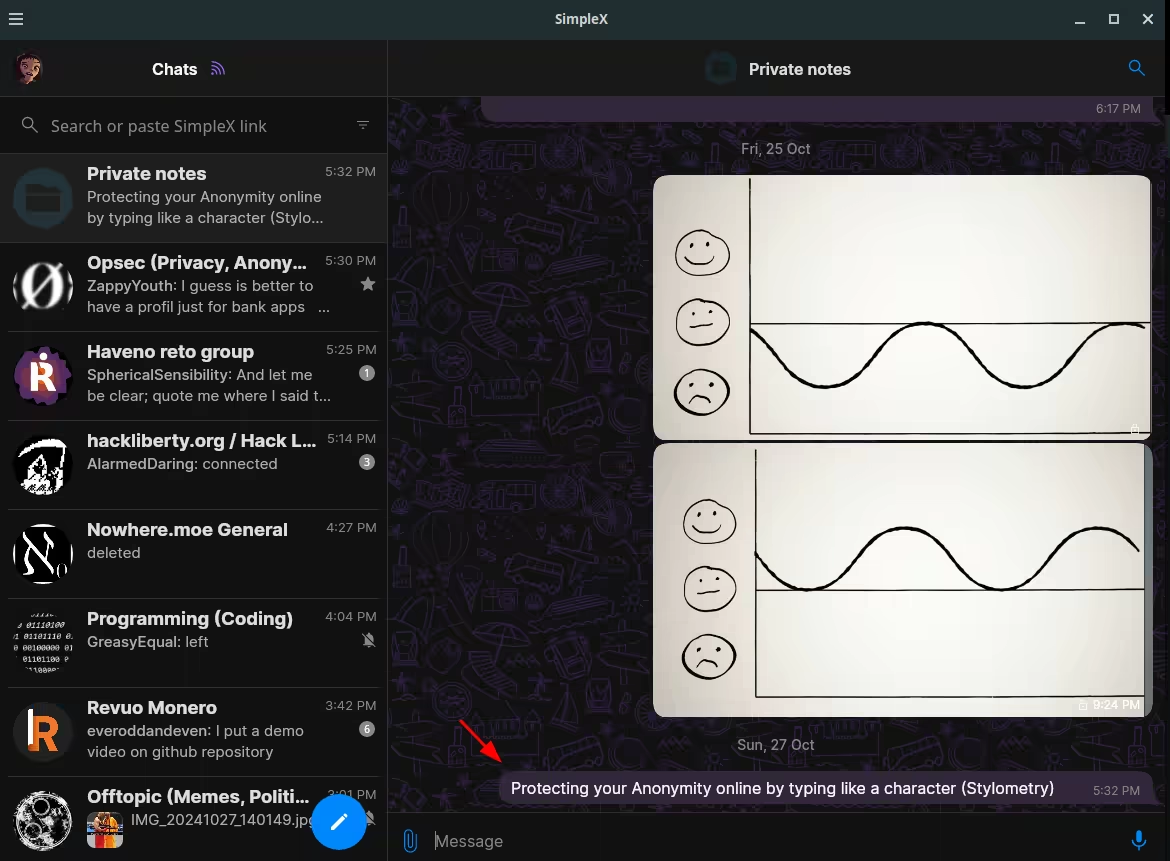
Now this may look like a simple idea, but it will need to be brainstormed further when you get the time to dig into it, back home like I did here.
When you get a complex idea
And sometimes, you may have a flash of lightning with a complete flow of ideas that you need to write down immediately. When that is so, I usually just grab a piece of paper and I start making a to-do list right off the bat like this one:
Requires:
-(at minimum 2 wan) dual wan config as showcased in https://blog.nowhere.moe/opsec/failover-wan/index.md
-power failover setup as showcased in https://blog.nowhere.moe/opsec/prevent-electrical-failovers-with-ups/index.md
-linux home-server https://blog.nowhere.moe/opsec/privacy-on-your-computer-with-linux/index.md
-qemu hypervisor https:///opsec/hypervisor-setup/index.md
-pfsense qemu VM as showcased in https://blog.nowhere.moe/opsec/pf_virt/index.md
-isolated LAN network for the VMs also as showcased in https://blog.nowhere.moe/opsec/pf_virt/index.md
Starting from a setup where you have:
-a pfsense VM
-an isolated LAN network
-and a debian VM in that LAN network
-a HDD with a VC hidden volume of 100GB (pfsense 20gb, debian 60gb)
To be showcased:
-how to move that debian VM in a VeraCrypt hidden container (shut it down and then move it in there)
-clone that debian VM to another debian VM B
-rename debian VM A to "Tor bridge VM (with VPN)"
-rename debian VM B to "hidden service VM 1"
-setup mullvadVPN on that VM for a "serverside -> VPN -> tor -> clients" setup
-Then mention the automating deniability protection w/ emergency shutdown script as showcased in https://blog.nowhere.moe/opsec/physical-security/index.md
-How to setup the firewall on the pfsense VM to only allow the "Tor Bridge VM (with VPN)" to access the WAN, and how to restrict any other host in the LAN network (such as the "Hidden service VM 1") to only access the "tor bridge VM"
-then on the "tor bridge (with vpn) VM" setup the tor bridge, with a mullvad connection ( "serverside -> VPN -> tor -> clients" setup)
-Then setup tor on the hidden service VM, and configure it to use the "tor bridge VM" as the bridge to connect to tor.
-Then setup the actual hidden service (on some basic local nginx service on port 80) saying "welcome to blahblah.onion"
Or I might also just start drawing graphs like this one on paper still:
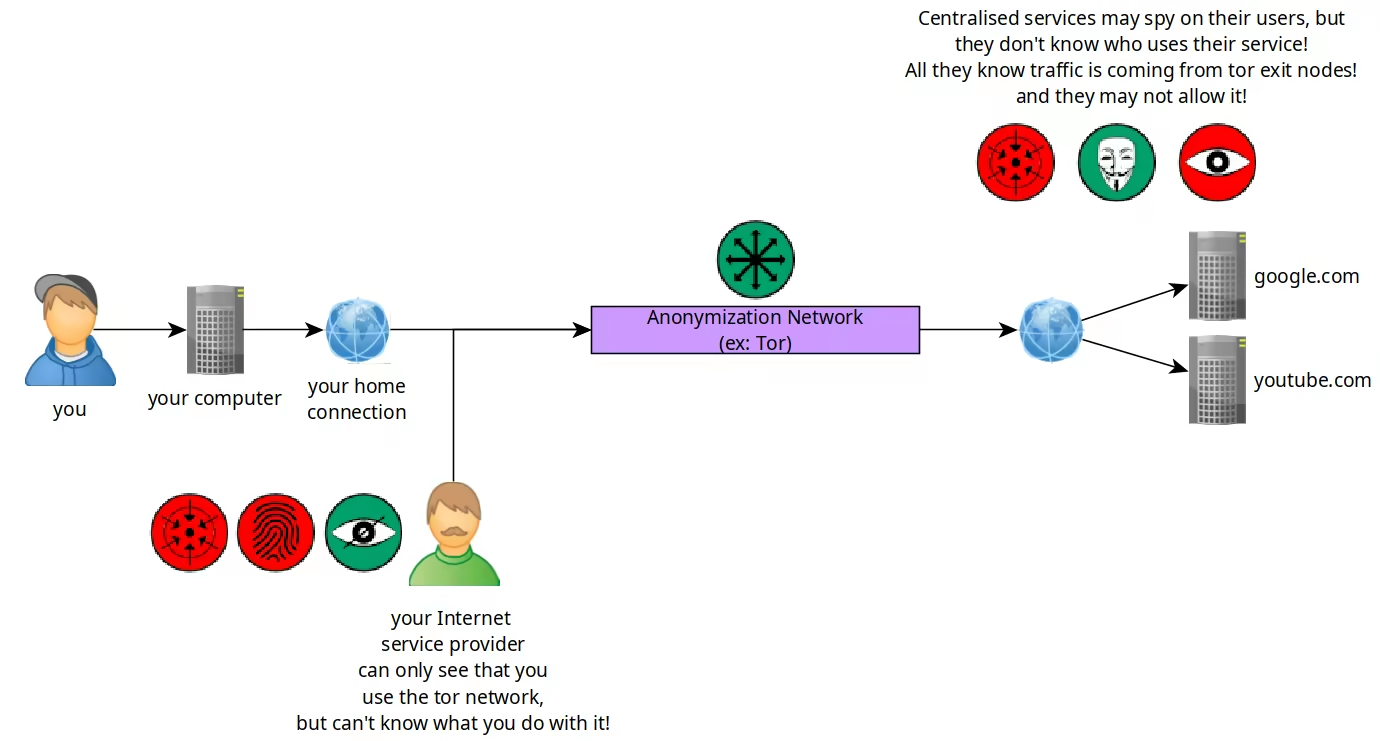
In case if you also work in IT like me, DO NOT USE YOUR WORK COMPUTER FOR PERSONAL PROJECTS, tackle personal projects either on your personal phone, or on a piece of paper that you'll fold and bring home with you. Make sure you always separate work life, and private life, work topics on your work computer, and personal topics on your personal computer/phone.
And then once you're at home, you can either open up your Simplex "Private Notes Chat", or unfold your piece of paper with your notes on it, to put your ideas in digital form into a Draw.io graph, or into a well-made to-do list on the appropriate Gitea issue.
And that's it! You're now able to grab a hold of your ideas wherever you go before you forget them, and bring them home into your projects, where they belong.